Monday, February 03, 2020

Opposing death penalty to address the terrible and distressing prevalence of sexual violence in our community


MASUM letterhead.jpg


Opposing death penalty to address the terrible and distressing prevalence of sexual violence in our community

We raise our strong objection to the imminent execution of the four convicts in the 2012 Delhi gang rape case. The court has scheduled the hanging of four out of the six convicts tomorrow at 6 am. The incident had shook the nation when it happened in the capital and while the crime committed by the convicts is inexcusable, punishing them with a death penalty enables a culture of violence. According to the Law Commission report on death penalty in 2015, charging people with death penalty is no stronger a deterrent of crimes than charging them with life imprisonment.
Public opinion in India has consistently been in the favour of death penalty. In November, the case of gang rape from Hyderabad triggered a massive uproar for executing the accused. The aftermath of this incident, where the police in Hyderabad shot the accused in an alleged encounter and received nationwide appreciation showcases how perilous this public opinion can be for the criminal justice system.
Recent trends have shown the courts using the death penalty frequently in cases involving sexual offences against women and children. According to a study conducted by the National Law University Delhi, 52.9% of those charged with death penalty in India were convicted with sexual offences and murder. The response of the judiciary is often motivated by the public outrage against the convicts along with media slander. However, death penalty has not led to a reduction in sexual offences, nor has it resulted in an increase in conviction rates. In fact, the spectacle of death penalty removes public attention from actual legal and social reform that guarantee the safety of women and children.
Among the many flaws of death penalty, perhaps the biggest one is that it is irreversible. In 2004, Dhananjoy Chatterjee was given a death sentence for the rape and murder of a school student. However, several years after his execution, many facts have come to light that hint at the possibility that he might not have been the actual perpetrator of the crime. This case is a gross miscarriage of justice that cannot be reversed. Secondly, the criminal justice system in India is based on the principles of reform rather than punishment. The death penalty assumes that the individual is incapable of reform, moreover, it fundamentally violates the principles of justice. On 28 January, the Supreme Court granted bail to 15 convicts serving life sentences in the Gujarat Riots of 2002 on the condition that they engage themselves in religious and community services. If the apex court can deem the convicts of mob rioting, mass rapes and vandalism capable of reform, any other charges of death penalty can be questioned on constitutional and humanitarian grounds.
According to Amnesty International, 106 countries have abolished the death penalty. There are several international legal instruments that challenge the death penalty on humanitarian principles including the Second optional Protocol to the International Covenant on Civil and Political Rights. Death penalty endows excessive power upon the state and judiciary. It is an autocratic decision by the state which can be fatal to the foundations of a democracy. Moreover, particularly in India, the victims of death penalty in India almost always belong to the lower classes, marginalized and vulnerable groups who suffer from a lack of legal, institutional and political support.
At this time, we call to mind the recommendations set out within the Law Commission of India’s study of the death penalty, Report No. 262, in which it is noted that: ‘The notion of “an eye for an eye, tooth for a tooth” has no place in our constitutionally mediated criminal justice system. Capital punishment fails to achieve any constitutionally valid penological goals.’
Therefore, death penalty is an inhuman, cruel and degrading practice that serves no purpose in actually deterring criminals. With due respect to the victim’s family, it is our strong recommendation that the decision of execution is reviewed by the Supreme Court and the convicts are instead sentenced to imprisonment for life. Capital punishment is again a murder of justice.
my signature.JPG
-- 
Kirity Roy
Secretary
Banglar Manabadhikar Suraksha Mancha
(MASUM)
&
National Convenor (PACTI)
Programme Against Custodial Torture & Impunity
40A, Barabagan Lane (4th Floor)
Balaji Place
Shibtala
Srirampur
Hooghly
PIN- 712203
Tele-Fax - +91-33-26220843
Phone- +91-33-26220845
Mobile (0) 9903099699
e. mail : kirityroy@gmail.com
Web: www.masum.org.in

Saturday, February 01, 2020

37 Groups - Singapore Must Stop Targeting HR Defenders and Media that Highlight Injustice and Wrongdoings -Immediately withdraw POFMA Notices and Investigate Allegations Highlighted-


Media Statement – 2/2/2020

Singapore Must Stop Targeting HR Defenders and Media that Highlight Injustice and Wrongdoings

-Immediately withdraw POFMA Notices and Investigate Allegations Highlighted-

We, the 37 undersigned groups and organizations, and 3 individuals, are appalled by Singapore’s denial and response to the highlighting of alleged unjust ‘barbaric’ unlawful practices in Singapore's execution method that was highlighted vide a media statement dated 16/1/2020 issued by the Malaysian Human Rights Defender group, Lawyers for Liberty(LFL). Singapore claims that it is "untrue, baseless and preposterous".(Straits Times, 22/1/2020).

We are also shocked by Singapore’s invoking of the Protection from Online Falsehoods and Manipulation Act (POFMA), and the issuing of notices/directions ordering Lawyers for Liberty (LFL) and three parties that have shared the allegations - Singaporean activist Kirsten Han, The Online Citizen website and Yahoo Singapore - to correct the false statements. To comply with this POFMA Order, ‘…"They will be required to carry a correction notice alongside their posts or articles stating that their posts or articles contain falsehoods," MHA said…’ (Straits Times, 22/1/2020).

Not compliance with the POFMA notice is a crime, and if convicted an individual may be liable to ‘…a fine not exceeding $20,000 or to imprisonment for a term not exceeding 12 months or to both;..”, whereas others will be liable to a fine not exceeding $500,000. Then it also can lead to an access blocking order, whereby service providers will have ‘…to disable access by endusers in Singapore to the online location…’ It is not a defence even if one has applied to the Minister to withdraw/vary the order, appealed to court or is  ‘…subject to a duty under any written law, any rule of law, any contract or any rule of professional conduct, that prevents the person from complying…’ with the POFMA Notice.

It is totally deplorable to ask any human rights defender or media agency to publicly take a position that the alleged rights violations and/or injustices that they highlighted or reported on are FALSE or ‘contains falsehood’.  

Where there is an allegation of a wrongdoing or a crime, it is the duty of a human rights defender or any concerned person is to highlight it, and thereafter, it falls on the relevant government, and/or relevant national, regional or international or UN bodies to conduct the needed independent and determine whether what was alleged was true or baseless. Note that many investigations may even come to no conclusions due to sufficiency of evidence, and this should in no way lead to the assumption that the allegations were untrue.

A perusal of the LFL statement shows that the source of their information, amongst others, is from a credible source – ‘….a Singapore Prison Services (SPS) officer who had served at the execution chamber in Changi prison, and himself carried out hangings...’ This would reasonably be someone who had first-hand knowledge of what was being alleged. In the LFL statement, it also says that ‘…This officer is prepared to come forward and testify at the appropriate forum…’

LFL also did highlight this allegation earlier, in their 23/11/2019 statement, where they said, ‘…. Finally, we have also received shocking information relating to the process of execution at Changi prison. We have incontrovertible evidence that unlawful and extremely brutal methods are secretly used in carrying out hangings by the Singapore Prison Services (SPS). We are prepared to reveal this evidence, supplied by prison officers, in due course…’

LFL, in their 16/1/2020 statement, also said ‘…We had also written to the Singapore authorities and informed them that we are prepared to meet them and handover the evidence in our possession. However, the Singapore government has met our disclosures with deafening silence. Significantly, they have also not denied our allegation of brutality in carrying out hangings, which has been widely reported…’

Singapore government should have rightfully met with LFL, received the evidence and conducted a proper investigation and disclosed its findings.

According to law, police are not supposed to torture detainees, but the fact is that some police officers do torture and even kill those in their custody. It may not the fault of government, but the fault of these errant officers who did wrong. But, if a government, after receiving information of such wrongdoings, chooses to do nothing about it, then it can be said that the government who ‘covers-up’ wrongdoings of public servants or simply ignores it may be just as guilty of the said wrongdoings.

Media is obliged to report to the public, and that includes statements and positions of ordinary people and human rights defenders. Most media, would as a matter of good practice, try to get a response from the alleged perpetrator or other relevant parties but the news ought never be stifled simply because the perpetrators (or interested parties) or in this case Singapore does not provide an immediate response. Of course, most media will carry even a late response from alleged perpetrator and/or other interested parties.

Obligations imposed on media should not be the same as imposed on individuals using social media. Many good person who share news/views on social media, if they do get a response from alleged perpetrator or interested parties, they usually will also share that response with their readership.

In Malaysia, many human rights violations and even crimes that were highlighted by HR Defenders or media were investigated by the government.

As an example, in Malaysia, it was the investigation by the New Straits Times Special Probes Team into the mass killings in Wang Kelian in 2015 that highlighted and suggested a massive, coordinated cover-up. It revealed the human trafficking death camps had been discovered months earlier, but police only announced the discovery on May 25. It also questioned why the police ordered the destruction of these camps, which were potential crime scenes, before they could be processed by forensics personnel?

The Malaysian government’s response was to investigate this case, and on 16/1/2020, it was reported that the Home Ministry will present a report by the Royal Commission of Inquiry (RCI) on the Wang Kelian human trafficking incident to the Cabinet next week.(New Straits Times, 16/1/2020). Hopefully, thereafter the report will be made public.

Like Malaysia, Singapore too should have conducted a comprehensive investigation on the allegations raised by LFL, and not try to ‘force’ LFL and others who highlighted and/or reported this issue to publicly admit that it was contained FALSEHOOD.

Publicly highlighting allegations and/or facts of wrongdoings, rights violations and injustices today is a means of ensuring that justice be done, for otherwise relevant governments and enforcement authorities can sometimes chose to simply ‘cover-up’ such allegations.

It is wrong for any government to use laws and crimes (with serious penalties) to prevent human rights defenders, media and others from highlighting allegations of wrongdoings. Such laws that undermine the responsibilities of human rights defenders, including media, ought to be repealed. 

Freedom of expression, opinion and peaceful assembly ought to be protected.

The courage of human rights defenders, including media, in highlighting possible human rights violations, injustices and wrongdoings of the powerful and government without fear or favour should be applauded, not stifled or penalized.

Media reports that the Singapore Minister of Communications and Information(MCI) on Thursday (Jan 23) directed Infocomm Media Development Authority (IMDA) to get Internet service providers here to block the website of Lawyers for Liberty (LFL) who did not comply with a correction direction issued under the fake news law(POFMA).(Straits Times, 23/1/2020).

Therefore, we

-          Call on Singapore to immediately and unconditionally withdraw that notice/directions and internet access blocking orders pursuant to Protection from Online Falsehoods and Manipulation Act (POFMA) that were directed at Lawyers For Liberty, Kristen Han, The Online Citizen, Yahoo Singapore and/or any other;


-          Call on Singapore to ensure an independent and thorough investigation be conducted concerning allegations of unjust and barbaric practices that allegedly happen during the hanging of  persons in Singapore;

-          Call on Singapore to respect Human Rights Defenders and media agencies, and not to stifle them from carrying out their responsibility and duty to highlight allegations of human rights violations and injustices; and

-          Call on Singapore to abolish the Death Penalty.

Charles Hector
For and on behalf of the following 37 groups and 3 individuals listed below

ALIRAN
Anti-Death Penalty Asia Network (ADPAN)
Asian Federation Against Involuntary Disappearances (AFAD)
Association of Parents of Disappeared Persons from Indian Administered Jammu and Kashmir
Association of Human Rights Defenders and Promoters- HRDP in Myanmar
Asociación de Trabajadoras del Hogar a Domicilio y de Maquila–Atrahdom, Guatemala
Australians Against Capital Punishment
Banglar Manabadhikar Suraksha Mancha (MASUM), India
Dutch League For Human Rights
Empower Foundation Thailand
Families of Victims of Involuntary Disappearance (FIND) – Philippines
German Coalition to Abolish the Death Penalty (GCADP)
Global Women's Strike(GWS), United Kingdom
Japan Innocence and Death Penalty Information Center
Karapatan Alliance Philippines
LAW, United Kingdom
MADPET(Malaysians Against Death Penalty and Torture)
Malaysian Trade Union Congress(MTUC)
Manushya Foundation, Thailand
MAP Foundation (Migrant Assistance Program) , Thailand
North South Initiative(NSI)
Odhikar, Bangladesh
Payday Men’s Network, United Kingdom
Persatuan Komuniti Prihatin Selangor dan Kuala Lumpur
Programme Against Custodial Torture & Impunity (PACTI), India 
People's Empowerment Foundation, Thailand
Sarawak Dayak Iban Association(SADIA)
Singapore Anti Death Penalty Campaign (SADP)
SUARAM, Malaysia
Terai Human Rights Defenders Alliance (THRD Alliance), Nepal
The Advocates for Human Rights
The Day of the Endangered Lawyer Foundation
The Julian Wagner Memorial Fund, Australia
Union for Civil Liberty, Thailand
Workers Assistance Center, Inc. Philippines
World Coalition Against the Death Penalty/ Coalition mondiale contre la peine de mort
WH4C (Workers Hub For Change)

Vucong, Giao (PhD) - School of Law, Vietnam National University Hanoi, Vietnam
N. Jayaram - Journalist, Bangalore, India
Mohammad Ashrafuzzaman - Human Rights Defender from Bangladesh, in Hong Kong

Wednesday, January 29, 2020

Everyone should be out in BAIL during trial? Wrong to languish in detention until trial is over? Not guilty?

After Cradle CEO’s widow allowed bail, we take a look at how bail works in Malaysia

Samirah Muzaffar, widow of Cradle Fund CEO Nazrin Hassan, attends a court hearing in Putrajaya May 28, 2019. — Bernama pic
KUALA LUMPUR, June 5 — The Federal Court’s recent decision to allow bail for Samirah Muzaffar, charged with murdering her husband and Cradle Fund CEO Nazrin Hassan, has stunned many, both in the legal fraternity and outside.

This is because murder, under Section 302 of the Penal Code, is a capital crime and remains punishable with death even after the Pakatan Harapan (PH) government’s recent legal reforms; it is a non-bailable offence.

Because many were left wondering if they had read or heard the news right, Malay Mail sought the expert views of several lawyers to find out what the court decision meant, and how it came to be.

Precedent

Seasoned criminal lawyer Datuk Geethan Ram Vincent said Samirah’s bail for murder was not the first allowed in the country.

He recalled the case of a former lawyer, the late Datuk Balwant Singh, who was similarly charged under Section 302 of the Penal Code for shooting and killing despatch rider Gobala Krishnan in Bangsar, Kuala Lumpur in 2002.

Balwant, 81 at the time, was granted bail after the court took into account his age and health. He was later found not guilty and acquitted in 2003.

“Other than the case of Datuk Balwant Singh which was a decision in 2003, there has never been a decision where a person charged with a capital offence is released on bail pending trial, so this is a landmark decision,” Geethan told Malay Mail.

How bail works

Let’s look at how bail works in Malaysia. Essentially, there are three categories of offences: Bailable, non-bailable and unbailable.

As a general rule, bailable offences are those punishable with less than three years in jail and/or with fines.

Non-bailable offences are those punishable with three years’ imprisonment or more, or by death. Here, bail may be given at the discretion of the courts.

Non-bailable offences can be further divided into two categories. If the offence is not punishable with the death penalty or life imprisonment, then bail may be allowed by the courts.

But if the offence is punishable with death or life imprisonment, then bail shall not be allowed, unless one: There is no reasonable grounds that the accused has committed such offence; or two: If the accused is a woman, or is a child below 16 years old, or is infirm or a sick person.

For the record, Samirah was released on bail because murder is categorised as a non-bailable offence.
In Balwant’s case back in 2003, he was allowed bail because he was both sick and infirm, while in Samirah’s case, it appears to be because she is a woman.

It needs to be made clear that the purpose of bail is not to punish; the person charged is presumed innocent until proven guilty, which is the basic tenet of the justice system. This is why there are trials.

Bail is only to make sure the person charged turns up in court for the duration of the trial, as explained in the Malaysian Bar website.
Shamsher welcomed the top court’s decision to allow bail in Samirah’s case but expressed disappointment with the sexist clause in the law. — Picture via Facebook
Lawyer and academic Shamsher Singh Thind explained that unbailable offences are not under the Penal Code, citing as example offences under the Dangerous Drugs Act 1952 and the Security Offences (Special Measures Act) 2012.

“Unbailable offences do not fall under the Penal Code, and are those which the courts simply have no discretion to grant any bail, regardless of the punishment the offences carry, or the gender, age or the health condition of the accused.

“Examples are the offences of drug trafficking and of smuggling of migrants,” he told Malay Mail.
Samirah’s bail of RM500,000 was posted on May 29, a day after the Federal Court allowed her to do so with two sureties pending trial scheduled to begin on September 3.

A former senior executive with the Intellectual Property Corporation of Malaysia and a mother of two, she was charged on March 12 with murdering Nazrin at a house in Mutiara Homes, Shah Alam between 11.30pm on June 13, 2018, and 4am on June 14, 2018 alongside two juveniles and an Indonesian woman Eka Wahyu Lestari who remains at large.

The charge under Section 302 of the Penal Code read together with Section 34 of the same law provides for the mandatory death sentence upon conviction and is a non-bailable offence.

However, the High Court in Shah Alam allowed bail for the two teenagers in March with the amount set at RM50,000 each with two sureties.

Samirah appealed for bail at the same time, but was denied by the same court then with the judge citing a high probability that she would abscond as well as possible tampering with witnesses.

The Federal Court overruled the High Court on May 28.

What Samirah’s bail signals

Geethan thinks the Federal Court decision is progressive.

“We welcome this decision because it’s a development in the law. At the end of the day, this is opportunity, so in future, where there are cases of a similar nature, we know for a fact that a precedent has been set, that bail can be allowed in specific circumstances.

“The judge had rightly considered the facts of the case whereby he considered that she had two very young children and certain conditions have been laid for the bail to be allowed. Also, the bail amount is RM500,00 which is a very stiff amount. I think that is an amount that is reasonable to ensure she does not jump bail,” he said, adding that her passport has been impounded and she has to report to the nearest police station to her home regularly.

Shamsher too welcomed the top court’s decision to allow bail in Samirah’s case but expressed disappointment with the sexist clause in the law.

He believes that Section 388(1) of the Criminal Procedure Code, though interpreted correctly by the Federal Court, should be amended to be fair to all accused persons, regardless of their gender.

“I think that if you want to say that a healthy woman is able to get bail because she’s a woman, but a healthy man cannot get bail because he is a man, and that he has to be sick, old or below 16 to get bail, then this is not progressive. It is not balanced,” he said.

He also suggested another change in the law on bail, saying those who are willing to co-operate and who especially have no proven history of violent crimes could be allowed bail, and advocated the use of electronic monitoring device to track the movements of the accused person.

“When the laws on bail were being drafted, we were not that technologically advanced. Now we are living in the era of GPS and smart gadgets. What is the logic of locking people up for years on mere suspicious grounds, when their crimes are yet to be proven? Is the government willing to compensate those who are later acquitted by the courts?” he asked.
While she welcomed the Federal Court decision to allow bail in extenuating circumstances, Suzana said that in Samirah’s case, there were none. — Picture via Facebook
Senior criminal lawyer Suzana Norlihan Ujen echoed Shamser’s sentiment, saying it could create another imbalance in the justice system between the rich and poor.

While she welcomed the Federal Court decision to allow bail in extenuating circumstances, she said that in Samirah’s case, there were none.

“The advantage is that after this, all cases can be bailed. So that means, we can save in terms of not having to pay the cost of keeping the accused in prison, paying for their food and drinks, and they also have the opportunity to look for witnesses. But there is also a possibility of tampering with witnesses,” she said.

“Meaning to say, is the court willing to give bail even when there are no special circumstances? Just because one’s client will not tamper with the witness, or is innocent until proven guilty. Would that just be the main reasons for bail to be given?

“If let’s say those are the reasons, that means in Malaysia there is no need for a classification between non-bailable offence, unbailable offence and bailable offence,” she told Malay Mail.

She also said that the possibility of bail jumping for those charged with capital offences may still happen, especially if the accused is rich.

“Even in the case of Altantuya, just imagine, the accused was able to flee to Australia, without people knowing,” she said, referring to former police commando Sirul Azhar Umar who fled to Australia after being convicted in 2013 of the 2006 murder of Mongolian model Altantuya Shaariibuu.

Sirul is currently under detention there and will not be sent back to Malaysia as Australia’s laws forbid it to deport anyone to a country where they face a death sentence.

“So that means the effect is that, at the end of the day, the rich people can escape,” Suzana said.

Another lawyer, Latheefa Koya, is all for bail to be allowed to an accused person, even for serious crimes, citing the fundamental principle that one is innocent until proven guilty.

The only caveat for her is if there is a legitimate concern of flight risk or interfering with witnesses.

“Deputy public prosecutors should abandon the knee-jerk reaction of objecting the bail, and instead focus on agreeing to conditions of bail.

“In this case, she is a parent of young children, and depriving them of their mother without compelling grounds would be grossly unfair.

“Just because a person is in the dock, it does not mean they’re guilty, and this is often forgotten by the DPPs, court and lawyers sometimes,” Latheefa added, using the abbreviation for deputy public prosecutors. - Malay Mail, 5/6/2019

Presumption of Innocence Until Proven Guilty and the Right to Bail Must Be Recognized and Respected (MADPET)


Media Statement – 29/1/2020

Presumption of Innocence Until Proven Guilty and the Right to Bail Must Be Recognized and Respected


MADPET (Malaysians Against Death Penalty and Torture) is appalled by the denial of bail to Gadek assemblyman G. Saminathan who is facing two charges for alleged terrorism activities linked to the Liberation Tigers of Tamil Eelam (LTTE). He is charged for committing the offence of ‘Soliciting or giving support to terrorist groups or for the commission of terrorist acts’ (Section 130J Penal Code).(New Straits Times 29/1/2020; Star 29/1/2020)


Article 11(1) of the Universal Declaration of Human Rights states that, ‘Everyone charged with a penal offence has the right to be presumed innocent until proved guilty according to law in a public trial at which he has had all the guarantees necessary for his defence.’ 


It is only just and right that anyone charged with any offence is presumed to be innocent until proven guilty, and as such should be granted bail. 


It is a gross injustice to deny bail, simply because the offence one is charged with carries the death sentence, life imprisonment and/or a long prison term.


In this particular case, if convicted, the sentence for committing the section 130J Penal Code offence, as it is now, is ‘…shall be punished with imprisonment for life or imprisonment for a term not exceeding thirty years, or with fine, and shall also be liable to forfeiture of any property used or intended to be used in connection with the commission of the offence.’ There may be a drafting error in this law. At present, our reading says that if convicted, the sentence could be just a fine, any period of imprisonment but not more than 30 years plus forfeiture.


From media reports, the learned Judicial Commissioner was quoted saying, “The court usually cannot grant bail for offences which carries life imprisonment or the death penalty,…” He seems to have only considered the maximum sentence being life imprisonment, which today in Malaysia is 30 years in prison.


MADPET is of the opinion, based on media reports, that the judge erred, as even for murder, which carries the mandatory death penalty, bail has been granted in the past in Malaysia. Thus, even for offences that carries the sentence of life imprisonment, bail can and ought to be granted. In the case of the late Datuk Balwant Singh, and the case Samirah Muzaffar, both who were charged with murder that carries the mandatory death penalty if convicted, bail was granted.


Bail, after all, is merely to ensure that a person turns up for trial. In this modern age, where there is also the possibility of electronic tracking device which makes it very difficult for anyone to abscond. Passports can also be retained preventing accused persons from leaving Malaysia or Peninsular Malaysia.


Even for the more serious offence of committing a terrorist act, where death does not result, the sentence prescribed in section 130C(1)(b) ‘…(b) in any other case, with imprisonment for a term of not less than seven years but not exceeding thirty years, and shall also be liable to fine….’. Where death is caused, the sentence is death.


MADPET is against the imposition of any mandatory sentence, including the death penalty, life imprisonment and/or one fixed prison term that removes judicial sentencing discretion.


Pakatan Harapan Must Repeal Draconian Provisions in Laws as Promised


Several prominent politicians including DAP stalwart Lim Kit Siang, Penang Deputy Chief Minister II Dr P Ramasamy, and DAP central executive committee member Ronnie Liu were also present at the court to show support. Questions arise as to why other Pakatan Harapan leaders were absent, for after all G. Saminathan is a Pakatan Harapan State Assemblyperson.


MADPET also draws the attention to the fact that Pakatan Harapan did promise in its 2018 Election Manifesto to abolish draconian provisions in the Security Offences (Special Measures) Act 2012 (SOSMA), which it has failed to do until now.


Now, we already have a High Court decision on 29 Now 2019, that declared that Section 13 of SOSMA, which denies bail to SOSMA listed security offences, was ultra vires to Articles 8 and 121 of the Federal Constitution.


A grave injustice is committed to any person denied bail, who is charged with an offence but is later found not guilty by the court. It affects not just the accused person but also his/her family and dependents.


It is unjust when many, especially the poor, languish in detention until their trial is over simply because they simply cannot afford to furnish bail. This raises the possibility that many innocent persons will simply opt to plead guilty and serve out definite prison terms, rather than languish in detention for an indefinite period whilst their trial proceeds. Malaysia may want to consider what neighboring Thailand does through its Criminal Justice Fund that helps the poor be out on bail, amongst others, during their trial. The money can also used for criminal defence.


SOSMA also have draconian provisions that allows the use of evidence not admissible under our Evidence Act  in trials, and for the use of ‘special’ unfair Criminal Procedures to be used during trial. 

SOSMA allows to be by-passed the scrutiny of the Magistrate by the requirement of remand hearing and remand orders before the police can further detain a suspect for more than 24 hours.


Essential (Security Cases) Regulations 1975 (ESCAR), which was similar to SOSMA today, saw the Malaysian Bar and lawyers in the name of justice protesting and even calling for boycott of cases that used ESCAR. SOSMA ought to be repealed, not simply amended if we believe in fair trial.


MADPET reiterates our call for the immediate repeal of the Security Offences (Special Measures) Act 2012 (SOSMA). If a longer remand period, more than 14 days is required for certain serious offences, the maximum remand period for the purpose of investigations could be extended to 28 days provided the requirement for further remand orders by Magistrates after hearing both parties is maintained.


MADPET also calls for the abolition of all those ‘detrimental to parliamentary democracy’ offences that was introduced by the Barisan Nasional government also be repealed.


MADPET also calls for the Pakatan Harapan government to review and consider the repeal of terrorist offences, noting that our laws already criminalizes all such actions. Malaysia must also review the list of current listed terrorist or criminal organizations, and publish it.


MADPET urges Malaysia to ensure the right to a fair trial, which includes the right to bail. The presumption of innocence until proven guilty must be put in practice.


Charles Hector

For and on behalf of MADPET(Malaysians Against Death Penalty and Torture)


High Court denies bail for Gadek rep over LTTE-related charges

Nation

Wednesday, 29 Jan 2020 4:41 PM MYT

By NURBAITI HAMDAN

KUALA LUMPUR: The High Court here has dismissed an application for bail filed by Gadek assemblyman G. Saminathan who is facing two charges for alleged terrorism activities linked to the Liberation Tigers of Tamil Eelam (LTTE).

In his decision here on Wednesday (Jan 29), Judicial Commissioner Ahmad Shahrir Mohd Salleh said that Section 13 of the Security Offences (Special Measures) Act 2012 (Sosma) was still in the statute books despite being declared unconstitutional by High Court judge Justice Mohd Nazlan Mohd Ghazali.


JC Ahmad Shahrir said although he was bound by Justice Nazlan's ruling, he had to consider that Section 13 of Sosma was still in effect.

He added that LTTE had been classified a terror group by the government and the Home Minister had yet to de-gazette this.

“The LTTE is gazetted as a terrorist group and supporting it is an offence and punishable under Section 130J of Penal Code, which carries life imprisonment.

“The court usually cannot grant bail for offences which carries life imprisonment or the death penalty, ” he added.

On Nov 29 last year, Justice Nazlan declared that Section 13 of Sosma was ultra vires to Articles 8 and 121 of the Federal Constitution.

A woman, believed to be Saminathan's wife, was seen sobbing when proceedings ended.

Lawyer Ramkarpal Singh, who represented the accused, told reporters that they accepted the decision.

“We accept the decision although we are disappointed. We will consider our options and our next step, ” he added.

On Jan 20, Saminathan, who is also a Melaka exco member, claimed trial to supporting the LTTE at a function held at Dewan Kasturi Ayer Keroh, Jalan Utama, Taman Ayer Keroh Heights in Melaka, from 8.30pm to 10.50pm on Nov 28,2018.

He was charged with possession of items with elements of terrorism or related to the LTTE in a mobile phone at the office of the Unity, Human Resources and Consumer Affairs executive councillor at the Chief Minister's Department at Kompleks Seri Negeri, in Melaka, at 10.25am on Oct 10,2019. - Star, 29/1/2020


Gadek assemblyman facing LTTE charges has to remain in jail, bail refused


G. Saminathan will remain in prison as the High Court dismissed his bail application. - NSTP/File pic

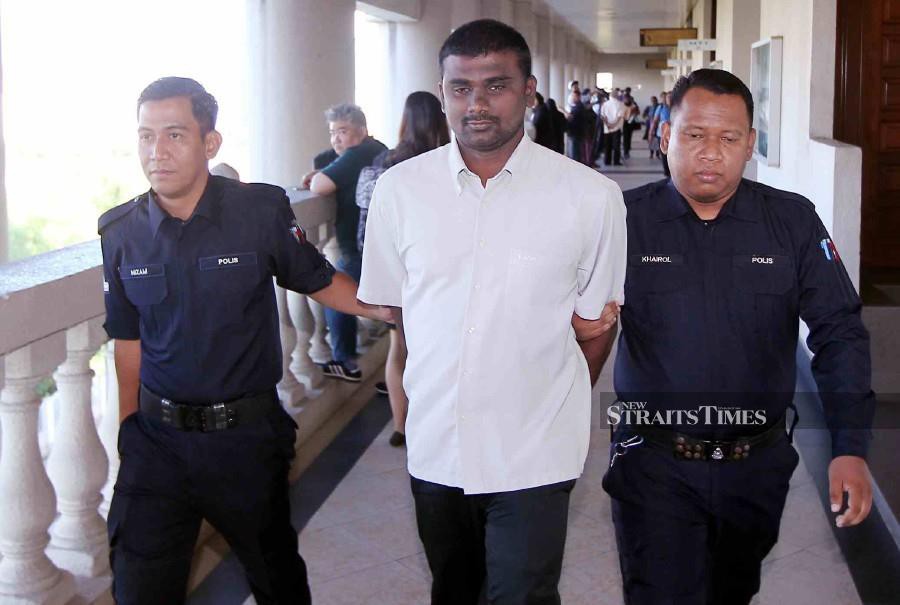
KUALA LUMPUR: Gadek assemblyman G. Saminathan who was charged with supporting terror group Liberation Tigers of Tamil Eelam (LTTE) has to remain in prison as the High Court dismissed his bail application today.

A woman believed to be the accused’s wife could not hold back her tears after Judicial Commissioner Datuk Ahmad Shahrir Mohd Salleh delivered his decision in a packed courtroom.

The woman, who was pregnant, cried and hugged Saminathan after the proceedings before she was calmed by her family and friends.

Ahmad Shahrir in his judgment said that Section 13 of the Security Offences (Special Measures) Act 2012 (Sosma) was still in the statute even though it was declared unconstitutional by High Court judge Mohd Nazlan Mohd Ghazali.

“I am bound by Nazlan’s declaration but I have to consider that Section 13 of Sosma is still in the statue,” he said.

On Nov 29, Nazlan declared that Section 13 of Sosma was ultra vires Articles 8 and 121 of the Federal Constitution.

Nazlan in his judgment said the judicial powers or the power to adjudicate in civil or criminal matters were exclusive of the courts.


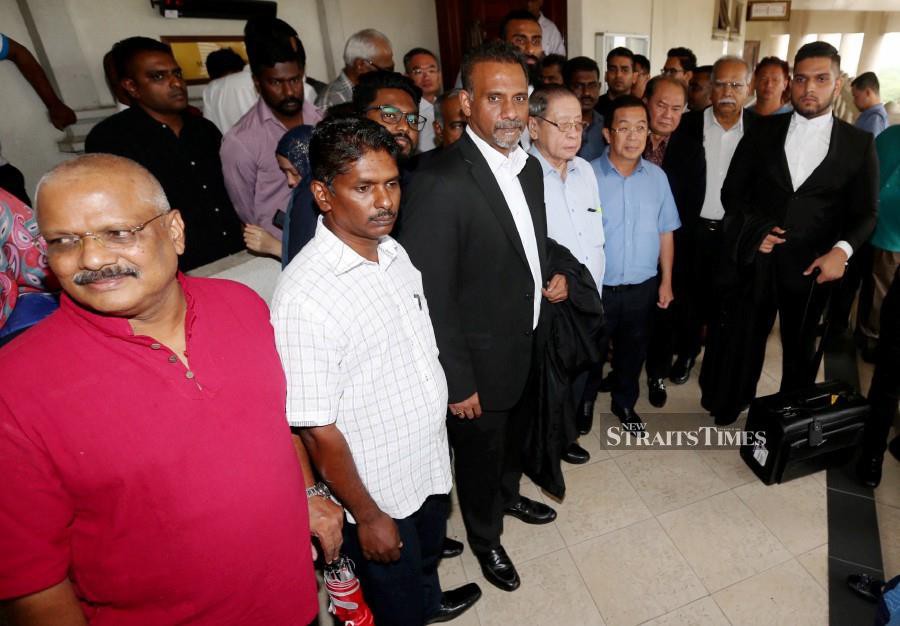
Lawyer Ramkarpal Sing with DAP stalwart Lim Kit Siang seen at the Kuala Lumpur High Court. - NSTP/Mohamad Shahril Badri Saali
Ahmad Shahril said LTTE was still gazetted as a terrorist group by the Home Ministry, even though there were claims that it has been disbanded in its origin country, Sri Lanka.

“Our country still gazettes LTTE as a terrorist group and offence of supporting it is punishable under Section 130J of Penal Code which carries life imprisonment.

“The court usually cannot grant bail for offences which carries life imprisonment or death penalty,” he added.

Counsel Ramkarpal Singh who represented the accused, when met after the proceedings, said they would consider filing an appeal against Ahmad Shahrir’s decision.

“We accept the decision although we are disappointed (with the ruling)… we will consider our next options,” he said.

Deputy public prosecutors Rohaiza Abd Rahman and Mohd Firdaus Abu Hanipah prosecuted.

Several prominent politicians including DAP stalwart Lim Kit Siang, Penang Deputy Chief Minister II Dr P Ramasamy, and DAP central executive committee member Ronnie Liu were also present at the court to show support.

Saminathan was charged with supporting the LTTE at a function held at Dewan Kasturi Ayer Keroh, Jalan Utama, Taman Ayer Keroh Heights here from 8.30 pm to 10.50 pm on Nov 28, 2018.

He was also charged with possessing items with elements of terrorism or related to the LTTE in a mobile phone at the office of the Unity, Human Resources and Consumer Affairs executive councillor at the Chief Minister's Department at Kompleks Seri Negeri here at 10.25 am on Oct 10 last year.

On Nov 1, Sessions Court Judge Rozina Ayob ruled that there was merit in the application made by the defence under Section 13(2) of SOSMA to refer constitutional matters concerning bail to the High Court.

The court allowed the applications of Saminathan and 11 other men to refer constitutional issues on bail to the High Court.

Besides Saminathan, the others are Seremban Jaya assemblyman P. Gunasekaran, 60; taxi driver V. Balamurugan, 37; postman S. Teeran, 38; scrap metal trader A. Kalaimughilan, 28; chief executive officer of a corporation S. Chandru, 38; technician S. Arivainthan, 27; storekeeper S.Thanagaraj, 26; security guard M. Pumugan, 29; a national secondary school teacher in Telok Panglima Garang, Selangor, Sundram Renggan @ Rengasamy, 52; DAP member V. Suresh Kumar, 43, and businessman B. Subramaniam, 57.

They were charged in separate Sessions Courts here and several states on Oct 29 and 31 with allegedly having links with LTTE. - New Straits Times, 29/1/2020