Showing posts with label Joint Statement. Show all posts

Tuesday, December 09, 2025

Abolish VETO power to enable the United Nations to be able to be an effective defender of human rights, with the power to end human rights violations(15 Groups)


Media Statement – 10/12/2025(World Human Rights Day)

Abolish VETO power to enable the United Nations to be able to be an effective defender of human rights, with the power to end human rights violations

On this World Human Rights Day (10 December) we, the 15 undersigned groups, organizations and trade unions express our greatest disappointment that the United Nations that was expected to defend and promote human rights have failed in its objects, and the expectations of the peoples of the world.

It is still possible to rectify this dilemma, if and only if the member states of the United Nations are committed to abolish the VETO power that is now with the 5 Permanent member States – Russia, China, France, United States of America and the United Kingdom, so that it can no longer impede the UN from defending and promoting human rights, and ensuring justice be done.

VETO violates principle of sovereign equality

The UN Charter, in Article 2(1) states, ‘The Organization is based on the principle of the sovereign equality of all its members.’ This fundamental principle of EQUALITY is violated if the United Nations continue to allow a class of ‘super members’, who can use their VETO power to prevent actions advocated by even the majority of UN member States.

VETO prevents UN from ending human rights violations

The preamble of the UN Charter clearly states the obligation of the UN is ‘to reaffirm faith in fundamental human rights, in the dignity and worth of the human person, in the equal rights of men and women and of nations large and small,’. Thus, the UN acts for human rights, not just when States commit extra-territorial human rights violations but also human rights violations within the jurisdiction of respective States, regardless they are UN members or not. Thus, the UN protects human rights of ALL human persons, and not just rights of member States.

Through the various UN processes, including the UPR process, the UN and UN member States has called on member States to move away from injustices and human rights violations, and calls on States and others to enact rights protecting laws, and abolish laws, practices and even policies that are in violation of human rights. As such, the UN has worked to promote, amongst others, women rights, indigenous rights, environmental rights and the rights of human rights defenders. It has opposed ethnic cleansing, genocide, forced labour

However, the United Nations have been prevented from doing the needful, by reason of abuse of power of some of the permanent 5 by the use of the VETO – that has effectively prevented UN from fulfilling its intended duties to human rights, especially when the perpetrator and collaborators of rights violation, are ‘friends’ of VETO power holding States, or the said VETO power holding States themselves.

The will of the majority of UN member States in issues of human rights can thus be IGNORED or prevented by the use of the VETO. Of late, this has happened in several countries including Palestine, Myanmar and Ukraine.

The VETO has been used to block UN actions. “Instead of being a vehicle for action, the Security Council has too often become an instrument of deadlock. “We see the consequences in places like Gaza, in the persecution of the Rohingya, and in the war in Ukraine,” he [Malaysian Prime Minister Anwar Ibrahim] said in his keynote address at the Common Action Forum (CAF) 2024.

The abolition of the VETO power will restore true sovereign equality in the United Nations, and will allow the UN to be a more effective tool to act against violation of human rights and injustices.

If perpetrators do not heed the call of the UN to stop human rights violations and restore justice, the UN can then take further actions in the form imposition of sanctions, and even cause the United Nation’s forces to enter into the area of rights violations, to not just protect victims, but to also cause perpetrators to do the needful to restore justice including the return of people back to their land and property, and to ensure justice be done.

VETO power CAN be ABOLISHED …

The VETO power can be abolished, whereby the UN Charter, amongst others, in Article 108 states that ‘Amendments to the present Charter shall come into force for all Members of the United Nations when they have been adopted by a vote of two thirds of the members of the General Assembly and ratified in accordance with their respective constitutional processes by two thirds of the Members of the United Nations, including all the permanent members of the Security Council.’

The VETO power can thus be abolished, if two-thirds of the UN Member States support the move, and the 5 existing Permanent Members with VETO power agrees to it. If any one of the VETO power-holding member State objects, it cannot be done. We hope that no member State will oppose this move to abolish the VETO power.

Therefore, we call of all members of the UN Member States to vote in favor of abolishing the VETO power, and all call on all the VETO power holding States to also support this initiative.

We call on all UN Member States to vote without fear or favour to remove this often abused VETO power, that has made the UN a ‘toothless tiger’ unable to act definitely to defend human rights and restore justice even when an overwhelming majority of UN member States wants the UN  to act;

We also call on all the 5 Permanent Members, being Russia, China, France, United States of America and the UK, to agree to the removal of the VETO powers to restore democracy and sovereign equality within the UN, so that the UN can regain its power to act in the interest of human rights, and

We call all the 5 Permanent Members, being Russia, China, France, United States of America and the UK to adopt a MORATORIUM in using their VETO powers pending the abolition of VETO.

Charles Hector

Koong Hui Yein


For and on behalf the 15 organizations/groups/trade unions listed below


MADPET (Malaysians Against Death Penalty and Torture)

Teoh Beng Hock Association for Democratic Advancement, Malaysia

Banglar Manabadhikar Suraksha Mancha (MASUM), India

COAC (Center for Orang Asli Concerns), Malaysia

Global Women’s Strike, UK

Global Women’s Strike, US

Legal Action for Women, UK

North South Initiative (NSI), Malaysia

Payday Men’s Network, UK-US

Programme Against Custodial Torture & Impunity (PACTI), India

Sabah Timber Industry Employees Union (STIEU), Malaysia

Second Chance Redemption, Pakistan

WH4C (Workers Hub for Change)

Women of Colour Global Women’s Strike, UK

Women of Color Global Women’s Strike, US

PM Anwar calls for ban on UNSC veto power in mass atrocities cases, wants global justice reform

United Nations Security Council (UNSC) veto power should be banned in cases of mass atrocities until it can be abolished, said Prime Minister Datuk Seri Anwar Ibrahim. — Bernama pic

KUALA LUMPUR, Dec 2 — United Nations Security Council (UNSC) veto power should be banned in cases of mass atrocities until it can be abolished, said Prime Minister Datuk Seri Anwar Ibrahim.

He said the UNSC decision-making processes require broader support from both permanent and non-permanent members and be subject to ratification by the General Assembly through a simple majority.

Anwar said the veto power has paralysed the council, while the lack of representation from regions such as Africa and Latin America reflects a bygone era.

“Instead of being a vehicle for action, the Security Council has too often become an instrument of deadlock.

“We see the consequences in places like Gaza, in the persecution of the Rohingya, and in the war in Ukraine,” he said in his keynote address at the Common Action Forum (CAF) 2024, here today.

The Prime Minister said the world stands at a critical juncture for global justice, emphasising that Israel’s actions against Palestinians undermine the very foundations of the global order.

“... war crimes, collective punishment, and genocide are a blatant affront to the norms of international law and fundamental human rights,” he said.

As Malaysia has advocated at the UN, Anwar said the world must take bold, immediate steps, starting with an arms embargo on Israel.

However, he said the severity of Israel’s actions warrants more including a global consensus towards suspending or even expelling Israel from the UN.

The UNSC reform is one of the key areas proposed by Anwar that urgently needs to be reformed for a more equitable world.

Other areas are the international financial architecture, international trading system, climate finance and climate justice.

At the UNSC Debate in New York in September, Malaysia made a strong appeal to limit the use of veto power in the UNSC, stressing that the unchecked use of veto has obstructed peace efforts, particularly in the case of Palestine. — Bernama

Malaysia urges UN to curb or abolish veto power

Foreign minister Mohamad Hasan says the UN Security Council must be freed from this humiliating paralysis.

mohamad hasan
Foreign minister Mohamad Hasan said the general assembly should be allowed to serve as the conscience and voice of the world, unimpeded. (Bernama pic)
PETALING JAYA:
The survival of the United Nations hinges on some urgent reforms, especially on the veto power held by the five permanent members of the UN Security Council.

In addressing the 80th session of the UN general assembly (UNGA) 2025 in New York yesterday, Malaysian foreign minister Mohamad Hasan said there was a need to limit, if not abolish, the veto power, Bernama reported.

“We must challenge it each and every time that it is wielded, particularly in cases of crimes against humanity.

“Authority must flow back to the general assembly. As the most inclusive body of this house, it should be allowed to serve as the conscience and voice of the world, unimpeded,” he was quoted as saying.

Mohamad urged the organisation to continue to demand accountability from the permanent members of the UN Security Council, referring to the United States, Russia, China, France and the United Kingdom.

“We must pursue results through Resolution 377A: Uniting for Peace. No more shall we quietly accept the dismissal of our collective voice.

“We must question and challenge the veto. We must free the UN Security Council from this humiliating paralysis,” he said.

He added that the UN must remain a relevant and effective international organisation and a global guardian of peace.

On the issue of Israel and its recent actions, Mohamad called for the UN to impose sanctions on Israel, stressing that the metastasis of Zionist regime brutality in the Middle East must not be allowed to continue.

He said Israel’s latest assault on Doha, Qatar, was not merely an attack on a few Hamas representatives but a violation of another state’s sovereignty and an insult to all mediation efforts.

Mohamad added that the strike signalled that Israel’s violence would continue to destabilise the region.

“The atrocities may have begun with Palestine, but they certainly will not end with Palestine. As the Middle East grows ever more dangerous for its residents, we will feel the reverberations all over the world.

“This is why simply advocating for a two-state solution is not enough,” he said, according to Bernama.

He also reiterated Malaysia’s commitment to support the Palestinian people through any measure, including the New York Declaration.

Mohamad said concrete action must also be taken against the occupying force, while long-term support should be prepared to ensure the development of a self-governing Palestinian state.

“The test that we now face is an existential one. After 80 years of the UN, and 77 years of the ethnic cleansing of Palestine, if we cannot resolve this, the citizens of the world will lose faith in us and in the international order,” he said. - FMT, 28/9/2025


Slovenian president reiterates end to UN Security Council veto power
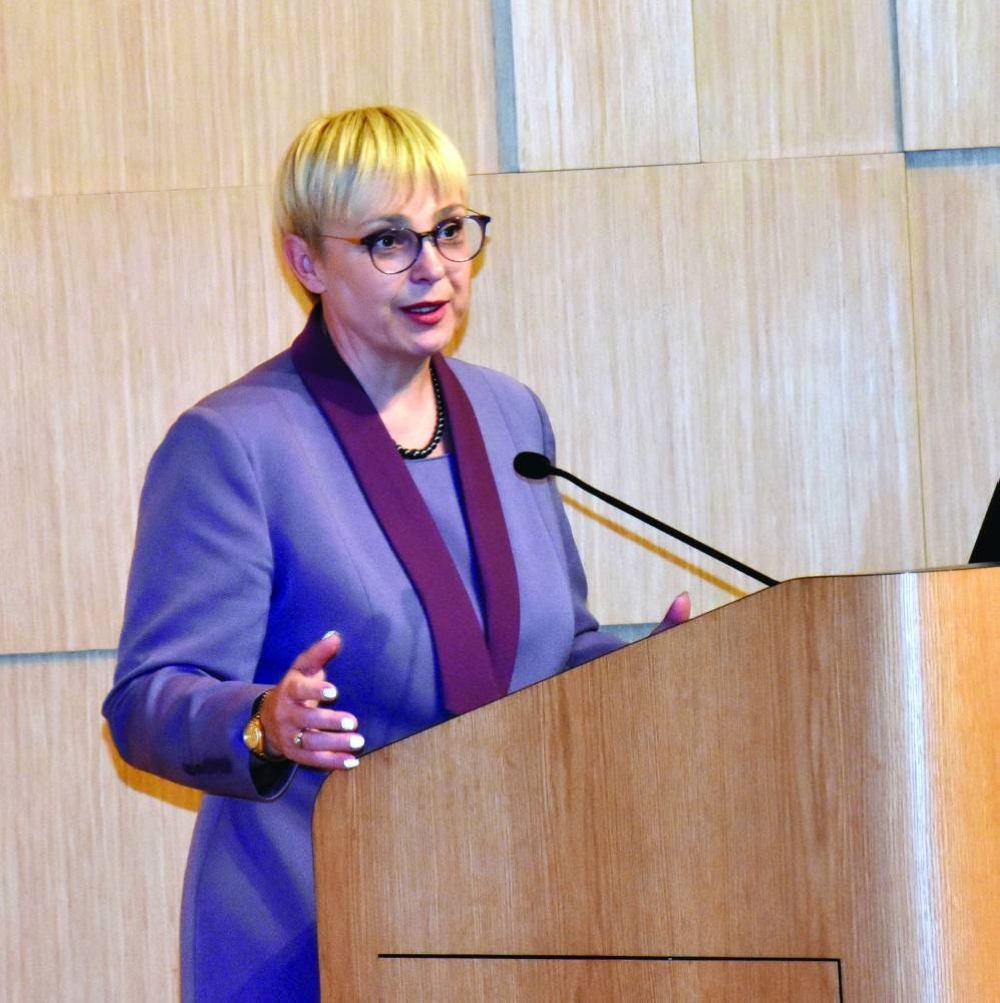
Slovenian President Dr Natasa Pirc Musar at HBKU yesterday. PICTURE: Thajudheen.
 
Slovenian President Dr NataÅ¡a Pirc Musar has reiterated her call to abolish the United Nations (UN) Security Council’s absolute veto power, arguing that the privilege 'corrupts absolutely' and has left the UN in a 'big struggle' to uphold its mission of global peace and security.

“When you do have something absolute, it is always a problem,” she said. “You know what the saying is?, ‘Power tends to corrupt, and absolute power corrupts absolutely’. It is so true, also in politics,” Pirc Musar said in her lecture, titled “The Realities of Multipolarism vs the Need for Multilateralism”.

She was speaking at Hamad Bin Khalifa University’s Minaretein Auditorium Monday, addressing global governance, artificial intelligence, and gender equity. The event forms part of her official visit to Qatar and reflected HBKU’s ongoing efforts to foster international dialogue on diplomacy and leadership.

Elected in 2022 as Slovenia’s first woman head of state, Pirc Musar used the platform to make an appeal for UN reform, particularly targeting what she described as the “hybrid war” within the Security Council, where five permanent members – the United States, United Kingdom, France, Russia, and China – hold veto powers.

The Slovenian president noted that while France and the United Kingdom have refrained from using the veto since 1986, other permanent members continue to use, and in some cases, abuse the power, stalling collective action in times of global crisis. “For 25 years we have been discussing UN reform. For 25 years we didn’t make any steps,” she added.

Pirc Musar outlined three proposals to curb the Security Council’s unchecked authority: Restricting voting rights of countries under discussion in the Council; banning the use of vetoes in cases involving mass atrocities, crimes against humanity, or genocide; and subjecting veto decisions to review by the UN General Assembly, where a two-thirds majority could overrule or confirm them.

The Slovenian president cited her September address at the UN General Assembly, where Slovenia urged the body to seek an advisory opinion from the International Court of Justice on the legality and limits of the veto power in cases of humanitarian crises. “Now is the time to discuss this really very important topic,” she said, adding that “we don’t have another 25 years to waste.”

Pirc Musar also touched on the interconnectedness of global issues, from wars in Ukraine, Palestine, and Sudan to the ethical implications of artificial intelligence: “Everything is interconnected,” she stressed, adding that knowledge-sharing and cultural dialogue are vital to overcoming political egoism and sustaining multilateral co-operation.

“Knowledge is to be shared and not a single country on this planet has all the knowledge it needs,” she said. “If you only stick to your own country and are not willing to share, that is egoistic.”

Pirc Musar also tackled the theme of gender equity, linking it to the broader struggle for fairness and inclusion in global governance.

Echoing her faith in multilateralism, she described the UN as “the only multilateral body covering the whole planet,” insisting that it “should be the diamond of international politics.” - Arab Times, 10/11/2025

Finland's president wants end of single state veto at UN Security Council

By Anne Kauranen
 
HELSINKI, Sept 18 (Reuters) - Finland's President Alexander Stubb has called for expansion of the U.N. Security Council, abolition of its single state veto power, and suspension of any member engaging in an "illegal war" such as Russia's invasion of Ukraine. .. Reuters, 18/9/2024
 

India to UN: Abolish Security Council veto powers or give them to new permanent members

Pressing its case for a reform of the United Nations Security Council, India has called for an equal voice for all nations—or at least, for permanent members.

Pratik Mathur, a counsellor at India's United Nations Mission addresses the General Assembly on Wednesday, April 26, 2023, on the use of veto powers by permanent members of the Security Council. (Photo courtesy the UN).

Pressing its case for reforming the UN Security Council, India has said that either the veto rights should be abolished or be given also to new permanent members in a reformed Council.

"Either all nations are treated equally in the context of voting rights or else the new permanent members must also be given the veto," Pratik Mathur, a counsellor at India's UN Mission said on Wednesday at the General Assembly.

"Extension of veto to new members, in our view, will have no adverse impact on the effectiveness of an enlarged Council," he said, countering arguments made by some countries against expanding permanent membership.

He said that the question of veto should be addressed as part of a comprehensive reform of the Council through clearly defined timelines in the Inter-Governmental Negotiations (IGN) for reforms.

The IGN has virtually stalled because a small group of countries have manipulated the process to prevent progress, observers believe.

Mathur was speaking at an Assembly debate held on the first anniversary of the landmark resolution requiring a discussion by the Assembly within 10 days of a veto being cast in the Council.

While the Assembly cannot override a veto in the Council, by having a discussion, it hopes to bring moral pressure to bear on the vetoing countries or hold them accountable to the rest of the world.

Mathur said that the veto resolution adopted by consensus "unfortunately, reflected a piecemeal approach to UNSC reform, thereby highlighting one aspect, ignoring [the] root cause of the problem".

The root cause—in the view of India and many countries—is the architecture of the Council that reflects the post-World War II scenario and gives veto-wielding permanent seats to the five victorious Allies (Britain, China, France, the US and now Russia, which holds the seat originally given to the Soviet Union).

Mathur said, "As rightly called out by our African brothers, it goes against the concept of [the] sovereign equality of states and only perpetuates the mindset of World War II: 'To the victor belongs the spoils'.


"Let me flag what our African brothers have repeatedly stated in the IGN: The veto as a matter of principle should be abolished. However, as a matter of common justice, it should be extended to new permanent members so long as it continues to exist."

During the debate, Kenya's deputy permanent representative Michael Kiboino reaffirmed the same point, citing the Common African Position on the Security Council reform.

"If the pursuit of the purposes of the UN Charter is based on the principle of sovereign equality of states, then the veto is a contradiction that should be abolished.

"But if it is to be retained in a reformed Security Council, it must be extended to new permanent members with all its attributes, including the prerogatives and privileges of permanent membership," Kiboino declared.

The most vigorous push for Council reform comes from the 54 nations of Africa, a continent without any permanent members on the Council although the majority of its actions relate to it.

South Africa's permanent representative, Mathu Joyini, said that the Assembly's veto resolution requiring discussions of it "should not be seen as an interim or ad-hoc solution to the need for urgent Security Council reform, which will address the structural challenges within the Council itself".

"We must continue our efforts for urgent Council reform and the revitalisation of the General Assembly. Ultimately, focus should be on giving greater momentum to the reform of the Security Council itself," she added.

The Assembly's resolution in April 2022—on holding debates on vetoes—was adopted after the Council was paralysed by Russia's veto of a resolution in February last year, condemning its invasion of Ukraine.

Russia vetoed another resolution in September condemning its referendums in areas of Ukraine it had annexed.

Last year, Moscow also vetoed a resolution on border crossings for sending aid to rebel-held areas of Syria, and joined China to shoot down a resolution condemning North Korea's intercontinental and other ballistic missile tests.

The Assembly held debates on those three vetoes.

Assembly President Csaba Korosi called the veto resolution "a breakthrough, a gamechanger" that "opened the door for a new form of collaboration and accountability" between the Assembly and the Security Council.

While India has insisted on veto rights for all permanent members in a reformed Council, it had also offered to forgo the veto power temporarily as a compromise.

During an IGN meeting in 2016, Syed Akbaruddin, who was then India's permanent representative, said, "Our own national position has been and remains that the veto should, as long as it exists, be extended to new permanent members. As a measure of flexibility and willingness for compromise, the use of the veto can be deferred till the Review Conference."

The UN Charter provides for a conference to review and amend the veto rights, but such a meeting has never taken place. - National Herald, 29/4/2023


China, Russia Again Veto UN Statement on Myanmar Conflict - The Diplomat

Tuesday, November 04, 2025

Stop Depriving over 30,000 Suspects in Remand...Remand Prisoners their ability to exercise their RIGHT to vote in Malaysian Elections.(12 Group Media Statement)

Joint Media Statement (12 Groups) – 5/11/2025

Stop Depriving over 30,000 Suspects in Remand for investigation, and Remand Prisoners who have yet to be tried, convicted and sentenced their ability to exercise their RIGHT to vote in Malaysian Elections.

State must ensure that every qualified Elector has the ability to exercise the right to Vote to ensure FREE and FAIR Elections.

The Federal Constitution guarantees the basic right of every Malaysians 18 years and above the RIGHT to VOTE in State and Federal Elections, and the law explicitly denies this right ONLY to just those with a mental disability and those convicted criminals serving a prison sentence.

Article 119 Clause 3 of the Malaysian Federal Constitution states ‘A person is disqualified for being an elector in any election to the House of Representatives or the Legislative Assembly if—  (a) on the qualifying date he is detained as a person of unsound mind or is serving a sentence of imprisonment; or  (b) having before the qualifying date been convicted in any part of the Commonwealth of an offence and sentenced to death or imprisonment for a term exceeding twelve months, he remains liable on the qualifying date to suffer any punishment for that offence.’

Thus, it is clear, that suspects in remand detention by police and other law enforcement agencies, and remand prisoners in Malaysian prisons have right to Vote in State and Federal Elections.

Remand Prisoners are those yet to be tried, convicted and sentenced, and they are in detention because either they could not afford Bail because of poverty, or they have been denied Bail by law or the courts. There are presumed innocent until tried and convicted by a court of law.

27,877 Remand Prisoners, and maybe 10,000 or more remanded suspects

It must be noted that currently there are about 27,877 remand prisoners in Malaysian prisons(Star, 7/10/2025), and the number of suspects in remand for the purpose of investigation in police and other law enforcement detention facilities fluctuates, but it could be as high as 5,000 -10,000 or even more. Then, we have persons under Detention Without Trial laws who are being detained, and/or restricted from moving out from a particular area, and those in other kinds of Detention facilities.

If they in State detentions were given the ability to exercise the right to VOTE, it may have the effect of changing the outcome of elections, be it at the Constituency level, and may also affect who ultimately will be Prime Minister or Chief Minister or even the State/Federal government.

Note that these are not electors who choose not to VOTE but electors whose ability to vote is denied by State and state agencies.

If they VOTED, Election outcome can change

For example, In the last Sabah State Elections, N16 Karambunai State seat was won by majority of just 16, N23 Petagas by a majority of 261, and N50 Gum Gum by a majority of 269.

For example, in the Sabah Parliamentary elections, P173 Putatan was won by a majority of 124, and P170 Tuaran had a majority of just 233.  

Thus, it is very possible that if these electors, now denied the ability to vote, did VOTE – it may have affect the final outcome of elections.

The Election Commission MUST ensure that every Malaysian with a right to vote has the ability to exercise that right in every election. Considering that these places of detention are known State facilities, one option is EARLY VOTING – which will also give time for the Election Commission to send the marked ballots back to reach the relevant Constituencies in time to be counted.

Extend EARLY Voting to State Facilities That Hold Remand Prisoners

At present, EARLY voting is already used for personnel in the armed forces, police, public servants and also EC officers who will be on duty on Election Day.

Thus, it is no big problem to also have EARLY VOTING in places of Detentions.

The Election Commission can also use other methods to ensure that all qualified Electors in State detention have the ability to exercise their right to VOTE in Malaysia’s elections, that usually happens once every 4 or 5 years.

Magistrates should facilitate the Ability to Exercise Voting Rights

Magistrates could also consider Elector’s right to vote, and thus should try no not grant remand order during election period so as not to prevent a suspect’s ability to go and vote on voting day. Criminals like Najib Razak, Zahid Hamidi, some politicians and others were never remanded for the purpose of investigations.

Alternatively, Magistrates can order the detaining authority to ensure that suspect is able to exercise his/her right to VOTE if remand orders are made – a most fundamental right of all Malaysians, 18 years and above.

No POSTAL VOTE for Malaysians in other States?

It was shocking that ‘The Election Commission (EC) has ruled out allowing Sabahans living in Peninsular Malaysia to cast their ballots by postal vote in the upcoming state election, EC chairman Datuk Seri Ramlan Harun said.’ (Malay Mail, 16/10/2025).

This is shocking if Malaysians have to travel far or even fly back to Sabah or Peninsular just to be able to VOTE. This affects all Malaysians, even those who will have to travel 100-300 kilometers just to vote.

It is also a serious failure to consider the current financial reality of Malaysians, making it very difficult for many Malaysians to expend monies, effort and time just to return to their relevant Constituency to vote on Election day – and this includes students, workers, business persons and others. For some, this means also having to drag their children out of school for the parents to have to travel to relevant Constituencies just to VOTE.

All Malaysians living, working or studying away from their Constituency should be accorded the RIGHT to POSTAL VOTING, or even EARLY VOTING in whichever State they are, so that Malaysia and the Election Commission not be seen as guilty of denying Malaysians the right to VOTE.

If Malaysians overseas have the right to vote by POSTAL VOTES – there is no justification why Malaysians working and living in other States or far from their Constituency cannot be accorded the right to vote by Postal Vote.

Paid Leave for Workers To Vote

Further, in Malaysia there is still NO Paid leave for Malaysians to travel back to their Constituencies to cast their vote. For some, they may have to take at least 3 days to be able to go back to vote and come back.

It is still NOT a Crime if employers prevent their employees the ability to return to their respective constituency in time to VOTE.

As such, we, the 12 undersigned groups, organizations and Trade Unions call on the Malaysian government, including the Malaysian Election Commission, to take all needed steps that ensure all qualified Malaysian voters, including those in detention in State facilities, are able to exercise their individual right to vote in all Malaysian State and Federal Elections.

Malaysia must not just simply recognize the right to Vote, but more importantly ensure that every qualified Elector has the ability to exercise that most important, fundamental and democratic right to vote both in State and Federal elections.

Charles Hector

On behalf of the 12 listed groups below


ALIRAN

MADPET (Malaysians Against Death Penalty and Torture)

COAC (Center for Orang Asli Concerns), Malaysia

National Union of Bank Employees (NUBE), Malaysia

National Union of Flight Attendants Malaysia (NUFAM)

North South Initiative (NSI), Malaysia

Parti Rakyat Malaysia (PRM)

Parti Sosialis Malaysia (PSM)

Social Protection Contributors Advisory Association Malaysia. (SPCAAM)

WH4C (Workers Hub for Change)

Haiti Action Committee (HAC)

PacificwinPacific, Australia

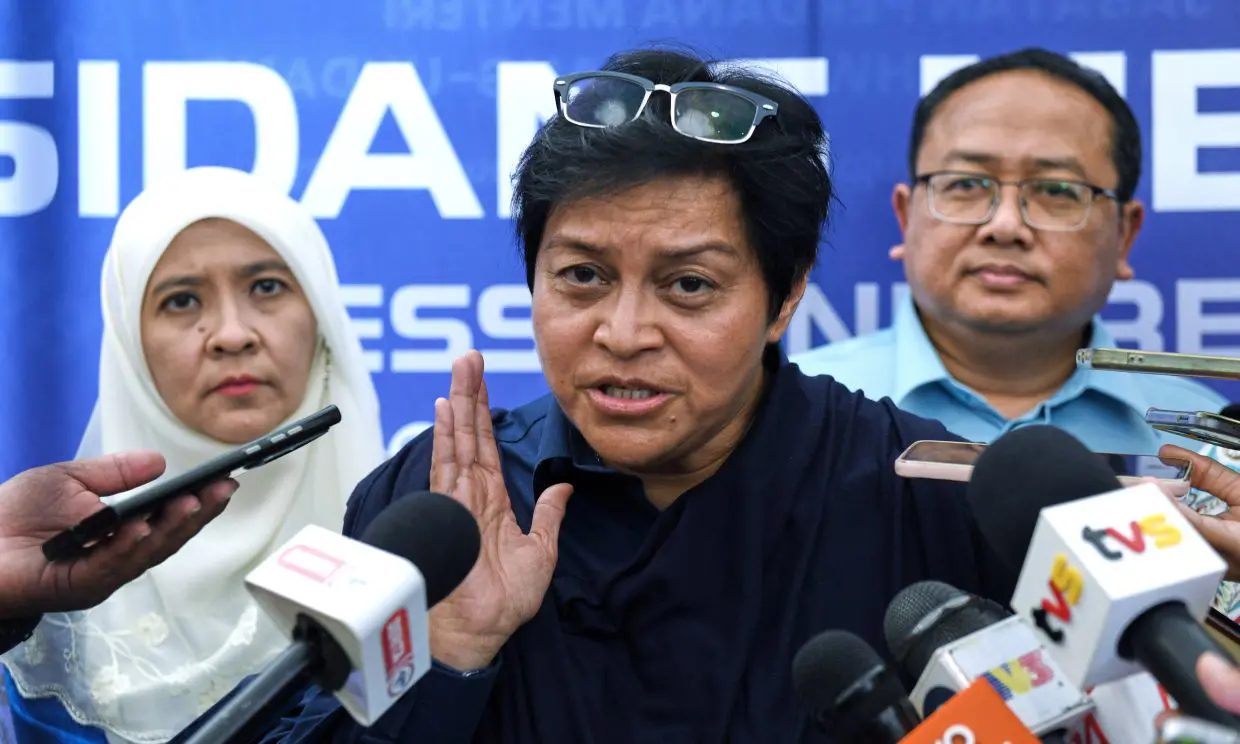
Nearly 28,000 prisoners currently on remand, awaiting resolution of court cases, says Azalina


facebook sharing button
twitter sharing button
whatsapp sharing button
telegram sharing button
linkedin sharing button
By GERARD GIMINO, MARTIN CARVALHOTEH ATHIRA YUSOF


KUALA LUMPUR: Some 27,877 prisoners are currently being remanded while awaiting the resolution of their court cases, says Datuk Seri Azalina Othman Said (pic).

The Minister in the Prime Minister’s Department (Law and Institutional Reforms) said the government, through the Chief Registrar of the Federal Court of Malaysia, has also issued a guide to judges and magistrates to manage and resolve cases efficiently.

“Based on information from the Office of the Chief Registrar of the Federal Court of Malaysia and the Prisons Department, the average waiting period for the resolution of criminal cases is between three to 24 months, subject to case developments,” she said in a written reply on Tuesday (Oct 7).

In the same reply, Azalina said the Chief Justice in 2011 had set a general 12-month timeline to conclude criminal cases in court.

The minister also cited a 2017 circular, which set a 12-month resolution timeframe for criminal and civil case resolutions in lower courts, beginning from the date the case is registered.

She further cited a 2019 circular on the timeline for the resolution of civil and criminal cases, applicable for courts in Sabah and Sarawak.

Here, criminal cases in the High Court must be resolved within six months, cases in the Sessions Court to be resolved within nine months, and cases in the Magistrates' Courts to be resolved between three to nine months from the date the case is registered.

She said the government is committed to ensuring the justice system is upheld without any delays or postponements unless there are unavoidable circumstances.

However, she noted that the resolution of criminal cases are influenced by multiple factors including the cases’ complexity, large number of witnesses or accused persons, and the availability of parties or witnesses for subsequent hearings.

“If courts were to strictly adhere to set timelines, there are concerns this could compromise fairness and affect judgments. Judges and magistrates will make every effort to conclude cases within a reasonable time frame,” she said.

She said trials of criminal cases will proceed without any delay to ensure a timely resolution.

“The government is also committed to upholding the principle that all persons are equal before the law and have the right to get equal protection in accordance with Article 8(1) of the Federal Constitution,” she said.

She was responding to a question by Datuk Seri Madius Tangau (PH-Tuaran) who asked about the number of prisoners currently being remanded whilst awaiting trial.

He had also asked about the average waiting period before going for trial, the targeted maximum waiting period and plans to reduce any delays. - Star, 7/10/2025

EC: No postal votes for peninsula-based Sabahans ahead of November polls

Election Commission (EC) chairman Datuk Seri Ramlan Harun points to a map of Sabah State Assembly seats during a press conference announcing key dates for the Sabah state election in Kota Kinabalu October 16, 2025. — Bernama pic

KOTA KINABALU, Oct 16 — The Election Commission (EC) has ruled out allowing Sabahans living in Peninsular Malaysia to cast their ballots by postal vote in the upcoming state election, EC chairman Datuk Seri Ramlan Harun said.

He added that no final decision has been made, meaning Sabahans will have to fly back to their home state if they wish to vote on November 29.

“For now, the decision has not yet been made. Sabahan voters who are outside the state will have to return here to vote,” Ramlan said when asked if postal voting would be extended to Sabahans living outside the state.

Asked about potential clashes with the Form Five Sijil Pelajaran Malaysia (SPM) exams, Ramlan said the EC had taken this into consideration and assured voters there would be no conflict.

“We’ve taken into account all our logistical facilities and there won’t be any issues with the voting process and the exam which starts on November 22. Moreover, the voting process will be held on Saturday, so it won’t clash with the SPM,” he said.

Several leaders and advocacy groups, including Bersih and Sabah civil society organisations, have urged the EC to allow postal voting for Sabahans based in the Peninsula. Some 200,000 Sabahans work in Peninsular Malaysia and would have to bear the cost of flying home to vote.

Meanwhile, when asked about the possibility of a by-election if a parliamentary seat is vacated before the government completes three full years, Ramlan remained non-committal.

He said it was up to the parliamentary speaker to declare a seat vacant, and the EC had the duty to call for an election within 60 days of the notice.

However, when asked whether a by-election would be held if a seat was vacated after three years of the Madani government, he said the EC would decide at that time.

The 17th Sabah state election is set for November 29, with nomination day on November 15 and early voting on November 25. - Malay Mail, 16/10/2025


Sabah GE14  Election Results - Star,  

Yakub Khan (BN - UMNO) 26.5% (5,180)

Ahmad Jais Bin Otong (WARISAN) 26.4% (5,164)

Marajoh Bin Unding (LDP) 5.4% (1,053)

Dayangku Ayesha Humaira Binti Ak Othman Shah (PCS) 1.6% (315)

Nerudin Ludah (PGRS) 1.5% (285)

Ibrahim Bin Linggam (GRS - USNO) 0.5% (90)

Registered voters: 19,560

Majority: 16

Voter Turnout: 12,087 (61.8%)

Awang Ahmad Sah (WARISAN) 30.0% (4,125)

Arsit Bin Sedi @ Sidik (GRS - SABAH BERSATU) 28.1% (3,864)

Paul Nointien (IND) 4.2% (572)

Ahmad Farid Bin Sainuri (PCS) 2.6% (355)

Jecky Lettong @ Thaddeus Jack (LDP) 0.9% (118)

Mohamad Bin Kulat (PGRS) 0.2% (33)

Registered voters: 13,763

Majority: 261

Voter Turnout: 9,067 (65.9%)

Arunarnsin Bin Taib (WARISAN) 25.2% (3,140)

Suhaimi Bin Nasir (BN - UMNO) 23.0% (2,871)

Yunus Bin Nurdin (IND) 13.5% (1,690)

Undang Bin Tumpong (PCS) 1.4% (172)

Jainudin Bin Berahim (LDP) 0.9% (113)

Riduan Bin Sampai (PPRS) 0.2% (23)

Registered voters: 12,474

Majority: 269

Voter Turnout: 8,009 (64.2%)

Incumbent: Arunarnsin Bin Taib


Madius Tangau (PH - UPKO) 29.9% (24,943)

Joniston Bangkuai (GRS - PBS) 29.6% (24,710)

Jo-Anna Sue Henley Rampas (WARISAN) 6.9% (5,728)

Noortaip Suhaili @ Sualee (IND) 2.4% (2,008)

Muminin Norbinsha (GTA - PEJUANG) 0.5% (445)

Boby Lewat (IND) 0.5% (393)

Registered voters: 83,419

Majority: 233

Shahelmey Yahya (BN - UMNO) 25.7% (16,234)

Awang Husaini Sahari (PH - PKR) 25.5% (16,110)

Ahmad Mohd Said (WARISAN) 13.5% (8,511)

Poyne B. Tudus @ Patrick Payne (GTA - PEJUANG) 0.6% (394)

Registered voters: 63,173

Majority: 124