MADPET is for the Abolition of Death Penalty, an end of torture and abuse of rights by the police, an end to death in custody, an end to police shoot to kill incidents, for greater safeguards to ensure a fair trial, for a right to one phone call and immediate access to a lawyer upon arrest, for the repeal of all laws that allow for detention without trial and an immediate release of all those who are under such draconian laws.
A country with a growing death row reconsiders its future with capital punishment
Gunalakshmi
Karupaya and Mainthan Arumugam were married in Kuala Lumpur in 1999.
Five years later, he was arrested and sentenced to death in a man’s
murder. (Preeti Jha)
By Preeti Jha
Dec. 31, 2019 at 8:00 p.m. GMT+8
KUALA
LUMPUR, Malaysia — When the ostensible murder victim showed up at a
family funeral, Gunalakshmi Karupaya thought her prayers had been
answered. Here was living evidence that could overturn her husband's
death sentence.
Yet
more than two years later, Mainthan Arumugam remains in prison, one of
nearly 1,300 inmates facing execution in Malaysia. It may be the largest
death row in Southeast Asia — and one that, like Mainthan, has become a
rallying point in a country on the cusp of a potentially historic legal
shift.
After
an upset election in 2018 that ended the ruling coalition’s six-decade
run, Prime Minister Mahathir Mohamad’s government issued an immediate
moratorium on executions. It also promised to abolish capital
punishment, a legacy of British rule and a mandatory penalty for almost a
dozen offenses. The subject has been intensely debated ever since.
Any
change would have significance beyond Malaysia’s borders. Nearly half
of the prisoners on death row here are foreign nationals, and more than
100 are women, Amnesty International reported this past fall.
The
report found that 73 percent of death row inmates had been sentenced
for drug trafficking, with most convicted of transporting small amounts
of drugs. It also documented the use of torture for “confessions,”
restricted access to legal counsel and a pattern of unfair trials.
The
circumstances that entangled Mainthan, a father of four who worked as a
scrap metal trader in the capital, represent “the most preposterous
case,” the executive director of Amnesty International Malaysia told a
public forum in November. “Mainthan was sentenced to death for a
murder,” Shamini Darshni Kaliemuthu recounted. “There was indeed a body.
But the person who he supposedly killed is still alive.”
Prime
Minister Mahathir Mohamad’s government initially pledged to end all
capital punishment in Malaysia. (Lim Huey Teng/Reuters)
He
and three other men were arrested in August 2004, a few days after
police found charred body parts in a Kuala Lumpur neighborhood. They
were charged with the murder of a man who had eloped with the
sister-in-law of a friend of Mainthan’s. During the trial, Mainthan said
he had only helped find the couple, who were brought to his house
before the friend took them away.
The
prosecution largely built its case on the evidence of two witnesses who
claimed they saw a bloodied person on Mainthan’s workshop floor the
night before the body parts were discovered. But the four suspects said
that person was an occasional worker for Mainthan — known as Devadass —
who they believed had stolen from a neighbor. They had admitted to
beating him up, but nothing more, and testified that he went to a
hospital for treatment.
The
problem was, defense lawyers could not locate Devadass to appear as a
court witness. The judge publicly doubted his existence, dismissing him
as a fictional “afterthought.” All the suspects were found guilty, but
three had their convictions overturned on appeal. Only Mainthan’s was
upheld.
So
Gunalakshmi was astonished to spot Devadass at her mother-in-law’s
funeral in March 2017. Devadass was almost equally surprised: He had no
idea her husband was on death row. He promptly signed a statement
explaining that he was the only man assaulted at the purported crime
scene on that night nearly 13 years earlier. Gunalakshmi soon filed an
application to reopen Mainthan’s case. The family expected it to be the
turning point that would win his release.
“I
thought Mainthan would be out soon,” she reflected recently, sitting in
the makeshift house where she has raised the children on her salary as a
school cleaner. While she doesn’t dwell on the family’s hardships
during the past 15 years, exposed electrical wiring and threadbare
furniture betray their ongoing struggle.
Criminal
defense attorney Amer Hamzah, who began representing Mainthan in 2014,
said he rarely takes on cases after the appeal process ends but was
struck by the “many unanswered questions” this one raised. He spotted a
jarring anomaly in the evidence: The identity of the victim named on the
charge sheet did not match the identity of the dismembered body, as
revealed by fingerprints. Then Mainthan’s family told him about Devadass
suddenly reappearing.
“Based
on the inadequacies in the evidence, Mainthan should not have been
found guilty,” Amer said. Testing Devadass’s testimony would be “the
best way to assure justice is done. Not only to Mainthan, but also to
the deceased.”
Gunalakshmi
Karupaya tried to have her husband’s case reopened, but Mainthan
Arumugam remains on death row in Malaysia. (Preeti Jha)
The
country’s highest court disagreed, an outcome that wasn’t a shock;
judges are very conservative about reviewing decisions, said lawyer
Khaizan Sharizad Razak, who co-directed a documentary about Mainthan’s
case that shot it to prominence. “But if the court has such a high
threshold for reopening a case, we’re all stuck.”
Malaysia’s death row inmates live years in limbo. The last known executions were in 2017, when the World Coalition Against the Death Penalty says
the country executed four people by hanging. Amnesty International
counts 30 executions there from 1998 to 2018, based on what the
organization describes as reports “from credible sources.”
Yet
the government’s proposed changes could set prisoners on a new course.
The call for abolition was lauded as a critical reform in a part of the
world where most countries retain capital punishment, although some
rarely apply it. At the same time, it angered families who have lost
loved ones to violent crime. They were supported by opposition
politicians and other proponents of the law.
The
government has since backtracked and now is focused on repealing only
the mandatory death penalty as it applies to 11 offenses, including
murder and hostage-taking. (The death penalty remains optional for
nearly two dozen other offenses.) Disappointed but undeterred, reform
advocates still view the proposal as an opportunity to start righting a
decades-old wrong — and as a first step toward abolition.
Public
opinion is also more nuanced than presumed, according to Ngeow Chow
Ying, a lawyer who has campaigned against capital punishment and who
convened the November forum. Recent surveys that went beyond a simple
for or against question, “to present specific scenarios” in which the
death penalty could apply, suggested there would be little public
opposition to abolishing the mandatory death penalty, she said.
A
bill to do so is expected to be introduced in Parliament by March. The
law minister has also raised the issue of resentencing inmates already
on death row. How this should happen is under discussion.
Mainthan
is closely following the debate through his family and their visits to
the prison. Now 48 and much thinner, his hair streaked gray, he has been
held in solitary confinement for nearly a decade. He continues to hope
for a favorable decision on his request for a pardon from the state
leader — in his case, the sultan of Selangor. Such action is his last
resort. Neither the sultan nor Mahathir has commented on the case.
At
home, Mainthan’s clothes remain ready for his return, folded neatly in
the small bedroom where everyone sleeps. His youngest child, just 16
months old when he was arrested, only remembers seeing him through the
glass window that separates prison visitors from inmates.
Gunalakshmi
looks tired, but her voice is unflinching. “He has hope. I have hope,”
she said. “We will fight again and again to get him back.”
The house where Mainthan Arumugam’s family lives — and awaits his return — is just off a busy highway. (Preeti Jha)Mainthan’s eldest daughter, Agilandeswari, tidies the family’s shrine in their living room in Kuala Lumpur. (Preeti Jha)Source: Washington Post, 31/12/2019
Death by Hanging is Malaysia’s ultimate punishment for a criminal since it was first introduced under British rule in 1952.
It was originally reserved for murderers but was later extended to
other crimes including drug-related offences when it was made mandatory
for those convicted of drug trafficking in 1983.
Since Malaysia gained independence in 1957, 469 executions have been carried out
– 229 for drug trafficking, 114 for offences under the Internal
Security Act, 1960, 106 for murder, 19 for firearm-related offences, and
1 for kidnapping.
It’s viewed by some as an act of justice and others as an inhumane way to end a person’s life. Picture Credit: NST
Waiting at the gallows
As of February 2019, 1,281 people in Malaysia were reported to be on death row, with 44% of them being foreign nationals.
Out of the 713 Malaysians currently on death row, 48% of them are
Malays while 24% are Chinese, 25% are Indian and 4% belong to other
ethnic groups
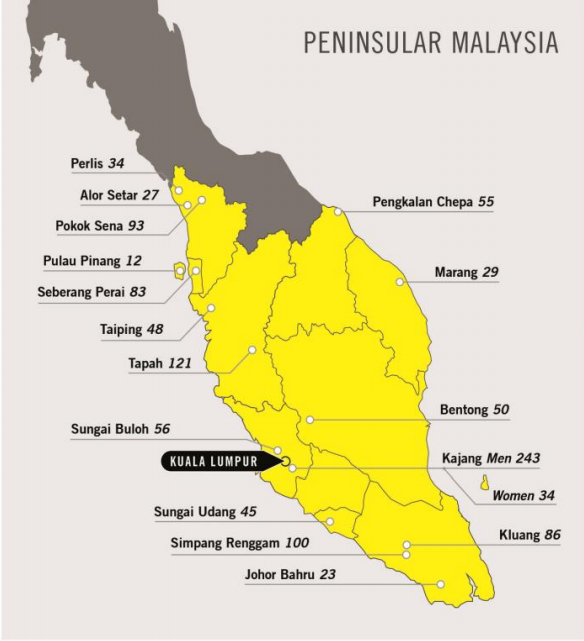
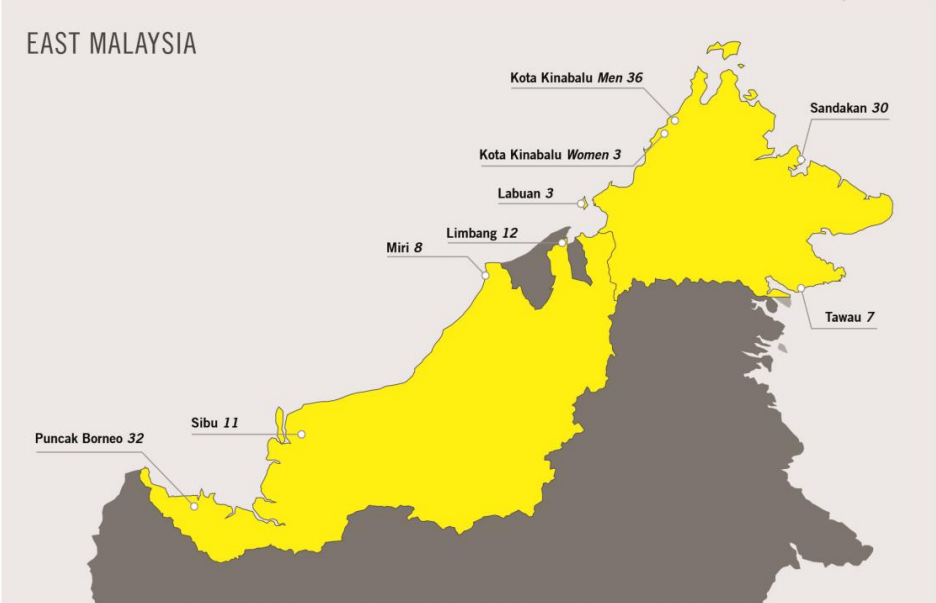
As of 2019, those sentenced to death are held in 26 detention
facilities across the country with 17 prisons in the peninsula holding
the majority of the inmates; 1,139, or 89% and remaining nine facilities
in East Malaysia house the remaining 11%.
Most of them, 89% or 1,140 individuals, are men while 141 are women.
Picture Credit: Amnesty International Malaysia
The remainder of those sentenced to death are made up of 568 Foreign nationals from 43 countries.
Nigerians make up 21% of the total, followed by Indonesia (16%), Iran (15%), India (10%), Philippines (8%) and Thailand (6%). Picture Credit: Amnesty International Malaysia
For crimes committed, 73% have been convicted of drug trafficking
under section 39(b) of the Dangerous of Drugs Act, 1952 while a further
25% were convicted of murder and the remainder of offences are related
to firearms and robbery.
Only one man currently holds the distinction of being sentenced to death for waging war against the King or Ruler of a State.
Point of discussion
Capital punishment has always been a prevalent talking point in society and was even included in Pakatan Harapan’s GE14 manifesto with them vowing to revoke mandatory death by hanging in all Acts.
After coming into power, the new government decided to abolish the death penalty for 32 offences under eight acts of law, including Section 302 of the Penal Code on murder.
They are the Firearms (Heavier Penalties) Act 1971, Firearms Act
1960, Kidnapping Act 1961, Armed Forces Act 1972, Water Services
Industries Act 2006, Strategic Trade Act 2010 and Dangerous Drugs Act
1952.
However, some quarters say the government did a “u-turn”
because they left it to the courts to decide whether a convict should
be hanged although the mandatory capital punishment will be abolished.
The move was heavily criticised by lawyers associations in the country who called it “shocking and unprincipled”, calling it a move to prevent political backlash from the public.
With Malaysia currently looking at ways to deal with the situation,
we take a look at different perspectives from both sides to understand
the issue. Picture Credit: Malay Mail
They hold the view of the death penalty as discriminatory and any
society which executes offenders is committing the same violence it
condemns.
They’ve also cited countries who abolished capital punishment such as
Canada which saw the murder rate decreased since the death penalty was
first abolished.
When the death penalty is carried
out, it is final. Mistakes that are made cannot be unmade. An innocent
person may be released from prison for a crime they did not commit,
but an execution can never be reversed. Amnesty International Malaysia
The Argument For The Death Penalty
The families of murder victims have spoken out against abolishing the death penalty for heinous crimes, including murder from premeditation.
They were also concerned that Malaysia could become a haven for criminals and said the move by the current government protects the interests of criminals more than the victims.
Most of all, they want justice to be served to those who took away their loved ones and caused trauma to the victims’ families.
What is your view on the death penalty? We are currently running a
poll on Facebook to gauge with our audience on what they feel about the
sentence - TRP, 16/1/2020
Justice For Murder Victim’s Families Is Not Death Penalty But A Better
Administration Of Justice And Adequate Compensation For Their Loss
MADPET (Malaysians Against Death
Penalty and Torture) acknowledges the desire of families and friends of murder
victims for justice, which reasonably should be that murderers, and hopefully also
the persons that ordered and paid for the killing of their loved ones, be identified,
investigated, prosecuted and accorded a fair trial. If convicted, they ought to
be punished. However, MADPET disagree that the death penalty ought to be
retained to ensure justice.
The families of the late deputy
public prosecutor Datuk Kevin Morias, millionaire Datuk Sosilawati Lawiya, bank
manager Stephen Wong Jing Kui, university student Chee Gaik Yap, Annie Kok,
one-year-old Muhammad Hafiz Idris and his 4 year old sister Nurulhanim Idris
was reported to have met with the Select Committee for Abolition of Death
Penalty chaired by former Chief Justice Tan Sri Richard Malanjum at Parliament
on Tuesday (14/1/2020) to urge for the retention of the death penalty.(Malay Mail, 14/1/2020, New Straits Times, 14/1/2020,
FMT, 13/1/2020)
No One Wants An Innocent Man To Be Executed
MADPET also believes that no one,
including the family and dependents of murder victims, wants anyone to be
wrongly convicted or executed. We recall one recent case in Asia where an innocent man was wrongly
executed, whereby in January 2011, Taiwan’s Ministry of Justice admitted that
Chiang Kuo-ching, a private in the Air Force, had been executed in error in
1997 for a murder committed 15 years previously.
“No criminal justice system is
perfect. You take a man’s life and years later, you find out that another
person did the crime. What can you do?” - Datuk Seri Nazri Abdul Aziz, the then
Minister in the Malaysian Prime Minister’s Department.
Risk Of Miscarriage Of Justice in Malaysia Is Real
In Malaysia, the risk of this
miscarriage of justice is high. In our system of administration of justice made
up of the police, prosecutors, lawyers,
judges and/or even witnesses can make mistakes that may lead to the conviction
and execution of innocent persons. It can also lead to the real perpetrators
and masterminds evading justice.
In the case of the murder of Bill
Kayong, a human rights defender, 4 persons were jointly tried, where 1 was
charged for murder and the other 3 were charged for abetment of murder. At the
close of the prosecution case, the High Court acquitted 3 because the
prosecution failed to adduce sufficient evidence to prove the charge. Only one Mohd Fitri Pauz was convicted and sentenced
to death by the High Court in August 2018. A perusal of the judgment points
towards a possible failure of the prosecution to adduce sufficient evidence,
even circumstantial evidence, to even satisfy the Judge to ask the 3 abettors to enter their defence. The 3 were acquitted.
In the murder case of N
Dharmendran, who was killed in police custody, all 4 police officers were
acquitted. For a crime that happened in police custody, it is odd that there
was no evidence linking those who had been charged to the torture and/or
killing of the victim.
Attention also must be drawn to
the inquiry findings of the Enforcement Agency Integrity Commission (EAIC) into
the death of Syed Mohd Azlan Syed Mohamed Nur that concluded that the police
caused the death and worse that the police also tampered and/or removed
evidence.
In both the cases of Dharmendran
and Syed Mohd Azlan, recently the High Court following civil suits initiated by
the families awarded compensation to the families but sadly none of the police
officers who tortured and killed seems to have been convicted.
Then, we have the case of Wang
Kelian, where more than 150 remains of foreigners, believed to be human
trafficking victims, had been exhumed from shallow, unmarked graves. We recall
that an exhaustive, two-year investigation
by the New Straits Times Special Probes Team into the mass killings in Wang
Kelian in 2015 suggested a massive, coordinated cover-up. ‘One of the biggest
revelations was that the human trafficking death camps had been discovered
months earlier, but police only announced the discovery on May 25…Another huge
question mark was why did police order the destruction of these camps, which
were potential crime scenes, before they could be processed by forensics
personnel?...’(New Straits Times,
20/12/2017)
We recall also how the former
Attorney General/Public Prosecutor decided not to proceed with charging anyone
for the IMDB and/or SRC cases.
All these, and many other cases
raises much questions about the state of the administration of justice in
Malaysia, and more importantly escalates the possibility of miscarriage of
justice which may result in the wrongful conviction of innocent persons, which
may also result in wrongful executions if the death penalty was retained in
Malaysia.
Justice demands a comprehensive honest
investigation by the police, enforcement agencies and the prosecution, and where
sufficient evidence is obtained a prosecution of accused persons and a fair
trial by competent judges.
The government must no longer
tolerate incompetence and wrongdoings of the police, enforcement officers,
prosecutors and judges. It ought to remove ‘bad apples’ in our administration
of justice and not merely subject them to disciplinary actions.
How many investigation of cases of
murder have not even resulted in identification of alleged perpetrators and/or
a trial in Malaysia?
During the rule of the Barisan
Nasional, the government stopped providing Malaysians with clear statistics as
to the actual number of murders, rape and other crimes and it is MADPET’s hope
that the new Pakatan Harapan government will now start to disclose actual
figures of crime including murder, together with the status of investigation
and prosecution. A crime index which lumps several offences together really
does not tell us how many murders have occurred, and how many such murder cases
remain unsolved. Justice demands thorough investigations followed by proper prosecution.
For murder, it is not just the
actual killer that need to be identified and/or prosecuted but also all others
who paid the killer to kill or ordered the killing. The abolition of the
mandatory death penalty, coupled with the possibility of reduced sentences for
information and evidence of those who ordered or paid another to kill will
bring about greater justice, and reduce the possibility of the guilty escaping
justice.
It is hoped that our new Pakatan
Harapan government will do the needful to improve our administration of justice
to ensure that justice is truly done.
Additional Justice For Family Of Victims And Victims of Crime – Compensation
The families of murder victims
today cannot even rely on the fact that the perpetrators have already been
found guilty and convicted for murder by court, in a civil suit seeking damages
and/or compensation from the perpetrator.
This is because section 43 of the
Evidence Act does not allow this. ‘The family of Mongolian model Altantuya
Shaariibuu will have to prove her brutal killing all over again as the civil
High Court has ruled that evidence from the murder case, which found two police
officers guilty, cannot be used in the civil case.’(Star, 2/10/2018)
This section ought to be amended
so that families of victims or victims of crimes, ought to be able to use these
conviction as proof of the alleged crime rather than being forced to prove all
over again in a new court case the fact that the perpetrator killed, raped or
committed a crime against the victim.
In criminal cases, the courts
should also order the perpetrators to pay victims adequate damages and/or
compensations.
Families Were Merely Objecting To Removal Of Death Penalty For Murder?
It must be noted that these were
families of victims that were murdered or killed, but in Malaysia there are
many offences that carry the death penalty, and some even the mandatory death
penalty, for offences that do not even directly result in the death or injury of
the victim.
Some offences that now have the
mandatory death penalty for crimes that do not result in death of victims
include drug trafficking and certain listed offenses under section 3 and 3A of theFirearms (Increased Penalties Act 1971) where a firearm is discharged, both the person
who discharged the firearm and the accomplices will face the mandatory death
penalty, when committing the following 6 crimes - 1. Extortion, 2. Robbery, 3.
The preventing or resisting by any person, of his own arrest or the arrest of
another by a police officer or any other person lawfully empowered to make the arrest.
4. Escaping from lawful custody, 5. Abduction or kidnapping under sections 363
to 367 of the Penal Code and section 3 of the Kidnapping Act 1961 [Act 365],
and 6. House-breaking or house-trespass under sections 454 to 460 of the Penal
Code.
The offences that carry the
mandatory death penalty that results in death of the victim other than
Murder(sec. 302 Penal Code) are Committing terrorist acts where the act results
in death (sec. 130C (1)(a) ]; and Hostage taking where the act results in death
(sec. 374(a) Penal Code).
Whilst the views of these family
of murder victims ought to be considered, justice demands that Malaysia ought
to abolish the death penalty without any more delay. It must be acknowledged
that there are also many family members of murder victims that are strong
advocates for the abolition of the death penalty.
The risk of miscarriage of
justice demands that we do not wrongly extinguish the life of a fellow human
being, and the only real solution is the total abolition of the death penalty.
Perpetrators of crime must be
punished but never put to death. We do not cut off the hand of a criminal who
by his crime resulted a victim to lose an arm. Likewise, we should not kill
someone who killed another.
MADPET reiterates its call for
the total abolition of the death penalty;
MADPET urges the government to
not procrastinate and promptly abolish the mandatory death penalty in the
upcoming Parliamentary session, which hopefully will follow soon thereafter
with the total abolition of the death penalty;
MADPET also calls for improvement
of administration of justice in Malaysia, especially in the quality of the
police, enforcement officers and the prosecution to ensure that justice be done;
MADPET also calls for the
provision of compensation and/or damages to murder victims and victims of crime,
and for the amendment of section 43 of the Evidence Act 1950 to allow victims
to use the fact of conviction as prove of the liability of the perpetrators in
their claims for compensation and damages in court.; and
MADPET also calls on the
government to abolish Detention Without Trial laws and all unjust laws
speedily.
Charles Hector
For and on behalf of
MADPET(Malaysians Against Death Penalty and Torture)
What about our feelings? Kin of murder victims lash out at death penalty repeal
Tuesday, 14 Jan 2020 08:23 PM MYT
BY R. LOHESWAR
Tan Siew Lin, mother of Annie Kok Yin
Cheng, holds back tears as she speaks during a news conference at the
Legal Affairs Division of the Prime Minister's Department in Putrajaya
January 14, 2020. — Picture by Yusof Mat Isa
PUTRAJAYA, Jan 14 — Several family members of murder victims have
accused Putrajaya today of purportedly being insensitive towards their
feelings with its move to abolish the capital punishment.
They claimed that justice will not be served as long as killers are
allowed to walk free, while others may use loopholes in the system to
avoid the gallows.
“We used to celebrate her birthday together on the sixth on June
every year. Now she’s dead but the government is considering abolishing
the death penalty.
“How is this fair? If he is let loose I will find him or ask someone
to find him and shoot him dead,” said Tan Siew Lin, referring to her
late teen daughter Annie Kok Yin Cheng, who was murdered and raped in
2009.
“For us there is no closure as long as we know these criminals are
out free or that there is a chance for them to escape the death
penalty,” she added.
Tan said she tried handing over a memorandum with 97,000 signatures
from those opposing the abolition of the death penalty to lawmakers last
year. She claimed she was refused entry into the Parliament.
A guest must be accompanied by an MP to enter the Parliament.
“The government doesn’t understand our pain. If it abolishes it, we
will make noise,” added Tan, whose daughter’s killer, Rabidin Satir, is
currently awaiting trial on several charges of rape and theft.
Representatives and family members of
murder victims who refuse to accept the abolishment of the death
penalty pose for a group photo in Putrajaya January 14, 2020. — Picture
by Yusof Mat Isa
Today, family members and representatives of the alleged murder
victims — Datuk Kevin Morias, Datuk Sosilawati Lawita, Stephen Wong Jing
Kui, Chee Gaik Yap, Annie, Muhammad Hafiz Indris, and Nurulhanim Idris —
attended a meeting with a Parliamentary Select Committee here to plead
against the repeal of the death penalty.
The family members said they all felt the committee has already made
up their mind to abolish the death penalty, and the meeting was just a
formality.
“They asked us, if the death penalty is imposed and the perpetrator
is killed, will that bring your loved ones’ back to life and will it
really make us happy?
“I feel this is a silly question,” said Mansur Ibrahim, representing the family of toddlers Hafiz and Nurulhanim.
Mansur said countries who have removed the death penalty are now
bringing it back as there has been an uptick in crime, but did not
provide any examples to back his claim.
Out of 195 members of United Nations, only 55 countries still retain the death penalty.
“Seems as though they’ve already set their minds to abolish the Act.
We just met them as a formality,” said Alan Ong Yeow Fooi, representing
Morais and Sosilawati.
Tan Sri Robert Phang claimed that Malaysia could be a haven for
criminal activity if capital punishment is abolished. He also did not
provide any proof to back his claim.
“If the public demands it, then a referendum should be made to not abolish the death penalty,” Phang said.
Tan Siew Lin (left) holds up news
clippings of her daughter Annie Kok Yin Cheng as she speaks during a
news conference at the Legal Affairs Division of the Prime Minister's
Department in Putrajaya January 14, 2020. — Picture by Yusof Mat Isa
At the meeting today, the select committee was represented by Tan Sri
Richard Malanjum, Tan Sri Zahrah Ibrahim, Datin Paduka Sri Zauyah Be,
Datuk Mah Weng Kwai and Dr Farah Nini Dusuki.
The Pakatan Harapan government made a historic decision on December
2018 by voting in favour of a United Nations resolution for member
states that still retains the death penalty to establish a moratorium on
executions with a view to abolishing this punishment.
Two months after being voted into power in May 2018, the government
ordered in July that year a suspension of all pending death sentences.
However, it has since demurred on total abolition of the capital
punishment.
The Cabinet has been mulling three options: total abolition of the
death penalty; or making the death penalty non-mandatory for crimes such
as murder; or giving judges full discretion during sentencing for those
convicted under Section 39B of the Dangerous Drugs Act.
The abolition is expected to be tabled in the Parliament in March. - Malay Mail, 14/1/2020
PUTRAJAYA:
Family members and representatives of murder victims are vehemently
against any move to abolish the mandatory death penalty for heinous
crimes, including premeditated killings.
They expressed
their firm stand in a 90-minute meeting with the Select Committee for
Abolition of Death Penalty chaired by former Chief Justice Tan Sri
Richard Malanjum on Tuesday.
The families comprised that of
the late deputy public prosecutor Datuk Kevin Morias, millionaire Datuk
Sosilawati Lawiya, bank manager Stephen Wong Jing Kui, university
student Chee Gaik Yap, Annie Kok, one-year-old Muhammad Hafiz Idris and
his sister Nurulhanim Idris, 4.
Tan Siew Lin, 57, the
mother of Kok, who was 17 years old when she was raped and killed at her
house in 2009, wants her killer to hang.
"If he is freed, I will hunt down that person myself,” said Tan, who still cries in the bathroom when she thinks of Kok.
"I
will only have peace when her killer is dead," she told reporters after
the meeting, adding no one could truly understand how the families of
murder victims felt until they themselves experienced it.
The
families, in a joint statement said they strongly felt criminals who
planned, raped, kidnapped, maliciously and deliberately killed their
victims in cold blood deserved to hang.
"We want a life for
a life, no less. Take note, the killer(s) took not just one precious
life, but also destroyed many others’, including ours.
"We
will not accept compensation from the government or killers’ family in
order to absolve the criminals from capital punishment. If they have the
courage to kill, they must also have the courage to take responsibility
for their actions, ie. be hanged. This is our rule of law," the
statement said.
The families added they had seen killers freed more often than hanged.
"The justice system should be getting justice for victims, not to protect criminals.
"We are very sad to see the government working closely with only pro-abolition NGOs to remove the death penalty.
"Some
of these NGOs are privately well-funded. Some are even funded by the
government, They are equipped with resources to fight for freedom of the
criminals. Victims like us have nothing.
“Some of us had to borrow money to bring the cases to civil court," they said.
The families said they were sad to see that the government seems to be fighting only for the benefit of criminals.
“We feel betrayed and abandoned.”
In removing the mandatory death penalty, they said it would only make "death penalty" be seen on paper, but not in practice.
"Have
you (the government) done your research to see how our neighbours keep
the death penalty to protect the people and keep the city safe?"
Social Care Foundation Malaysia chairman Tan Sri Robert Phang urged the government not to abolish the mandatory death sentence.
(Clockwise from top left) Kevin Morais, Stephen Wong Jing Kui, Chee Gaik Yap, Annie Kok Yin Cheng and Sosilawati Lawiya.
PETALING JAYA: Families of three murder victims will meet Putrajaya’s
special committee to review the mandatory death sentence tomorrow,
ahead of a report on its findings expected this month.
They are expected to voice their opposition against any move to replace the mandatory death sentence.
They include families of deputy public prosecutor Kevin Morais,
cosmetics business owner Sosilawati Lawiya, banker Stephen Wong Jing
Kui, UUM graduate Chee Gaik Yap and teenager Annie Kok Yin Cheng, both
of whom were raped and murdered in 2006 and 2009 respectively.
A statement by their family members said they would meet former chief
justice Richard Malanjum, who heads the Special Committee on the Study
of the Alternative Sentence to the Mandatory Death Sentence and other
members.
The statement said the calls to abolish the death sentence from
“liberal pro-abolition NGOs” as well as government leaders have ignored
the victims of the convicted individuals.
“Sadly the dead victims do not have a voice and their families do not
have the support of the current Cabinet and they do not have any
platform to speak up on this issue,” they said. - FMT, 13/1/2020




.jpg "Tan Siew Lin, mother of Annie Kok Yin Cheng, holds back tears as she speaks during a news conference at the Legal Affairs Division of the Prime Minister's Department in Putrajaya January 14, 2020. — Picture by Yusof Mat Isa")
.jpg "Representatives and family members of murder victims who refuse to accept the abolishment of the death penalty pose for a group photo in Putrajaya January 14, 2020. — Picture by Yusof Mat Isa")
.jpg "Tan Siew Lin (left) holds up news clippings of her daughter Annie Kok Yin Cheng as she speaks during a news conference at the Legal Affairs Division of the Prime Minister's Department in Putrajaya January 14, 2020. — Picture by Yusof Mat Isa")