Sunday, January 28, 2007

OPEN LETTER TO THE MINISTER OF JUSTICE OF JAPAN, THE HON. NAGASE JINEN


Ref.: TG ASA 22/2007.001

Minister Nagase Jinen

Ministry of Justice

1-1-1 Kasumigaseki

Chiyoda-ku

Tokyo 100-8977

Japan

24 January 2007

OPEN LETTER TO THE MINISTER OF JUSTICE OF JAPAN, THE HON. NAGASE JINEN

Dear Minister,

I am writing on behalf of Amnesty International and the Anti-Death Penalty Asia Network (ADPAN)[1] to register our grave concern at the executions of four prisoners (Hidaka Hiroaki, 44, Hiroshima; Fukuoka Michio, 64, Osaka; Akiyama Yoshimitsu, 77, Tokyo; Fujinami Yoshio, 75, Tokyo) which took place on 25 December 2006.

This retrograde step runs counter to the universal protection of human rights and is at odd with the international trend away from the use of the death penalty. Very few countries currently carry out executions: provisional figures compiled by Amnesty International indicate that only 20 of the United Nation’s 193 member states carried out state killings in 2006. These executions in Japan, after a 15 month hiatus, will send a discouraging signal to nations in the Asia-Pacific region at a time when others – South Korea and Taiwan for example – are considering the abolition of the death penalty.

On his appointment in October 2005, your predecessor, the former Minister of Justice Sugiura Seiken, refused to sign execution orders due to his personal beliefs. This is not the first time a Minister of Justice in Japan has refused to sanction hangings. Former Minister of Justice Sato Megumu also refused to sign execution orders because of his religious beliefs.

During the four-year informal moratorium on death penalty between 1989 and 1993, homicides in Japan reached some of the lowest rates in modern times with 1,215 murders reported in 1991, well below recent figures such as the 1,419 homicides reported in 2004. Such figures contradict the argument that the death penalty is a uniquely effective deterrent against serious crime. The experience of other countries also shows that an absence of executions does not lead to an increase in homicide rates.

The four executions on 25 December run counter to a growing trend towards the abolition of the death penalty and a lessening in the number of executions; this global trend away from the use of capital punishment was highlighted in our recent report on the death penalty in Japan published in July 2006, “Will this day be my last?”: The death penalty in Japan” (AI Index: ASA 22/006/2006) The death penalty has already been abolished in Cambodia, Nepal, Timor Leste and recently in the Philippines. Currently the National Assembly of South Korea is giving serious consideration to abolition and the authorities in Taiwan have also indicated their desire to remove capital punishment from their laws. Japan seeks to become a permanent member of the UN Security Council; steps towards abolition of death penalty would demonstrate that Japan is progressing towards the full protection of human rights and showing strong leadership on this important matter.

We note your comments reported in various media sources that “…nearly 80 per cent of the people of this country have no objection to the existence of the death penalty”. After over 30 years researching the death penalty, Amnesty International believes that public support for the death penalty is overwhelmingly based on a desire to be free from crime as well as the erroneous belief that executions prevent murders. Amnesty International recognizes the right of citizens to create laws via their elected representatives; such laws must be formulated with respect for human rights. History is littered with human rights violations that had the support of the majority but in modern times are looked upon with horror. Slavery, racial segregation and lynching all had widespread support in the societies where they occurred but constituted gross violations of the victims' human rights. In more recent times, grave violations of human rights in Bosnia, Rwanda and East Timor all had the support of large sections of the population in those countries but were no less unacceptable because of such popularity.

Amnesty International's opposition to the death penalty does not in any way distract from the sympathy the organization and others feel towards the victims of violent crime and their loved ones. As an organization dedicated to working for the victims of human rights violations, Amnesty International is fully aware of the suffering caused by violent crimes. We believe that everyone in society should work to lessen violent crime and that all those impacted upon by such appalling acts as murder, rape and other crimes should be supported and helped as they rebuild their lives after suffering such trauma.

Amnesty International and the Anti-Death Penalty Asia Network (ADPAN) urge the Japanese government to:

  • Stop further executions;
  • Commute all death sentences and impose an immediate moratorium on executions, pending abolition of the death penalty;
  • End secrecy around the application of the death penalty and initiate a public and parliamentary debate on abolition of the death penalty by making available all information regarding the use of the death penalty;
  • Implement procedural safeguards around the right to life and respect the rights of detainees, by improving prison conditions, allowing families, friends and lawyers greater access to prisoners, and ensuring prisoners have access to medical facilities.
I look forward to hearing from you on this important matter.

Yours sincerely,

Irene Khan

Secretary General

Enclosed: Amnesty International Report: Will this day be my last?”: The death penalty in Japan” (AI Index: ASA 22/006/2006)


[1] The Anti-Death Penalty Asia Network (ADPAN) was launched on 10 October 2006. ADPAN consists of lawyers, parliamentarians and activists from 16 countries: Australia, Hong Kong, France, India, Indonesia, Italy, Japan, South Korea, Malaysia, Mongolia, Philippines, Singapore, Taiwan, Thailand, UK and USA.

ADPAN has 33 members, including 13 organizations: Hong Kong Society and Community Organization, Commission for Disappearances and Victims of Violence (KONTRAS) (Indonesia), Forum 90 (Japan), Catholic Human Rights Committee (South Korea), Malaysians against the Death Penalty and Torture (MADPET), Murder Victims' Families for Human Rights (USA), Philippine Human Rights Information Center (Philrights), Think Centre (Singapore), Taiwan Alliance to End the Death Penalty (TAEDP), FORUM-ASIA (Thailand), Comunità di Sant'Egidio (Italy), World Coalition against the Death Penalty and Amnesty International. See: http://asiapacific.amnesty.org/

Sunday, January 21, 2007

Suspect found dead in police lock-up


Suspect found dead in police lock-up

SEREMBAN: A part-time lorry driver, who was being remanded to help in investigations into a robbery, died in the police district headquarters lock-up here yesterday.

District police chief Asst Comm Hasanuddin Hasan said that the 46-year-old man's body had been sent to the Tuanku Jaafar Hospital for a post-mortem.

“An investigation is being conducted, including looking at the CCTV (closed circuit television) recordings,” he said.

It is learnt that the suspect and two other men were detained in a restaurant at Jalan Tun H.S. Lee in Kuala Lumpur on Thursday.

Family members of the deceased and MIC official Shivarraaj Chandran met ACP Hasanuddin over the death yesterday.

The suspect's brother said that he received a telephone call from the police yesterday morning informing him of the death.

“He was fine when he was detained. When I asked the policeman what had happened, he said that my brother took a shower about 3am and then went to sleep.

“They found him dead at about 5am,” he said.

21 arrested in toll protest (Malaysiakini)

21 arrested in toll protest
Jan 21, 07 5:41pm (Malaysiakini)

After watching the anti-toll hike protest from the sidelines for the past two weeks, the police today did the reverse - arresting 21 demonstrators even before the protest had started.

Among those arrested were protest leaders including Parti Keadilan Rakyat Information chief Tian Chua, PAS leader Dr Hatta Ramli and DAP leader Ronnie Liu.

The demonstration in Cheras today was organised by anti-toll hike organisation Protes - a coalition of opposition parties, civil society groups, trade unions and student groups, in which Hatta is the movement's secretary.

The arrested protestors have been taken to the Kajang police headquarters.

Four protestors, including Tian Chua, were hurt in the melee with the police and had been taken to the hospital for treatment.

All the protestors held at the police station were released at about 9.30pm on police bail and have been asked to report to the Kajang magistrate's court on Feb 5.

Crowd in front of station

Earlier, DAP secretary general Lim Guan Eng, who met with the police officials, told the media that he was given the assurance that the protestors would be released soon.

"They said that they will release the protestors after taking statements from them," he said.

A crowd of about 50 people has also gathered in front of the Kajang police station, waiting for the release of the protestors.

The protest today in Cheras in Kuala Lumpur was the third in the series of protests organised by the coalition to oppose the hike in the toll rates at five Klang Valley highways beginning Jan 1.

In the earlier two protests - the first at the Sunway City toll plaza along the LDP highway two Sundays ago and the second in Gombak last Sunday - the police force was widely commended for allowing the peaceful protests to proceed peacefully.

However, it was a different story today.

Shocked and surprised

Just as the protestors - numbering less than 100 - were gathering at two places at the Cheras Batu 11 toll plaza at about 4pm today to show their displeasure against the hefty toll hike, the police issued them a warning to disperse.

Kajang police chief ACP Rosli Mohd Nizam told the crowd to disperse as it was an illegal assembly.

In one of the spots - near a concrete road barrier closing an alternate route which bypass the Cheras-Kajang highway toll - about 30 would-be protestors led by PKR leader Lee Kim Sin had gathered. The concrete barrier forces residents in the area to use the toll highway.

However, some of them left the scene after the police warnings of dispersals.

Later, about 40 others led by Bandar Mahkota Cheras Free Access Road Action Committee president Tan Boon Hwa came to the area with banners and flags.

They were given five minutes to disperse, but the police started arresting the protestors in about three minutes.

Tan (photo) and a few others put up a struggle, but eventually six at the concrete road barrier - including Lee Kim Sin - were arrested. There were about 80 police officers on the scene.

In all, the police arrested 21 protestors in both the spots - the second spot being the rest area near the toll plaza. Both the regular police force and the anti-riot Federal Reserve Unit were involved in dispersing the crowd.

Surprised and shocked by the harsh police action, the rest of the protestors slowly begin to disperse from the protest venues.

A malaysiakini journalist was also held by the police. He was not officially detained but his camera was seized. He too was also taken to the Kajang police station.

“I have not been detained but they are keeping me here. I can walk around and make phone calls,” said journalist Andrew Ong using his mobile phone.

He has been told that the police were awaiting orders from the Kajang police chief. He said that the police wanted to see the photographs he took of the protest.

He was later released with his camera after about two hours from the Kajang police station.

Sharp rise

Beginning Jan 1, the toll rates for five major highways in the Klang Valley increased between 20 to 60 percent.

Lebuhraya Damansara-Puchong (LDP) saw the highest rise with its toll rising from RM1 to RM1.60 while the Kuala Lumpur-Karak Highway's Gombak toll is now at RM5, an increase of RM1. The highway's Bentong toll was increased by 50 sen to RM3.

The other affected highways are Shah Alam Highway, Cheras-Kajang Highway and the Guthrie Corridor Expressway.

The hikes have drawn strong reaction from various groups including component parties of the ruling Barisan Nasional coalition.

The protest in Sunway City was the most notable thus far which drew thousands of participants from all walks of life in denouncing the drastic hikes in toll charges.

[photographs by Andrew Ong]

Friday, January 19, 2007

Probe prisoner 'beatings': Suhakam tells police (Malaysiakini)

Probe prisoner 'beatings': Suhakam tells police
Andrew Ong
Jan 19, 07 5:00pm


The Human Rights Commission of Malaysia (Suhakam) said it will launch a public inquiry if the police do not investigate the alleged beatings of inmates in the Simpang Renggam detention centre in Johor.

According to Suhakam commissioner N Siva Subramaniam, the commission views seriously the allegations of abuse by warders compiled in his report after he visited the centre last week.

“We want the police to investigate the police reports lodged by the alleged victims and their parents first.

“We would give them one month to do so, failing which Suhakam would hold a public inquiry into the matter,” he said when contacted yesterday.

On Monday, he said Suhakam appointed three commissioners to carry out the tentative public inquiry - Muhammad Shafee Abdullah, Dr Chiam Heng Keng and newly appointed commissioner and former director of the Public Complaints Bureau Khalid Ibrahim.

“A public inquiry would once and for all enable victims and their parents to present their evidence (on the alleged abuse) to the inquiry,” he added.

To date, there has been no official account of the incident. According to news reports, 16 inmates were given outpatient treatment at the Kluang hospital after the incident.

One inmate, who contacted malaysiakini shortly after the incident, claimed that ratan canes and batons were used to beat inmates after they were made to squat on the floor.

Previously, Siva said his Jan 8 visit to the detention centre revealed prima facie evidence of human rights abuse by the warders.

Don’t delay

In another development, rights group Suaram urged Suhakam not to delay in holding the public inquiry as evidence might be tampered with over the month.

“We think it should be done as soon as possible because physical evidence on the inmates would be less obvious over time. Furthermore, any delay might allow certain parties to threaten the victims against giving evidence,” said Suaram coordinator Chang Lih Kang.

On January 5, Suaram had written to Suhakam chairperson Abu Talib Othman, urging him to conduct the public inquiry.

The detention centre holds some 4,000 inmates detained without trial under the Emergency Ordinance 1969 and the Dangerous Drugs (Special Preventive Measures) Act 1985.

The centre has been the subject of controversy due to it being overcrowded and unhygienic.

Thursday, January 18, 2007

Murder Victim's Families Against the Death Penalty

Tuesday, December 19, 2006 ( from Asia Death Penalty Blog)

Death penalty victims speak out

Execution leaves a prisoner dead, but it leaves their families serving a deeply painful life sentence. Yet we rarely hear their stories, and we are almost never confronted with the consequences for them of having a loved one killed by the state.

A new report in the USA has broken this silence surrounding the families of executed people.

The report by Murder Victims' Families for Human Rights (MVFHR), released on Human Rights Day -- 10 December, documents the experiences of the families and how they suffer similar effects to others who have experienced violent loss.

MVFHR said it produced the report Creating More Victims: How Executions Hurt the Families Left Behind "to highlight the similarities between the experiences of survivors of homicide victims and survivors of people who are executed".

MVFHR is an organisation of the families of people killed through murder and terrorist acts, and the families of people killed by the state. It works against the death penalty, based on a human rights perspective.

"Family members of the executed are the death penalty's invisible victims," said Renny Cushing, executive director of MVFHR.

"With each execution, we create a new grieving family who experience many familiar symptoms of trauma, some of them long-lasting. As a society, what are we doing to address the suffering of these families?"

Hearing their voices
The report is based on the deeply moving testimony of many families from "this new group of victims".

"I don't think people understand what executions do to the families of the person being executed," said Billie Jean Mayberry, whose brother Robert Coe was executed in Tennessee in 2000.

"To us, our brother was murdered right in front of our eyes. It changed all of our lives."

Robert Meeropol, whose parents Julius and Ethel Rosenberg were executed when he was six years old, emphasised the devastating effect of execution on children.

"What impact does this event have on children’s impressionable lives, and what cost does society pay for that impact?"

The report makes recommendations for mental health professionals, educators, and child welfare advocates.

MVFHR has also sent a copy to the United Nations High Commissioner for Human Rights with a request that she undertake a study of the impact of executions on surviving families.

Read their stories
Our colleagues at the Abolish the Death Penalty blog are running a two-week, ten-part series with the families' stories from the MVFHR report.

The first post is available here.

The full report is available here. (Please note the file is 2.46Mb.)

Labels: ,

Have a heart for the disabled, KLCC told (Malaysiakini)

Have a heart for the disabled, KLCC told
Andrew Ong
Jan 18, 07 11:40am


Mohd Firdaus Azizan suffers from cerebral palsy. The condition prevents the 24-year-old from being able to feed, dress or clean himself.

He suffers from speech impediment and cannot use his limbs. He has limited use of his fingers, but still manages to manuever a motorised wheelchair.

Despite this, Firdaus is determined to live as independently as possible.

The youth sells souvenir items such as key-chains and postcards along the pedestrian tunnel linking the KLCC Putra LRT station and Suria KLCC shopping complex.

"I enjoy selling these things and making an honest living," said Firdaus with the help of an interpreter during a press conference in Kuala Lumpur yesterday.

But now, his livelihood is at stake because KLCC Urus Harta managing director Mustafa Awang said that 'beggars' along the tunnel portray a negative image about Malaysia.

KLCC Urus Harta took over the tunnel from Kuala Lumpur City Hall (DBKL) on Jan 1 and has given its ‘squatters’ till Jan 18 to vacate.

Failing which, Mustafa reportedly warned that enforcement officers from the DBKL and Welfare Services Department would be summoned to remove them.

'Be proud of him'

Are petty traders with physical and mental disabilities seen as ‘damaging’ to the country’s reputation?

This was the question raised at the press conference called by the newly formed Malaysians Against Discrimination of the Disabled (Madd) coalition.

“Being able to sell things gives Firdaus some purpose and joy in his life,” said the coalition’s legal adviser N Surendran (right).

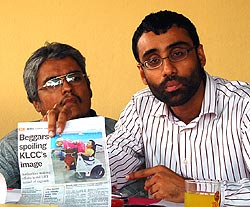
While acknowledging that KLCC has full rights over the tunnel, he said the company could have handled the situation better.

“We would think that KLCC would use their discretion and allow them to continue trading, or at least propose an alternative for them to earn a living,” he added.

KLCC should help the disabled as part of their corporate social responsibility, stressed the lawyer.

Meanwhile, wheelchair-bound activist Anthony Thanasayan also expressed disappointment over the issue.

“Why should we see people like Firdaus as a shame to the country? KLCC should be proud of him,” he told the press conference.

He said inaccessibility of public transport and buildings hinder many talented disabled people from seeking meaningful employment.

Contacted today, Mustafa declined to comment on the criticisms. He referred malaysiakini to a public relations officer who could not offer immediate comments.

Wednesday, January 17, 2007

2 Workers Dead & 10 seriously injured in Industrial Accident at Work Place


Recently on 10/1/2006, it was reported that one Malaysian & one Burmese worker were killed, and 12 other Indian Migrant Workers were seriously injurded when a scaffolding at the construction site(their workplace) collapsed. They were hit by the slabs, which fell from the seventh level. Twelve slabs, each weighing about 50 kgs, were said to have fallen from a platform on the scaffolding.

The dead are 52-year-old Malaysian Liew Wan Chew and Myanmar national Boi Nei Tang, 35. The injured have been identified as Balraj Singh, 21, Pretap Singh and Arjan Singh both 22, Aman Singh, 23, Kala Singh and Gurbachan Singh, both 24, Salam Khan, 25, Subash Kumar, 26, Gurnam Singh, 30, Jamuna Prasad, 33, Rampal Singh, 37 and Kashmeer Singh, 40. Except for Salam who is from Bangladesh, the rest are from Punjab, India.

The police says that it is a case of sudden death ("
Dang Wangi OCPD Asst Comm Mohammad Zulkarnain said the police have classified the case as sudden death" - a bit too fast for a conclusion, is it not - was there thorough investigation done before hand..and what does that "sudden death" mean) - BUT the question is whether any criminal action will be taken against the said employers and/or the developers.

The question is whether the Employers will be fined and/or required to pay any compensation to these workers. It was sad to note that the Minisiter, was seen to listen to the briefing of the by developer Pavilion Kuala Lumpur Sdn Bhd - strange that he did not seem to have gotten any briefing from any Occupational Health and Safety inspectors. A stop-work order was issued BUT for how long. Will there be an investigation into the incident, and will the said Developer and persons involved in the constructions be penalized.

The questions that arise:-

1) Have the Occupational Health and Safety Officers been doing visits to construction sites to ensure that working condirtions are safe for the workers on a regular basis? It is not enough only to come in when there is an industrial accident that receives the attention of the media. Looking at construction sites, and comparing it with some other countries like Hong Kong, it can be seen that the Malaysian worksites are not as safe as those. In Hong Kong, safety netting covers the whole of the building and there is very little (or no) risk of any brick falling and other things falling. It all looks so safe.

2) 2 died and 12 were injured but the Developer seem to be more concerned about completing the work done - which they said was only 6 weeks away from completion. Now, will the government do a thorough investigations and ensuring that all requirements to ensure safety is complied with is in place before revoking the stop-work order OR will the stop-work order be revoked in a few days time after the issue is no more a hot topic in the media. Has work already started.

3) What are the benefits that these migrant workers will get? Are they covered by SOCSO and/or Workman's Compensation Act? Was all the said Migrant Workers documented workers? If they were not, would they receive any compensation at all - for after all it was not too long ago that some undocumented Indonesian migrant workers were declared to be not entitled to receive their wages because they were undocumented. What about these 1 Migrant Worker and the 12 others who were injured - are they documented or not? And if they are documented with the relevant government department ensure that they get their due compensation as the law requires - or just keep quite and not make any payment out because these workers did not take the necessary steps to put in for their claims (After all Migrant Workers are not part of any Unions and many are ignorant about the law and/or how to make the necessary applications for compensation). Note some of the injured also may be not able to work anymore - and would the employer just terminate them - and not pay them for the months that could not work (or the remaining period of their work permit)? Many may just want to get back to their country - and the employer would get off scot-free, and the SOCSO and Workmen's Compensation also may just forget them.

4) Would the Company - its Directors and its shareholders be penalized and also charged for reckless killing of another (or murder or some other offence in the law) - or will they again get off scott-free. They must be penalized and also charged in court - and this will also serve as a warning so that other employers/developers would thereafter make sure that safety at the workplace is at its highest standards. Would the said Developer be "black-listed" - of course not just the company BUT also the Directors (if not that same group of Directors, CEO and COO etc will just go away and set up another company and escape the intention of the "black-listing").

5) Lifes were lost and persons were injured - but alas the coverage by the local media was dismal and in fact foreign media had more details about what happened and who got killed/injured.

6) Several years ago a Sudanese young man, who came to Malaysia to study, was killed by electrocution at the workplace (i.e. the Putrajaya Mosque) - and sadly this never received media attention - and in fact the incident was also not reported to the Labour Ministry. The boys family is yet to receive any monies from Workmen's Compensation. How many more migrant workers (documented or otherwise) have been similarly killed and/or injured at worksites - and have just not gotten reported, and even if the case was reported or was in the knowledge of the Ministry have not been given even the required workmen's compensation as required by law. Migrants are also human beings - and it must be the duty of the government, be it the Ministry or the police force, to ensure that they get whatsoever compensation as required by law and that the developers/employers be penalized for their negligence that caused the death of workers.

This case, like most other cases involving the ordinary man, will just be forgotten - BUT it is hoped that the Ministry and the police do the necessary to ensure that JUSTICE be done.

Selected reports from the local media, and also some foreign media about the incident is as follows. The source has been the internet version of these media - not the print media version.

STAR
Two dead, 10 injured when scaffolding collapses

Update by The Star newsdesk
KUALA LUMPUR:

Two died and 10 others were injured when a scaffolding they were standing on collapsed at a construction site in Jalan Bukit Bintang around noon on Wednesday.


Four of those injured are in critical condition.


The two dead workers were a Malaysian and Myanmar.
Dang Wangi OCPD Asst Comm Mohamad Zulkarnain bin Abdul Rahman, who was at the scene of the incident, said the two died when they construction material fell onto their heads after they landed on the ground.

The injured workers were sent to Kuala Lumpur Hospital.


The workers were standing on a platform on the metal scaffolding about 15m above the ground when it collapsed.


Eleven Indians injured in Malaysia

Press Trust of India
Thursday, January 11, 2007 (Kuala Lumpur):

Two people were killed and 11 Indians injured, some of them seriously, when a scaffolding with several slabs of granite and construction materials plunged 15 metres to the ground in the Malaysian capital.


The accident took place at the construction site of a swank condominium-cum-botique hotel complex in downtown Kuala Lumpur on Wednesday.


One of the dead was a Malaysian national while the other was from Myanmar.


The Indians were all reported to be from Punjab who had come to Malaysia to work as construction site workers.


They were on the ground floor when the scaffolding crashed on them. Four of the injured were reported to be in a serious condition.


One of the injured workers, 22-year-old Rampal Singh whose arm got fractured was quoted by the New Straits Times as saying that he had managed to jump clear just before the slabs hit the ground.


"I am returning to India when I recover," Singh said. Seven of the injured are still at the hospital.


Work suspended


The two dead people were in a lift outside the second level of the building when they were hit by the slabs, which fell from the seventh level.


Twelve slabs, each weighing about 50 kgs, were said to have fallen from a platform on the scaffolding, the report said.


Work has been suspended at the Pavilion Kuala Lumpur project site by authorities. Human Resources minister Fong Chan Onn said he would not compromise on safety at construction sites.


The Kuala lumpur Department of Occupational Safety and Health director Omar Piah said 17 people died at construction sites in the city and at the administrative capital of Putrajaya last year.


The incidents happened at 10 construction sites, he was quoted by the media as saying.
One of the accidents that hit media headlines here last year was the death of a management consultant who was killed when a 720 kg concrete mould fell on him from a 20th floor of a partly completed complex.

Star,
Thursday January 11, 2007
Two die in scaffolding mishap,
KUALA LUMPUR:

Two men were killed and 12 others injured when an upper-level scaffolding with several granite slabs collapsed and hit them.
Police said the scaffolding could have collapsed from the weight of the slabs, each weighing about 50kg.

The tragedy occurred at 12.30pm yesterday at the 5ha construction site of the Pavilion Kuala Lumpur, a residential cum boutique hotel project, in Jalan Bukit Bintang here.


Dangling scaffolding: Workers and passers-by looking up at part of the collapsed scaffolding left in mid-air after the 12.30pm mishap which killed two workers.

The dead are 52-year-old Malaysian Liew Wan Chew and Myanmar national Boi Nei Tang, 35.

It is believed that the two were in a lift outside the second level of the building when were hit by the slabs, which fell 15m from the seventh level.


Twelve slabs, each weighing about 50kg, were said to have fallen from a platform on the scaffolding.

The falling slabs also injured 12 workers who were on the ground floor. Four of them are in serious condition. The injured have been identified as Balraj Singh, 21, Pretap Singh and Arjan Singh both 22, Aman Singh, 23, Kala Singh and Gurbachan Singh, both 24, Salam Khan, 25, Subash Kumar, 26, Gurnam Singh, 30, Jamuna Prasad, 33, Rampal Singh, 37 and Kashmeer Singh, 40. Except for Salam who is from Bangladesh, the rest are from Punjab, India.

At press time, Balraj Singh, Gurbachan Singh, Subash Kumar, Salam Khan, Arjan Singh, Rampal Singh and Kashmeer Singh were still warded in Kuala Lumpur Hospital.


Dang Wangi OCPD Asst Comm Mohammad Zulkarnain said the police have classified the case as sudden death.
When met at the Kuala Lumpur Hospital mortuary, Lim's wife, who declined to be named, demanded action to be taken against those responsible.

Related Stories:
Deaths the second fatal incident in five months

Star Thursday January 11, 2007
Deaths the second fatal incident in five months
KUALA LUMPUR:

The death of two workers from falling granite slabs at the Pavilion Kuala Lumpur project site was the second fatal accident in five months. A stop-work order has been issued on the project.


Human Resources Minister Datuk Seri Dr Fong Chan Onn said a worker died in August last year after he was hit by a piece of wood that fell from a scaffolding.
“The fact that there had been two accidents within five months shows some degree of non-compliance or a lapse in the system,” he told reporters after inspecting the accident site and a briefing by developer Pavilion Kuala Lumpur Sdn Bhd yesterday. Dr Fong said an immediate stop-work order had been issued on the residential cum boutique hotel project. “The scaffolding may have given way due to overloading,” he said. During the briefing, Pavilion executive director Y.S. Liew said the project was just six months away from completion. He said the workers had been installing tiles on the outer part of the building when the incident occurred.

In a faxed statement, Pavilion and its sub-contractor Putra Perdana Construction Sdn Bhd expressed regret over the incident and extended their condolences to the families of the deceased workers.


Two dead, 10 hurt when scaffolding collapses at Malaysian site

dpa German Press Agency
Published: Wednesday January 10, 2007 Kuala Lumpur-

A Myanmar construction worker and his Malaysian colleague were killed when a 15-metre high scaffolding they were on collapsed Wednesday in the heart of Malaysia's capital Kuala Lumpur. Ten other workers at the construction site in the city's major tourist and shopping area were injured in the accident.


The two victims, a 50-year old local worker and the 35-year old Myanmarese national, died from severe head wounds, said district police chief Muhammad Zulkarnain Abdul Rahman.


Out of the injured, six were said to be in critical condition, Muhammad Zulkarnain was quoted as saying by the official Bernama news agency. The nationalities of the injured, who have been sent to a nearby hospital. have not been confirmed, he said.

In the noon incident, the cables of the metal scaffolding was believed to have given way due to overloading.

Work on the site has been temporarily halted until investigations are conducted.


© 2006 dpa German Press Agency

Malaysiakini: Going 'Madd' over discrimination

Going 'Madd' over discrimination
Andrew Ong
Jan 17, 07 3:10pm

Spurred by recent events, a new coalition has been formed with the aim of ending discrimination against the disabled community.

Comprising 12 groups, the Malaysian Coalition Against Discrimination of the Disabled or Madd wants the government to facilitate anti-discrimination and equal opportunity laws.

“Madd was formed due to the realisation among NGOs and activists that there is a complete lack of sensitivity on the part of the authorities towards the needs of the disabled,” the coalition’s legal advisor N Surendran told a press conference in Kuala Lumpur today.

The most recent incident which had caused an outrage was the alleged mistreatment of 36-year-old petty trader and father of four Murugan Rajoo by Selayang Municipal Council (MPS) officers.

MPS officers had seized his possessions for trading without a license on Jan 5. He and several disabled activists were later allegedly confined for an hour at the MPS Rawang branch when they attempted to reclaim the possessions.

Last Monday, several disabled groups tried to submit a memorandum of protest on the matter to MPS president Zainal Abidin Azim but the latter had insisted that they come up to see him on the ninth floor.

He later told reporters that his enforcement department and the police are investigating the allegations and would make an official statement on the matter in due time.

“The MPS president was neither apologetic nor remorseful. And even after police reports were lodged, no statements have been recorded (from Murugan and his friends),” Surendran said.

Attitude change

Anthony Thanasayan, a wheelchair-bound activist and newspaper columnist, said the lack of action taken against MPS showed that the government consented to the council’s treatment of the disabled.

“The authorities should be protecting us and be approachable. Instead, we are subject to their (alleged) abuse just because we are disabled,” he said.

Thanasayan said the key to making society more inclusive for the disabled community lied within the attitude of the authorities.

“You (the authorities) can’t just provide disabled friendly facilities when your attitude is hostile towards us [...] We held a big showcase of the Fespic Games (2006) but the authorities do not show support for their local disabled groups,” he added.

Madd also demanded that the government initiate a special commission to look into the laws and other issues deemed discriminatory to the disabled.

The coalition also called for the enactment of the Persons with Disabilities Act similar to those found in India and Australia.

Asked on the next course of action for the coalition, Thanasayan said the demands have been made out and the ball was now in the government’s court.


(MADPET is a member of Malaysian Coalition Against Discrimination of the Disabled (MADD))

Thursday, January 11, 2007

Human rights violated in Simpang Renggam (Malaysiakini)

Human rights violated in Simpang Renggam
Andrew Ong
Jan 11, 07 2:02pm


Human Rights Commission of Malaysia (Suhakam) commissioner N Siva Subramaniam is certain that human rights and prison rules were violated during a fracas at the Simpang Renggam detention centre in Johor last week.

Siva had visited the centre on Monday following complaints of physical abuse by wardens on the inmates. He interviewed some 40 inmates regarding the Jan 3 incident.

“While they (the prison authorities) might have reasons to justify the onslaught on unarmed prisoners, (I believe) they have no reason to justify the violation of basic human rights,” he said when contacted yesterday.

The commissioner said he saw the physical evidence of beatings on several of the detainees.

“In my opinion, we should hold a public inquiry on the matter. But its up to Suhakam to decide on Monday after I table my report on the visit,” he added.

There has been no official account of the incident. According to news reports, 16 inmates were given outpatient treatment at the Kluang hospital.

One inmate, who contacted malaysiakini shortly after the incident, claimed that ratan canes and batons were used to beat inmates after they were made to squat on the floor.

Appalling conditions

Based on his findings, Siva said an argument between an inmate and warden led the latter to raise the alarm.

Following this, the Prison Safety Unit (UKP) stormed in and began assaulting the inmates.

“What surprised even more was when I was told that prison officers were shouting at the UKP to stop (the beatings), but they didn’t,” said Siva, a former unionist turned Suhakam commissioner.

The commissioner said he was saddened to learn that several inmates were afraid to seek medical treatment for their injuries for fear of reprisals such as as solitary confinement.

He also pointed out that Simpang Renggam is highly unsanitary and many inmates were suffering from skin diseases and inactivity.

“They are not asking for a five-star hotel. They just want to be treated like decent human beings and also be given medical attention. If not, what rehabilitation are we talking about?” he added.

Meanwhile, human rights watchdog Suaram yesterday submitted a letter to Suhakam chairperson Abu Talib Othman, urging him to conduct a public inquiry into the matter.

“Suhakam is the right body because they are entrusted to defend and promote human rights. Hence, they are duty bound to conduct this public inquiry to ascertain who are the perpetrators and propose how it can be avoided in the future,” said Suaram executive director Yap Swee Seng.

The detention centre holds some 4,000 inmates detained without trial under the Emergency Ordinance 1969 and the Dangerous Drugs (Special Preventive Measures) Act 1985.

Wednesday, January 10, 2007

Disabled: Come down! MPS president: Come up!

Disabled: Come down! MPS president: Come up!
Andrew Ong (Malaysiakini)
Jan 10, 07 5:14pm

About 30 disabled people, some wheelchair-bound, waited in vain for nearly an hour outside the Selayang Municipal Council (MPS) building to meet council president Zainal Abidin Azim today.

They wanted to submit a memorandum to Zainal in the lobby but he insisted that they come up to his office on the ninth floor.

The group refused and waited from 11am to nearly noon but the president did not show up.

Led by Independent Living and Training Centre (ITLS) secretary Gurdip Kaur, they chanted slogans such as ‘MPS oppresses the disabled’ and ‘MPS does not understand the disabled’.

They wanted to meet Zainal to air their grievances over an incident last Friday where council officers had allegedly ill-treated disabled petty trader Murugan Rajoo, 36.

After several rounds of negotiations with Zainal’s aide, Murugan’s lawyer N Surendran told the group that there was a stalemate and there will be no meeting with the council president.

Speaking to reporters later, Surendran said he was disappointed that Zainal did not come down to meet the group.

“He (Zainal) made the ridiculous suggestion of having these people go up to see him. This shows the core problem that council officers, including the president, are insensitive to the needs of the disabled,” he said.

Among the protestors was former TV3 personality Ras Adiba Radzi (right), who has been confined to a wheelchair after a mishap.

Special committees

Anthony Thanasayan, a wheelchair-bound activist, said Zainal’s action this morning rendered MPS’ drive to make the district more disabled friendly meaningless.

“There is no point in making ramps (for us) on the outside, but inside (the council) their (negative) attitude towards the disabled is still the same. Maybe he (Zainal) would understand when he becomes disabled,” he added.

Thanasayan also urged all local authorities to form special committees that includes disabled groups to look into the needs of the disabled and the elderly.

Last Thursday, Murugan (centre) had his motorcycle-cum-stall seized by MPS officers for trading without a licence and was left stranded by the roadside.

Subsequently he and several ILTS members tried to reclaim his possessions at the MPS Rawang branch.

Following this, Murugan and his friends claimed they were illegally confined by MPS officers for an hour while he was not allowed to use the toilet and forced to urinate in his pants, in front of others.

MPS councillor MB Raja returned Murugan his possessions later that evening. Murugan maintains that he had tried in vain to apply for a trading licence for the past three years but became a petty trader to support his wife and four children.

According to Surendran, illegal confinement is a criminal offence under Section 340 of the Penal Code.

Under investigation

Meanwhile, Zainal told a press conference this afternoon that the incident is being investigated by the police and MPS.

Asked if the officers involved are still on active duty, he said: “I told (the enforcement director), if he had investigated and found a breach in procedure, he has to take action. If not, they (the officers) can continue.”

As to why he did not meet the group at the lobby and settle the matter amicably, Zainal said the building is accessible for the group and the meeting room is more conducive to hold discussions.

“In the first place, they wanted to see me. Like now you (reporters) want to interview me, I don’t have to go to the Bernama (office) right?

“Even if you are disabled, you must be sincere. If you want to give a genuine memorandum, you can come. You don’t have to bring lawyers or posters, that is if you genuinely want to address an issue,” he added.

Asked if he was accusing the group of being insincere, he replied: “I’m not saying that. You (journalists) have to observe yourself.”

(MADPET was part of this action and was represented by Mr N. Surendran)

Thursday, January 04, 2007

Video of Saddam Hussein being executed

Originally posted as a link on the Malaysian Bar website. MADPET is against the Death Penalty and condemns the hanging of Saddam Hussein. MADPET calls for the immediate abolition of the death penalty

Monday, January 01, 2007

Saddam Hussein's execution a public murder, says Dr Mahathir

Saddam Hussein's execution a public murder, says Dr Mahathir
Monday, 01 January 2007, 17:31
• NST Editorial: Death of a despot

KUALA LUMPUR, Jan 1 (Bernama) -- Barbaric, sadistic and a public murder -- this was how former prime minister Tun Dr Mahathir Mohamad described Saturday's execution of deposed Iraqi president Saddam Hussein.

In a strongly-worded statement here Monday, Dr Mahathir said the execution was sanctioned by U.S. president George W. Bush and British prime minister Tony Blair, whom he labelled as war criminals.

He said the sadistic act of broadcasting the execution to the whole world was a travesty of justice and meant to demonstrate the imperial power of the United States and served as a warning to peace loving people that they must either bow to the dictates of the Bush administration or face the consequences of a public lynching.

Dr Mahathir, who is a member of International Committee for the Defence of Saddam, said the former president's lynching was also an insult to all Muslims as it occurred on the Holy Day of Eid when Muslims devote themselves to prayer and forgiveness.

"It is all too clear that the war criminal Bush has no sensitivities whatsoever for Muslims on their pilgrimage to Mecca. This barbaric act is a sacrilege," he said.

He said Saddam's entire trial process was a mockery of justice in no less a Kangaroo Court.

"Defence counsels were brutally murdered, witnesses threatened and judges removed for being impartial and replaced by puppet judges. Yet, we are told that Iraq was invaded to promote democracy, freedom and justice.

Dr Mahathir, a vocal opponent of the U.S-led invasion of Iraq in 2003 when he was prime minister, said what happened now was that a peaceful country had been turned into a war zone.

Over 500,000 children died as a result of economic sanctions, and the latest findings by the medical journal, Lancet revealed that over 650,000 Iraqis had died since the illegal invasion.

He also accused Bush of killing more Iraqis than President Saddam ever did.

"If President Saddam Hussein is guilty of war crimes, then the world must find Bush, Blair and John Howard (Australian prime minister) equally guilty and the International Criminal Court cannot but prosecute these war criminals," he said. He said the inaction thus far by the International Criminal Court against Bush, Blair and Howard exposed its double standard when it did not hesitate to prosecute war crimes committed in Darfur, Rwanda and Kosovo.

"If we support human rights and justice, we must condemn this barbaric lynching of Saddam Hussein.

"There can be no excuse whatsoever for this injustice under any circumstances. Bush and the puppet regime in Iraq have made a mockery of the rule of law," he said.


--------------------------------------------------------------------------------

Press Statement: The Barbaric Lynching of President Saddam Hussein
by Tun Dr. Mahathir Mohamad

On the Holy day of Eid, the world watched in horror at the barbaric lynching of President Saddam Hussein of Iraq, allegedly for crimes against humanity. This public murder was sanctioned by the War Criminals, President Bush and Prime Minister Blair.

This sadistic act broadcasted to the whole world is a travesty of justice, and was meant to demonstrate the imperial power of the United States and serves as a warning to peace loving peoples that we must either bow to the dictates of the Bush regime or face the consequences of a public lynching.

The lynching was also an insult to all Muslims, as it occurred on the Holy Day of Eid, whereby Muslims devote themselves to prayer and forgiveness. It is all too clear that the war criminal Bush has no sensitivities whatsoever for Muslims on their pilgrimage to Mecca. This barbaric act is a sacrilege!

The entire trial process was a mockery of justice, no less a Kangaroo Court. Defence counsels were brutally murdered, witnesses threatened and judges removed for being impartial and replaced by puppet judges. Yet, we are told that Iraq was invaded to promote democracy, freedom and justice.

A peaceful country has now been turned into a war zone. Over 500,000 children died as a result of the criminal economic sanctions, and the latest findings by the medical journal, Lancet reveals that over 650,000 Iraqis have died since the illegal invasion of 2003.

The War Criminal Bush has killed more Iraqis than President Saddam ever did, if in fact he was guilty of any crime. If President Saddam Hussein is guilty of war crimes, then the world must find Bush, Blair and Howard equally guilty and the International Criminal Court cannot but prosecute these war criminals. The inaction thus far by the International Criminal Court against Bush, Blair and Howard exposes the double standard of the said Court, when it does not hesitate to prosecute war crimes committed in Dalfur, Rwanda and Kosovo.

If we support human rights and justice, we must condemn this barbaric lynching of President Saddam Hussein. There can be no excuse whatsoever for this injustice under any circumstances. War Criminal Bush and the puppet regime in Iraq have made a mockery of the Rule of Law.


Tun Dr. Mahathir Mohamad,
Former Prime Minister of Malaysia,
Member of the International Committee, For the Defence of President Saddam Hussein,

30th December 2006

Friday, December 22, 2006

CIPFG Asia Urges Open Investigation on the persecution of Falun Gong in China

Vice Team Leader of CIPFG Asia Urges Open Investigation
Epoch Times Malaysia Staff Dec 21, 2006

KUALA LUMPUR–In a press conference held in Kuala Lumpur on December 19, Edmund Bon, vice team leader of Coalition to Investigate the Persecution of Falun Gong (CIPFG) Asia (Malaysia), requested the Chinese Communist Party (CCP) to allow CIPFG Asia to have investigation without restriction on the persecution of Falun Gong in China.

The Coalition to Investigate the Persecution of Falun Gong Asia Delegation was officially formed on December 10, 2006, the International Human Rights Day. According to CIPFG Asia, there are over 116 members to date in the coalition, including local council leaders, administrative leaders, non-governmental leaders, figures from human rights circles, law, medicine, professionals, and media from six countries/regions in Asia.

CIPFG Asia is headed by Dr. Lai Ching-te, who is a member of the Taiwan Legislative Council and a doctor. Individuals in law and political circles in Japan, Korea, Hong Kong, Macau and Malaysia were appointed as vice team leaders in each country/region. All the six countries/regions held a press conference in their respective regions simultaneously on December 19 to inform the public on the formation of CIPFG Asia.

Malaysia is so far the first South East Asia country to have members joining the coalition. According to lawyer Mr. Edmund Bon, CIPFG Asia in Malaysia consists of several lawyers and an NGO, Malaysians Against Death Penalty and Torture (MADPET). The team will invite other regions in Asia to join and expand the coalition.

Lawyer Edmund Bon (The Epoch Times)"This Coalition was setup as part of the international effort to continue the pressure on the Chinese government, because it is quite clear from the evidence and documents, including the United Nation reports, which we have come to know that thousands of Falun Gong practitioner in China are being persecuted for their freedom of belief, expression, and conscious," said Edmund Bon in the press conference.

"The Chinese government should respect the basic rights of the Chinese people declared under the Universal of Declaration of Human Right and International Covenant on Civil and Political Rights and also to really open up all the detention centers, prisons and rehabilitation camps to allow UN staffs, members within and outside China to be able to access to prisoners of conscience who have made the allegations about inhuman torture and illegal treatments," Edmund said.

Edmund Bon also urged the CCP to answer the Canadian independent investigation report which was released on July 6 this year. The investigation report was authored by Mr. Kilgour, a former MP and cabinet member of Canada, and Mr. Matas, a renowned international human rights lawyer. The investigation report concluded the allegations of living organ harvesting of the Falun Gong practitioners by the CCP are true, with the support of 18 proof and disproof.

"Up to this point in time, we have not seen any reply from the CCP to the investigation report. What I think the allegations on the report are serious and we want further investigation," said Edmun Bon.


After the press conference, Edmund Bon together with another CIPFG Asia team member and lawyer Miss Chen Mei Shang went to the Chinese embassy to submit a letter requesting for open investigation into China. The Chinese embassy accepted the letter. About 15 Falun Gong practitioners also showed up to voice their support to the CIPFG Asia by displaying slogans and banners outside the embassy.

The letter to the embassy and the CCP consists of 2 requests:

Falun Gong practitioners support the formation of CIPFG Asia outside the Chinese embassy. (The Epoch Times)1) Follow the Universal Declaration of Human Rights to protect the human rights and enforce the recommendations stated in the Kilgour-Matas Report, i.e. to stop all mistreatments and repression on Falun Gong practitioners; to stop organ harvesting from executed prisoners, and to stop commercialization of organ transplants.

2) Allow CIPFG Asia to have investigation without restriction into all the prisons, forced labor camps, detention centers, mental hospitals, organ transplant hospitals (including organ transplant centres and military hospitals) in Liaoning, Shandong, Henan provinces and Tianjin City which detain Falun Gong practitioners. CIPFG Asia requests to the Chinese government to announce the records of the source of organs and the agreements of the donors to CIPFG Asia and the public.

Wednesday, November 22, 2006

4 from Saudi, Africa caught in Malaysia drugs haul(AFP)


4 from Saudi, Africa caught in Malaysia drugs haul
(AFP)

22 November 2006


KUALA LUMPUR - Four students from Africa and Saudi Arabia, including two women, could face the death penalty after being nabbed by Malaysian police with marijuana, officials said Wednesday.

“They were arrested in a special operation last weekend by our district police narcotics officers,” said Zahedi Ayob, district police chief of Sepang, south of the capital, Kuala Lumpur.

“We have evidence to charge them with drug trafficking, as they had a huge amount of drugs in their possession,” he told AFP.

The four students — two Kenyan women, one man from Eritrea and another man from Saudi Arabia — were arrested at their apartment in the town of Cyberjaya at the weekend.

Zahedi said the four, aged between 18 and 22, were students from a nearby higher learning institution, adding they were arrested after a tip-off.

They were being detained until Friday, when an investigation into their case would be concluded, and were then expected to be formally charged, he said.

Zahedi said narcotics officers found four slabs of marijuana and various small plastic packets of the drug during the arrests, adding the total weight of the drugs seized was about four kilograms (nine pounds) with an estimated street value of about 7,200 ringgit (1,982 dollars).

“We are investigating where they got their supply from, how they came into possession of such a large amount of drugs, and what it was intended for,” Zahedi said.

Malaysian laws set a mandatory death sentence for anyone caught with 200 grams or more of marijuana.

More than 100 people, a third of them foreigners, have been hanged for drug offences in Malaysia since the law was introduced in 1981, but the lucrative drug trade continues to lure traffickers.

Tuesday, October 10, 2006

WORLD DAY FOR THE ABOLITION OF THE DEATH PENALTY

WORLD DAY FOR THE ABOLITION OF THE DEATH PENALTY
LAUNCH OF ADPAN
SEOUL, 10 OCTOBER 2006
Statement by Purna Sen,
Director, Asia-Pacific Programme, Amnesty International


The death penalty is the ultimate cruel, inhuman and degrading punishment. It violates the right to life. It is irrevocable. It can be and has been inflicted on the innocent. To move towards a world where human rights are protected and respected those counties that still execute must abolish this penalty. A world where human rights are real is a world without executions. What will be Asia’s part in this journey? What will be said of South Korea?

We meet today on the occasion of the World Day Against the Death Penalty, the fourth of its kind, called by the World Coalition against the Death Penalty. This grouping of lawyers, NGOs including Amnesty International, trade unions, local governments from across the world, is an important umbrella for work to abolish the death penalty. Last year saw 263 actions all over the world on 10 October. This year we bring an added dimension to the power of this global call with a focus on Asia and the Pacific, through the launch of the Anti-Death Penalty Asia Network (ADPAN). This network brings together voices of those fighting for human rights and against the death penalty across various countries in this region.

Trend towards abolition
In April 2006 Amnesty International estimated that 20000 people were on death row throughout the world. They wait to be killed by their own governments. Despite the shocking figures, the trend towards abolition is clear: the number of countries carrying out executions halved in the last 20 years and has dropped for the fourth consecutive year.

Progress towards global abolition has been dramatic. In 1977, just 16 countries had abolished capital punishment for all crimes. Today the figure stands at 88:
• 88 countries and territories have abolished the death penalty for all crimes;
• 11 countries have abolished the death penalty for all but exceptional crimes such as wartime crimes;
• 30 countries can be considered abolitionist in practice: they retain the death penalty in law but have not carried out any executions for at least the previous 10 years and are believed to have a policy or established practice of not carrying out executions,
This is a total of 129 countries which have abolished the death penalty in law or practice.

Asia
In Asia this trend towards abolition has not been as strong or clear as in the rest of the world. In fact, it could be said that Asia has bucked this trend

The region contains countries with high rates of executions and rare prospects of abolition. Several Asian countries, including Japan, China, Singapore and Indonesia, appear to be staunch supporters of capital punishment. In 2005, China was one of four countries in which 94 per cent of all known executions took place (the others were Iran, Saudi Arabia and the USA) and has the dubious ‘honour’ of being the country with the highest number of executions in the world. In China a person can be sentenced and executed for as many as 68 crimes, including non-violent crimes such as tax fraud, embezzlement and drug offences.

After fifteen months with no executions, Indonesia reaffirmed its preference for executions, with the killing of three men in September 2006. India has announced an October execution date after two years of no state killings (the date has since been postponed). Singapore continues to execute, despite high levels of concern and appeals for clemency from across the world; the state has killed 420 people since 1991. Hanging, shooting, lethal injection and stoning are methods used in Asia to carry out the death penalty.

It is in this context that today we are launching ADPAN – a network of local, Asian voices against the death penalty working together towards a region without state executions. The Anti-Death Penalty Asia Network (ADPAN) brings together 21 members from twelve countries and will campaign against the injustice inherent in the administration of the death penalty in Asia and the Pacific. Today’s launch is marked by a range of activities across the region. These include
 A public outreach action to raise awareness of the death penalty in various countries
 The launch of a national coalition against the death penalty in Indonesia, that will be marked by a candlelight vigil
 A pubic education activity day in Hong Kong
 A demonstration outside Bankwang prison in Thailand, at which messages from prisoners on death row will be shared
 Website blogs against the death penalty in Malaysia and Australia
 As part of ADPAN, Amnesty International will launch a website today where ADPAN members talk about the death penalty in their countries and where other regional information is available
 In the light of the President’s stated goal of ‘zero executions’ Amnesty International has also written to the Taiwanese government, on the occasion of their national day and the world day against the death penalty, to urge abolition.

Asia is indeed a diverse region but moves against the death penalty are increasingly united, as ADPAN demonstrates. We also note, with great pleasure, the recent abolition of the death penalty in the Philippines and congratulate the government for taking this step. Such leadership in the region is very welcome and increases the number of abolitionist countries, to include Nepal, Bhutan, Samoa, Australia and New Zealand, Cambodia, Micronesia, Solomon Islands, Timor-L’este. The work to win abolition in more Asian and Pacific countries will continue and will learn from the examples set by those countries that have lead the way.

Secrecy and doubt surround the death penalty in Asia. Many governments, like China, refuse to publish full official statistics on executions while Viet Nam has even classified statistics and reporting on the death penalty as a 'state secret'. Statistics on executions and prisoners on death row are very hard to elicit from the Indian government. If the claim that the death penalty is a deterrent to crime surely governments would be making them public: how often they execute and for what crimes. The absence of transparency, however, suggests shame; secrecy indicates that the state has something to hide and robs the people of the chance to see what their governments are doing and to hold them to account.

Crime and the death penalty
The death penalty is not the unique or powerful deterrent against crime it is often claimed to be. Instead of relying on the illusion of control given by the death penalty, governments must focus on developing effective measures against crime.

Studies have consistently failed to find convincing evidence that the death penalty deters crime more effectively than other punishments. Reviewing the evidence on the relation between changes in the use of the death penalty and homicide rates, a study conducted for the United Nations in 1988 and updated in 2002 concluded that fears of sudden increases in crime rates as a consequence of abolition are not supported by statistics.

Crime figures from abolitionist countries fail to show that abolition has harmful effects. In Canada, for example, the homicide rate per 100,000 population fell from a peak of 3.09 in 1975, the year before the abolition of the death penalty for murder, to 2.41 in 1980, and since then it has declined further. In 2003, 27 years after abolition, the homicide rate was 1.73 per 100,000 population, 44 per cent lower than in 1975 and the lowest rate in three decades.

It is not the death penalty that inhibits crime but the knowledge that an effective and prompt criminal justice system will investigate and prosecute crime. This is what states must deliver as an effective element of crime reduction strategies; a reliance on the death penalty is not a substitute.

Use of the death penalty today is a failure of justice and a dangerous conclusion to trial processes that are deeply flawed. The death penalty is an irreversible act – a cruel and inhuman punishment indeed. But where the criminal justice process that preceeds state execution is itself flawed the penalty becomes even more indefensible. Allegations of torture and reliance on confessions make convictions questionable and have featured in death penalty cases in Asian countries. The alleged murder victims in cases where the accused have been executed have even re-emerged, sometimes after the execution of the so-called murderer.

South Korea
ADPAN held its inaugural meeting July 2006 and decided that an appropriate launch would be in South Korea, where the potential for an impressive step lies in the hands of the present government. By launching in Seoul, ADPAN draws attention today to the Special Bill to abolish the death penalty, introduced in 2004 and still awaiting its review by the Legal and Judiciary Committee of the National Assembly. South Korea has strengthened its human rights work in the Ministry of Justice, has introduced the language of human rights into public discussion and most likely will provide the next Secretary-General of the United Nations. The eyes of the world are upon this country: will South Korea now deliver on the promises it has made to human rights by showing leadership on that most basic right – the right to life – by abolition of the death penalty? Or will it remain among those countries whose names are shamefully associated with the unjust and outdated practice of the death penalty?

Since the mass state execution of 23 people in December 1997, South Korea has not carried out further executions; 64 people remain on death row. The 15th and 16th National Assemblies considered Special Bills to abolish the death penalty but parliamentary time for debate lapsed before discussion had progressed. The National Assembly again showed in 2005 the strength in this country of the pro-abolition voice. ADPAN calls upon the government, upon the National Assembly, to demonstrate a leadership role in Asia by ending the death penalty not only in practice but in law. Courageous steps have been already been taken; this opportunity cannot be wasted. South Korea must show itself to be a nation progressing towards the full protection of human rights by legal abolition of the death penalty.


Relevant websites:
www.amnesty.org
http://asiapacific.amnesty.org
http://asiadeathpenalty.blogspot.com/2006/07/malaysias-inexcusable-position-on.html
http://www.amnesty.org.au/Act_now/campaigns/adp

Monday, September 11, 2006

Malaysia would not abolish the death penalty as it served as a ‘good deterrent’?


Dr M attacked in death penalty debate
Beh Lih Yi
Sep 11, 06 4:10pm

Minister in the Prime Minister’s Department Mohd Nazri Abdul Aziz appears to be using every opportunity that arises to criticise former premier Dr Mahathir Mohamad.

This was apparent during the question and answer session in the Dewan Rakyat today, where Karpal Singh (DAP-Bukit Gelugor) became collateral damage in the attack.

The minister used the death penalty issue to draw a comparison between Mahathir and his successor Abdullah Ahmad Badawi.

It started when Karpal
asked if the government would review using the death penalty since Nazri had supported calls for its abolishment recently.

Explaining that it was his personal stand, the minister said: “Regarding my statement, I am free to give my views in this more open administration but I will have to adhere to the government’s final decision, this is democracy.

“Maybe (Karpal) is still trapped in the time when his ‘mentor’ was the prime minister,” he added in an obvious reference to Mahathir.

Nazri once again attacked Mahathir when Karpal, in a supplementary question, asked why the minister breached the cabinet’s spirit of collective responsibility by supporting calls to abolish the death penalty.

“You (Karpal) are not a minister. I comply to whatever final decision which is made by the government, not like your mentor (Mahathir), after the cabinet makes a decision (he) still makes noise,” he said.

Nazri has been Mahathir’s strongest critic since the 81-year-old former premier launched an offensive against the current administration.

On one occasion, the minister even challenged Mahathir to “be a man and resign from Umno”.

Good deterrent

Earlier, Nazri said
Malaysia would not abolish the death penalty as it served as a ‘good deterrent’ to hardcore crimes..

“It (the death penalty) has to be maintained to show the government’s determination and seriousness in fighting heavy crimes,” he added
.

Citing an example, the minister said the police’s surprise announcement last week to slash traffic fines led to the perception that the police was not serious in combating such offences. The cabinet later reversed the decision.

Nazri, who is also the defacto law minister, said there were enough ‘safeguards’ in the legal system to ensure a death penalty would not be simply handed down.

In his supplementary question, Karpal said
there was no proof that the death penalty served as a good deterrent but the minister disagreed.

“Murders still happen even though we have the death penalty in place at the moment, try to imagine when there is no death penalty?” he argued.

The Malaysian Bar, which represents some 12,000 lawyers, had passed a resolution during its annual general meeting in March calling for the death penalty to be abolished and for a moratorium on all executions.

Malaysia remains one of the 74 countries yet to abolish capital punishment while 123 other countries have done so.