MADPET is for the Abolition of Death Penalty, an end of torture and abuse of rights by the police, an end to death in custody, an end to police shoot to kill incidents, for greater safeguards to ensure a fair trial, for a right to one phone call and immediate access to a lawyer upon arrest, for the repeal of all laws that allow for detention without trial and an immediate release of all those who are under such draconian laws.
Jurucakap
Madpet, Charles Hector, berkata mereka yang ditahan di bawah Sosma
dinafikan ikat jamin dan hak untuk mendapat perbicaraan adil.
PETALING JAYA: Kumpulan hak asasi manusia menuntut kerajaan
memansuhkan peruntukan menafikan ikat jamin yang terkandung dalam Akta
Kesalahan Keselamatan (Langkah-Langkah Khas) 2012 (Sosma), selain
mengembalikan peranan majistret berhubung perintah reman.
Malaysians Against Death Penalty and Torture (Madpet), berkata
pihaknya kecewa dengan Menteri Dalam Negeri Saifuddin Nasution kerana
mempertahankan Sosma dan mahu akta itu dimansuh atau dipinda.
“Adalah penting semakan dan pindaan dibuat memandangkan ramai
meringkuk dalam penjara tanpa dibenar diikat jamin kerana Sosma, ketika
mereka menunggu perbicaraan tamat, mereka pada akhirnya mungkin didapati
tidak bersalah,” kata jurucakapnya, Charles Hector dalam kenyataan.
Semalam, Saifuddin memberi petunjuk akta itu tidak akan disemak
semula, sambil menyatakan individu ditahan boleh mengambil khidmat
peguam sekiranya dihadapkan ke mahkamah.
Katanya, akta itu berbeza berbanding Akta Keselamatan Dalam Negeri
(ISA) yang membenarkan penahanan tanpa bicara dan Ordinan Darurat yang
membenarkan tempoh tahanan selama 60 hari.
Subseksyen 4(5) Sosma membenarkan polis menahan individu disyaki
terbabit dalam aktiviti keganasan tidak melebihi tempoh 28 hari untuk
siasatan.
Hector berkata, akta terbabit mengabaikan elemen terkandung dalam
Akta Keterangan 1950 dan Kanun Tatacara Jenayah kerana membenarkan pihak
berkuasa menahan individu tanpa bukti.
Beliau berkata, hal itu melanggar hak individu untuk mendapat
perbicaraan adil dan membuka ruang kepada salah guna kuasa oleh polis.
Beliau juga menggesa Putrajaya mendedahkan jumlah sudah ditahan,
dituduh dan disabit mengikut Sosma, sejak ia berkuat kuasa pada Julai
2012, selain menuntut kerajaan menggubal akta pampasan jenayah bagi
membela mereka yang ditahan secara salah.
Dalam pada itu, Timbalan Ketua Menteri Pulau Pinang P Ramasamy,
berkata kerajaan tidak patut menolak melakukan semakan ke atas Sosma
yang disifatkannya sebagai “undang-undang zalim terhadap hak asasi
manusia”.
Katanya, perbandingan dibawa Saifuddin antara akta itu dengan ISA
serta Ordinan Darurat sebagai tersasar dan tidak logik, sambil
menyatakan penahanan tanpa bicara sama ada 28 atau 60 hari tidak
sepatutnya berlaku sama sekali. - FMT, 14/12/2022
New home minister must immediately repeal Sosma – Madpet
Is Datuk Seri Saifuddin Nasution Ismail’s refusal to review a betrayal of unity govt?
Updated 2 days ago · Published on 14 Dec 2022 8:59AM
Home
Minister Datuk Seri Saifuddin Nasution Ismail has indicated that he has
no intention of reviewing the Security Offences (Special Measures) Act
2012, a law that provides for special measures relating to security
offences. – Jabatan Imigresen Malaysia Facebook pic, December 14, 2022
MADPET (Malaysians
Against Death Penalty and Torture) is disappointed that Home Minister
Datuk Seri Saifuddin Nasution Ismail of the Pakatan Harapan-Barisan
Nasional unity government indicated that he has no intention of
reviewing the Security Offences (Special Measures) Act 2012 (Sosma),
which is a law that provides for special measures relating to security
offences.
Saifuddin is right that Sosma is not a
detention-without-trial law or a preventive detention law like the
Prevention of Crime Act or Prevention of Terrorism Act 2015, as all
arrested for Sosma-listed offences will at the end of the day be charged
in court and tried, or will be released after the detention for purpose
of investigation.
The problem with Sosma was caused by
Parliament, and it ousted the power of the magistrate and/or judiciary,
and even safeguards against police abuse and law-breaking.
It also allowed for trials that can
ignore some requirements of the Evidence Act and Criminal Procedure
Code, which do violate one’s right to a fair trial.
Madpet is of the view that Sosma needs to
be repealed, and people charged under these security offences – now
being some offences under the Penal Code and Anti-Trafficking in Persons
and Anti-Smuggling of Migrants Act 2007 – and all offences under the
Special Measures Against Terrorism in Foreign Countries Act 2015 should
be treated the same, including fair trial, in compliance with the
existing Evidence Act and Criminal Procedure Code.
At the very least, Sosma must be amended
and reviewed as a first step, especially on the question of bail and the
requirement of the magistrate’s remand orders for further detention for
investigation purposes.
Bail should be free on condition you turn up for trial
Section 13(1) of Sosma states that “bail shall not be granted to a person who has been charged with a security offence”.
By reason of the use of the word “shall”,
the courts’ jurisdiction to grant bail or not has been ousted by the
act. This provision needs to be repealed, as the law specifying the
offences already determines which offences are bailable or unbailable,
and the courts still have the power to determine whether bail is
granted, and have even in exceptional situations in the past granted
bail to persons charged with murder.
Judges are wise, and will consider all
relevant factors before deciding to grant bail or not, and what
conditions will be imposed. It is absurd for someone charged with having
a book in his possession to languish in prison without bail.
Note that even after trial, when he/she
is found not guilty and acquitted – the loss suffered by reason of
incarceration is not even compensated by the state.
Before magistrate in 24 hours after arrest, no further detention without remand order
Being brought before a magistrate within
24 hours of arrest, without any further detention for purpose of
investigation without a magistrate’s remand order, is very important to
prevent abuse by police, including torture, and for the protection of
the suspect’s rights.
Malaysia amended the Criminal Procedure
Code in 2007 to further limit the maximum number of days of remand that
can be obtained on the first and second applications, based on the
maximum sentences of the offence suspected.
Section 117(2) of the Criminal Procedure
Code states that the “magistrate before whom an accused person is
produced under this section may, whether he has or has no jurisdiction
to try the case, authorise the detention of the accused in such
custody”.
The section states that “if the offence
which is being investigated is punishable with imprisonment of less than
14 years, the detention shall not be more than four days on the first
application and shall not be more than three days on the second
application”.
It also states that “if the offence which
is being investigated is punishable with death or imprisonment of 14
years or more, the detention shall not be more than seven days on the
first application and shall not be more than seven days on the second
application”.
Sosma, however, does not even require the
arrested suspect to be brought before the magistrate within 24 hours,
and for further detention, a “police officer of or above the rank of
superintendent of police may extend the period of detention for a period
of not more than 28 days, for the purpose of investigation”, according
to Section 4(5).
Hence, the obligation to produce suspects
within 24 hours of arrest, with further detention as allowed by the
magistrate for purposes of investigation, is not there in Sosma.
Note that besides the Criminal Procedure
Code, the federal constitution in Article 5(4) states that “where a
person is arrested and not released, he shall without unreasonable
delay, and in any case within 24 hours (excluding the time of any
necessary journey) be produced before a magistrate and shall not be
further detained in custody without the magistrate’s authority”.
Madpet demands that the provision denying
bail be absolutely repealed, and the role played by the magistrate to
protect suspect rights and prevent abuse by police be restored.
Taking evidence in absence of accused/lawyer
Sosma has many other draconian
provisions, including the taking of evidence of unnamed witnesses in the
absence of the accused and their lawyer.
An accused in a fair trial has the right to listen to testimonies of witnesses, and be able to then question the said witness.
We know that so many allegedly credible
witnesses in cross-examination by the accused have been found wanting,
having either lied or made their credibility questionable.
Challenging witnesses is primarily the
duty of the accused and/or their counsel. How can the government or
minister not see that there is a serious and urgent need for the repeal
of, or at least serious amendments to Sosma?
The Essential (Security Cases)
Regulations 1975 (Escar), similar to the present Sosma, saw the
Malaysian Bar and lawyers protesting in the name of justice and even
calling for a boycott of cases that used Escar.
Sosma now ought to be repealed, not simply amended, if we believe in the right to fair trials.
Madpet also calls for the disclosure of
information of how many persons have been arrested for offences listed
under Sosma as security offences since the act came into force in July
2012, and how many of these have been charged and convicted.
How many had to suffer detention,
electronic monitoring, months/years in prison by reason of denial of
bail, and at the end of the day were never convicted of the offence they
were suspected of committing?
There is still no law that provides
compensation for these innocent victims for the loss of liberty and
other sufferings, which naturally also affected their families, income,
employment, and even businesses.
Madpet calls for the enactment of a Criminal Compensation Act that will provide for these victims.
On an urgent basis, Madpet calls for the
repeal of mandatory exclusion of bail, and the restoration of the role
of magistrate in the issuance of remand orders.
Madpet also calls for an urgent review of
the listed security offences in Schedule 1 of Sosma, and the removal of
offences like having books or badges and offences, where no victim was
killed or grievously hurt from the said list.
The urgency of the review and amendment
is paramount, as many still languish in prison without bail because of
Sosma as they await the end of their trials, which may at the end find
them not guilty.
There has been unnecessary suffering also
for families of these detainees, including children, and also for
Malaysia financially, among others, in the cost for providing food and
board for these detainees.
Note that in 2017, statistics suggested
that 29.8% (17,663) of those in Malaysian prisons are
“pre-conviction/remand prisoners, not persons convicted and serving
their prison sentences”.
For many of these, poverty is the reason they simply cannot afford bail. – The Vibes, December 14, 2022
The statement is issued by Charles Hector for and on behalf of Madpet (Malaysians Against Death Penalty and Torture) - Vibes, 14/12/2022
Madpet’s Charles Hector says those detained under Sosma are denied bail and a right to a fair trial.
PETALING JAYA:
A rights group has demanded that the government repeal the provision
that denies bail under the Security Offences (Special Measures) Act 2012
(Sosma) and restore the role of the magistrate in granting remand
orders.
Malaysians Against Death Penalty and Torture (Madpet) said it was
disappointed with home minister Saifuddin Nasution Ismail for defending
Sosma and called for the Act to be immediately repealed or
significantly amended.
“The urgency of the review and amendment is paramount, as many
still languish in prison without bail because of Sosma as they await the
end of their trial, which may at the end find them not guilty,” Madpet
spokesman Charles Hector said in a statement.
Yesterday, Saifuddin indicated that the Act would not be
reviewed, stating that “the law allows the court process to take place”.
He said this was in contrast to the now-defunct Internal Security
Act (ISA), which allowed for detention without trial, and the emergency
ordinances (EO) which allowed for detention of up to 60 days.
Sub-section 4(5) of Sosma enables the police to detain a person
suspected of being involved in terrorist activities for a period not
exceeding 28 days for investigations.
Hector said the Act also ignored elements of the Evidence Act
1950 and Criminal Procedure Code as the authorities could detain a
person without evidence. He said this violated a person’s right to a
fair trial and allowed for abuse of power by the police.
He
urged Putrajaya to reveal how many people had been arrested, charged
and convicted under Sosma since it came into force in July 2012, and
called for the government to enact appropriate legislation aimed at
compensating those who are wrongfully detained.
Penang deputy chief minister P Ramasamy said the government could
not ignore reviewing Sosma as it was an “obnoxious draconian law
against human rights”.
He said Saifuddin’s comparison of the Act to the ISA and EO was
misguided and illogical, adding that detention without trial, whether
for 28 or 60 days, should not happen at all.- Daily Express, 14/2/2022
Madpet’s Charles Hector says those detained under Sosma are denied bail and a right to a fair trial.
PETALING JAYA: A rights group has demanded that the government repeal
the provision that denies bail under the Security Offences (Special
Measures) Act 2012 (Sosma) and restore the role of the magistrate in
granting remand orders.
Malaysians Against Death Penalty and Torture (Madpet) said it was
disappointed with home minister Saifuddin Nasution Ismail for defending
Sosma and called for the Act to be immediately repealed or significantly
amended.
“The urgency of the review and amendment is paramount, as many still
languish in prison without bail because of Sosma as they await the end
of their trial, which may at the end find them not guilty,” Madpet
spokesman Charles Hector said in a statement.
Yesterday, Saifuddin indicated that the Act would not be reviewed,
stating that “the law allows the court process to take place”.
He said this was in contrast to the now-defunct Internal Security Act
(ISA), which allowed for detention without trial, and the emergency
ordinances (EO) which allowed for detention of up to 60 days.
Sub-section 4(5) of Sosma enables the police to detain a person
suspected of being involved in terrorist activities for a period not
exceeding 28 days for investigations.
Hector said the Act also ignored elements of the Evidence Act 1950
and Criminal Procedure Code as the authorities could detain a person
without evidence. He said this violated a person’s right to a fair trial
and allowed for abuse of power by the police.
He urged Putrajaya to reveal how many people had been arrested,
charged and convicted under Sosma since it came into force in July 2012,
and called for the government to enact appropriate legislation aimed at
compensating those who are wrongfully detained.
Penang deputy chief minister P Ramasamy said the government could not
ignore reviewing Sosma as it was an “obnoxious draconian law against
human rights”.
He said Saifuddin’s comparison of the Act to the ISA and EO was
misguided and illogical, adding that detention without trial, whether
for 28 or 60 days, should not happen at all. _ FMT, 14/12/2022
SOSMA must be repealed now, if not seriously
amended to remove mandatory denial of bail, and restoration of Magistrate’s role
in detention for purpose of investigation
Home Minister Saifuddin Nasution decision
not to review SOSMA a betrayal of the PH Plus Government?
MADPET (Malaysians Against Death Penalty and
Torture) is disappointed that Home Minister Saifuddin Nasution Ismail of the
Pakatan Harapan(PH) - BN Plus government indicated that he has no intention of
reviewing the Security Offences (Special Measures) Act 2012 (SOSMA), which is a
law to provide for special measures relating to security offences. (FMT,Malaysiakini 13/12/2022)
Saifuddin is right that SOSMA is not a Detention Without Trial law or a preventive detention
law like Prevention of Crime Act (POCA) or Prevention of Terrorism Act 2015 (POTA),
as all arrested for SOMA’s listed offences will at the end of the day be
charged in court and tried, or will be released after the detention for purpose
of investigation.
The problem
with SOSMA was caused by Parliament, and it ousted the power of the Magistrate and/or Judiciary, and even
safeguards against police abuse and law-breaking. It also allowed for trials which can ignore some requirements
of the Evidence Act and Criminal Procedure Code which do violate one’s
right to a fair trial.
MADPET is of the view
that SOSMA need to be repealed, and persons charged under these Security Offences, now being some offences
under Penal Code and Anti-Trafficking in Persons and Anti-Smuggling of Migrants
Act 2007; and all offences under Special Measures Against Terrorism in Foreign
Countries Act 2015 should be treated the
same, including Fair Trial, in compliance with the existing Evidence Act and
Criminal Procedure Code.
At the very least, SOSMA must be amended and
reviewed as a first step, especially on the question of Bail and the
requirement of Magistrate remand orders for further detention for investigation
purpose.
BAIL – Free on Condition You Turn Up
For Trial
BAIL – Parliament, in section 13(1) of SOSMA
states ’(1) Bail shall not be granted to a person who has been charged
with a security offence.’. By reason of the use of the word ‘shall’, Courts
jurisdiction to grant bail or not have been ousted by the Act. This provision needs
to be repealed, as the law specifying the offences already determines which
offences are bailable or unbailable, and the Courts still has the power to
determine whether bail be granted, and it has even in exceptional situations in
the past granted bail to persons charged with murder. Judges are wise, and will
consider all relevant factors before deciding to grant bail or not, and what
conditions will be imposed. It is absurd for someone charged with having in his
possession a book to languish in prison without bail. Note, even after trial,
when he/she is found not guilty and acquitted – the loss suffered by reason of
incarceration is not even compensated by the State.
Before Magistrate Within 24 hours
after Arrest, No further detention Without Magistrate’s Order
Brought before a Magistrate within 24 hours of
arrest, and no further detention for purpose of investigation without a
Magistrate’s remand order is very important to prevent abuse by the police, including
torture and for the protection of the suspect’s rights. Malaysia also did amend
the Criminal Procedure Code in 2007 to further limit the maximum number of days
of remand that can be obtained on first application and second application,
based on the maximum sentences of the offence suspected.
Section 117(2) of the Criminal Procedure Code
states, ‘…The Magistrate before whom an
accused person is produced under this section may, whether he has or has no
jurisdiction to try the case, authorize the detention of the accused in such
custody as follows:(a) if the offence which is being investigated is punishable
with imprisonment of less than fourteen years, the detention shall not be more
than four days on the first application and shall not be more than three days
on the second application; or (b) if the offence which is being investigated is
punishable with death or imprisonment of fourteen years or more, the detention
shall not be more than seven days on the first application and shall not be
more than seven days on the second application.";
SOSMA however do not
even require the arrested suspect to be brought before the Magistrate within 24
hours, and for further
detention, all that is required is for ‘…a
police officer of or above the rank of Superintendent of Police may extend
the period of detention for a period of not more than twenty-eight days, for
the purpose of investigation….’(Section 4(5) SOSMA).
Hence, the obligation to produce suspects
within 24 hors of arrest, and that further detention as allowed by Magistrate for
purposes of investigation is not there in SOSMA. Note that besides the Criminal
Procedure Code, Malaysia’s Federal Constitution in Article 5(4) states ‘ (4) Where
a person is arrested and not released he shall without unreasonable delay, and
in any case within twenty-four hours (excluding the time of any necessary
journey) be produced before a magistrate and shall not be further detained in
custody without the magistrate’s authority…’
MADPET demands that
the provision that denies bail absolutely be repealed, and the role played by
the Magistrate to protect suspect’s rights, and prevent abuse by the police be
restored.
Taking Evidence in Absence of
Accussed/Lawyer
SOSMA has many other draconian provisions,
including the taking of evidence of unnamed
witnesses in the absence of the accused and his/her lawyer. An accused in a
fair trial has the right to listen to testimonies of witnesses, and be able to
then question the said witness. We know that so many allegedly credible witnesses
in cross-examination by the accused have been found wanting, either they have
lied or their credibility became questionable. Challenging of witnesses is primarily
the duty of the accused and/or his/her counsel. How can the government or the
Minister not see that there is a serious and urgent need for the repeal, or at
least serious amendments to SOSMA.
The Essential (Security Cases) Regulations 1975
(Escar), which was similar to the present SOSMA, saw the Malaysian Bar and
lawyers protesting in the name of justice and even calling for a boycott of
cases that used Escar. SOSMA now ought to be repealed, not simply amended, if
we believe in the right to fair trials.
MADPET also calls for
the disclosure of information of how many persons have been arrested for
offences listed under SOSMA as security offences since SOSMA came into force in
July 2012, how many of these have been charged and convicted. How many had to suffer detention,
electronic monitoring, months/years in prison by reason of denial of bail and
end of the day were never convicted of the offence they were suspected of
committing?
There is still no law that provides
compensation for these innocent victims for the loss of liberty and other
sufferings, which naturally also affected their families, income, employment
and even businesses. MADPET calls for
the enactment of a Criminal Compensation Act that will provide for these victims.
On an urgent basis,
MADPET calls for the repeal of mandatory exclusion of bail, and the restoration
of role of Magistrate in the issuance of remand orders.
MADPET also calls for
an urgent review of the listed security offences in Schedule 1 of SOSMA, and the removing of offences like
having books or badges and offences where there no victim was killed or grievously
hurt from the said list.
The urgency of the review and amendment is
paramount, as many still languish in prison without bail because of SOSMA as
they await the end of their trial which may at the end find them not guilty. Unnecessary
suffering also for families of these detainees, including children, and also for
Malaysia financially in, amongst others, the cost for providing food and board
for these detainees.
Note In 2017, statistics suggest that
29.8%(17,663) of those in Malaysian prisons are 'pre-conviction/remand prisoners,
not persons convicted and serving their prison sentence. For many of these,
poverty is the reason as they simply cannot afford bail.
Charles
Hector
For
and on behalf of MADPET(Malaysians Against Death Penalty and Torture)
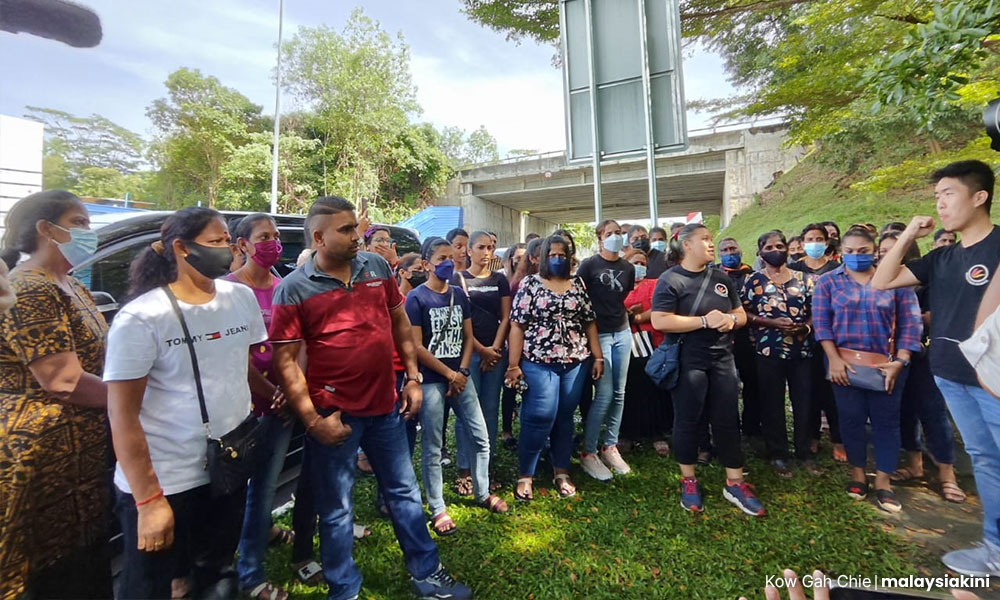
Three
families gathered at the Kajang prison on Dec 7 to find out why their
loved ones had been detained under Sosma for the past six months.
(Twitter pic)
KUALA LUMPUR: Home minister Saifuddin Nasution Ismail has indicated
that the government will not be reviewing the Security Offences (Special
Measures) Act 2012 (Sosma).
When asked by reporters whether Sosma would be reviewed, he defended
it by saying “the law allows the court process to take place”.
He said this was in contrast to the now-defunct Internal Security Act
(ISA), which allowed for detention without trial, and the emergency
ordinances (EO) which allowed for detention of up to 60 days.
“At
the end of the 28 days, there will only be two recommendations for the
detainee (under Sosma), which is either to charge them in court or to
free them,” he said at a press conference in Bukit Aman.
“People like to compare Sosma with other preventative laws, even though Sosma is not a preventative provision.”
He stressed that people were detained under Sosma following reliable
intelligence and evidence and it was for the sake of the country’s peace
and security.
“The root of Sosma is to ensure public safety,” he said.
In July, the Dewan Rakyat passed a five-year extension to a provision in Sosma that allowed for a 28-day pre-trial detention.
Sub-section
4(5) of Sosma, which enables police to detain a person suspected of
being involved in terrorist activities for a period not exceeding 28
days for investigations, was to have expired on July 31.
On Dec 7, more than 40 people from three families gathered at the
Kajang prison to find out why their loved ones had been detained under
Sosma for the past six months.
One of the family members, Abe Rameshwary, 42, said her husband and
four cousins were detained by the police on June 23, but she claimed
that the family was still in the dark as to why they were arrested.
Meanwhile, Tan Eng Huat said his brother had been detained under
Sosma since June 23, but he had not received any explanation from the
police or the home ministry. - FMT, 13/12/2022
Minister indicates no intention to review Sosma
Geraldine Tong
Published: Dec 13, 2022 2:54 PM
Home
Minister Saifuddin Nasution Ismail indicated that he has no intention
of reviewing the Security Offences (Special Measures) Act (Sosma).
He
defended Sosma saying the law allows the court process to take place,
unlike others like the now-defunct Internal Security Act (ISA) and
emergency ordinances (EO).
“People like to compare Sosma with other preventative laws, even though Sosma is not a preventative provision.
“For example, compared with the ISA or EOs (where someone can be held) of up to 60 days, Sosma is only 28 days.
“At the end of the 28 days, there are only two recommendations, that is to free them (detainees) or to charge them in court.
“If
they are brought to court, they can still have access to legal
services,” Saifuddin explained in a press conference at Bukit Aman
today.
He was making his first official visit to the police
headquarters today, where Saifuddin and his deputy Shamsul Anuar Nasarah
received a briefing from the inspector-general of police.
Saifuddin
said this in response to a question from a reporter on whether he would
review Sosma as well as the Independent Police Conduct Commission
(IPCC).
‘IPCC to take effect in June’
With regard to the IPCC, Saifuddin merely said it would take effect starting June next year.
Further
elaborating on Sosma, he said there are those who were arrested under
this law, who have since been released or won their cases in court with
the help of their legal counsels.
“Let us focus on the fact that not all Sosma detainees end up in jail because the process is being followed.
“If
in the end, after the 28 days of investigation and the court then
releases them, the police will comply with the decision,” he said.
Families of Sosma detainees gathered outside the Kajang Prison on Dec 7, urging the government to repeal Sosma
However,
Saifuddin stressed that arrests under Sosma were made on the basis of
reliable intelligence and evidence for the sake of the country’s peace
and security.
“I would like to repeat that when any arrest
is made, it is of course based on intelligence about any group or
activity that is seen to be dangerous or threatening to the safety of
the rakyat,” he said.
He also pointed out that under
the Federal Constitution, the government is empowered to enact
legislation, such as Sosma, which allows pre-trial detention.
Despite
Saifuddin’s assertion about Sosma only allowing an individual to be
detained for up to 28 days, there have been real-life examples that this
is not the case.
During a recent pre-trial case management involving 34 individuals detained under Sosma, family members of the detainees urged the new government to stop using the oppressive law.
Most
of the 34 men were detained under Sosma on June 23 this year, while the
remaining were nabbed soon after. They were later charged under Section
130(V)(1) of the Penal Code, which carries a jail term of up to 20
years upon conviction.
One of the detainees, a woman,
said she was upset that her husband has not been given a trial date
despite being in detention for nearly six months.
Back
in April this year, Saifuddin was reported back as saying that Pakatan
Harapan rejected the amendment to Section 4(5) of Sosma, which allows
the police to extend the 28 days period of detention. - Malaysiakini, 13/12/2022
SUHAKAM Must Be Independent, with the
Right To Inspect Police Lock-Ups Without Prior Notice, to investigate and
prosecute those who violate rights
Politicians Hasnal
Rezua Merican and Nazira Abdul Rahman must resign to protect the perception of the
independence of the Malaysian Human Rights Commission
SUHAKAM (Human Rights Commission of Malaysia)
now has the power to ‘(d) to visit places of detention in accordance with
procedures as prescribed by the laws relating to the places of detention
and to make necessary recommendations’ according to Section 4(2)(d) of Human
Rights Commission of Malaysia Act 1999. SUHAKAM chairman Rahmat Mohamad was reported
asking ‘…that Suhakam be given the power
to conduct unannounced visits to detention centers and prisons…’(FMT,
10/12/2022).
Prior Notice Allows for
Removal and Tampering of Evidence
Rightfully, SUHAKAM should have the right to
visit without prior notice any place of detention like police lock-ups,
Immigration Detention Centers and prisons. There should be no requirement to
comply with procedures relating to detention places sudden spot checks.
If a bad employer who have been illegally
holding on to passports of their migrant workers, gets prior information of the
visit of the Ministry of Human Resources or police to verify these allegations,
then the employer may ‘hide’ their crimes, maybe by returning passports to workers
and warning or threatening workers to deny such allegations failing which risk
retaliation. Hence, when the law enforcers do visit the site to determine
whether the allegations are true or otherwise, they will find no evidence.
Likewise, if SUHAKAM needs to inform first that
they will be visiting a police station and the lock-up, it is most likely that
when SUHAKAM do visit the site, they will not find it in the usual state.
Hence, the need to amend the law to make it clear that SUHAKAM Commissioners
and its officers can do sudden spot checks, without any requirement of any prior
notice to the Minister, the Head of the relevant law enforcement department or
others.
MADPET (Malaysians Against Death Penalty and
Torture) agrees that SUHAKAM must be given right to do spot checks or visits
without prior notification not just to places of detention, but also facilities
of law enforcement like police stations and/or any other private or public facilities
where SUHAKAM believes there may be a human rights violation.
Right to Investigate
and Prosecute
SUHAKAM must also be given the right to
investigate and prosecute wrongdoers, and not simply be limited to making
necessary recommendations. Even after SUHAKAM public inquiries concluded that
law enforcers like the police or others have been responsible for crimes, we
have not seen any needed follow up investigation and/or prosecution by the
police or even the Public Prosecutor, and as such it is important to bestow on
SUHAKAM the power to investigate and prosecute crimes, without the requirement
of any consent of the Public Prosecutor or the government.
Prime Minister power
to decide on SUHAKAM Commissioners must be removed
A major problem now is that the law says that ‘…the
members of the Commission shall be appointed by the Yang di-Pertuan Agong on the recommendation of the Prime
Minister…’, and there is a need to remove Prime Minister’s power in the
appointment of the Chairman and SUHAKAM Commissioners. It must be noted that
often the government and/or public officers are the alleged violators of human
rights, and, as such, it is best that the appointment of Commissioners be done
by an independent body – not the Prime Minister being head of government. Maybe
the Committee that the Prime Minister now need to consult before making recommendations
to the King ought to directly make the recommendations to the King with regard
to appointment of Commissioners, and this Committee composition itself also ought
not be determined by the Prime Minister.
Active Politicians
Should Not Be Human Rights Commissioners
SUHAKAM must be independent of the government,
and thus the Commissioners also should not include persons who are active in
parties that are part of the government or in the Opposition.
In the recent appointment of Commissioners that
happened in 1/7/2022 vide the announcement by the then Prime Minister (who was
then also a UMNO Vice President), several quarters have raised concern about
the appointment of the Selayang Umno chief Datuk Hasnal Rezua Merican Habib
Merican and the Kulim Umno women’s division chief Nazira Abdul Rahman as
SUHAKAM Commissioners.
UMNO is the dominant party in the Barisan
National, which was part of the coalition government at the time of the
appointment, and again now is a member of the current coalition government,
whereby the President of UMNO is now the Deputy Prime Minister.
Although Section 5 that does not specifically
say that active politicians cannot be appointed as SUHAKAM Commissioners,
section 11A(4) on the Committee to be consulted with regard to appointment,
states clearly that ‘The following persons shall not be appointed as members of
the committee … (a) any person who is actively involved in politics and
registered with any political party…’.
Thus, to ensure independence of the SUHAKAM
Commissioners, it would be best that no ‘…personis actively involved in politics and
registered with any political party…’ be appointed Commissioner, at least not those
that have held or is holding office in political parties.
MADPET is of the view that political party
members can be appointed as SUHAKAM Commissioners, but not those that have held
office in political parties in the past 3 years, or is currently holding
office.
Commissioners Hasnal
Rezua Merican and Nazira Abdul Rahman must resign
Is Hasnal Rezua Merican and Nazira Abdul Rahman, 2
of the 8 currently appointed Commissioners, still holding office or is active
in UMNO? If they are, it seriously jeopardizes the independence of SUHAKAM.
MADPET calls on Hasnal
Rezua Merican and Nazira Abdul Rahman to immediately resign for the sake of human rights and to
ensure that the perception that SUHAKAM is truly an independent human rights
commission, in compliance with the 1993 Paris Principles.
MADPET calls for a
truly independent and active Malaysian Human Rights Commission, that will uphold the cause of human
rights and justice without fear or favour, and will bravely act and speak out even when the violator of human rights is
the government, Minister or public officers.
Charles
Hector
For
and on behalf of MADPET (Malaysians Against Death Penalty and Torture)
Political will needed to empower Suhakam on human rights issues
Rahmat Mohamad said Suhakam should also be given the power to conduct unannounced visits to detention centres and prisons.
PETALING JAYA: Political will is needed if the government is to equip
human rights commission Suhakam with more power to promote and protect
human rights in the country.
Currently, Suhakam can only provide recommendations to the government about human rights issues.
“Perhaps it’s about time the government gave more power to Suhakam.
There must be trust on its part for this to materialise,” Suhakam
chairman Rahmat Mohamad told FMT in a recent interview in conjunction
with the United Nation’s Human Rights Day today.
“Will the government be comfortable (with giving more power to
Suhakam)? If the government is serious about maintaining human rights,
then some power must be given. (But) is the government ready to do so?”
Rahmat was also hopeful that Suhakam be given the power to conduct
unannounced visits to detention centres and prisons. He also wanted to
see Suhakam’s recommendations implemented, and justifications to be
provided if the proposals are rejected.
Separately, the former law professor suggested that the government
have a legal framework to identify various categories of undocumented
people in order to support any effort by the government in dealing with
them, including providing assistance.
“Not all of them are undocumented immigrants. For instance, there are economic migrants, asylum seekers, and refugees,” he said.
Rahmat also called for the new government to table and debate the annual Suhakam report in Parliament.
Suhakam wants to be given the power to conduct unannounced visits to detention centres and prisons. (Bernama pic)
“The report needs to be laid out in the Dewan Rakyat so that all 222
MPs are aware of the issue of human rights. It is only when it is
debated that they would know what action to take.
“Issues such as statelessness, citizenship, and cramped prisons need
to be debated. Otherwise, the report will only belong to the library,”
he said.
Rahmat added that it’s the responsibility of the government to
provide education and training to everyone, including the country’s
large Rohingya community.
“They are stuck here. If you train them and give them the right to
work in a certain sector such as plantation, I think a third country
will consider taking them,” he said.
However, he emphasised that the government must assure the public that such migrants are not here to steal their jobs.
The United Nations High Commissioner for Refugees (UNHCR) says Malaysia hosts some 181,000 refugees and asylum-seekers.
Around 85% are from Myanmar, including some 103,000 Rohingyas. The
remaining are from 50 other countries, including Pakistan, Yemen, Syria,
and Somalia. - FMT, 10/12/2022
New Suhakam commissioners have a lot of catching up to do ― Hafiz Hassan
Thursday, 11 Aug 2022 1:09 PM MYT
AUGUST
11 ― Newly minted Suhakam commissioner Ragunath Kesavan said on
Wednesday that there was no provision in the Human Rights Commission of
Malaysia (Suhakam) Act 1999 (Act 597) that prohibited individuals with
political ties from becoming a Suhakam commissioner.
The former Bar Council president was responding
to questions by reporters on recent criticisms, including from several
rights groups, who raised concerns about “controversial appointments”
that could compromise Suhakam’s work.
Among others who questioned
the appointments was rights group Suara Rakyat Malaysia (Suaram) who
claimed that the appointment of Selayang Umno chief Datuk Hasnal Rezua
Merican Habib Merican and Kulim Umno women’s division chief Nazira Abdul
Rahman would severely compromise the neutrality of the human rights
commission.
It’s true.
By section 5(3) of Act 597, a Suhakam commissioner “shall be appointed from amongst men and women of various religious, political and racial backgrounds who have knowledge of, or practical experience in, human rights matters.” (Emphasis added)
Ragunath
should know better. But as men and women “who have knowledge of, or
practical experience in, human rights matter”, he and his fellow
commissioners should know that Suhakam is one of more than 110 National
Human Rights Institutions (NHRIs) which are members of the Global
Alliance of National Human Rights Institutions (GANHRI).
GANHRI
brings together and supports national human rights institutions to
promote and protect human rights. It represents more than their members
and staff across all regions, GANHRI is one of the largest human rights
networks worldwide.
GANHRI
is recognised, and is a trusted partner, of the United Nations (UN). It
has established strong relationships with the UN Human Rights Office
and other UN agencies, as well as with other international and regional
organisations, NGOs, civil society and academia.
As members of
GANHRI, NHRIs like Suhakam are accredited by GANHRI. Accreditation takes
place under the rules of procedure of GANHRI’s Sub-Committee on
Accreditation (SCA).
The accreditation
is guided by the principles of transparency, rigour and independence.
There are currently two levels of accreditation: Status “A” and Status
“B.”
Status “A” NHRIs are in full compliance with the Paris
Principles – a set of international standards which frame and guide the
work of NHRIs. Drafted at an international NHRIs workshop in Paris in
1991, they were adopted by the UN General Assembly in 1993.
Status “B” NHRIs are only in partial compliance with the Principles.
Suhakam has been accredited with “A” status since November 2009 after being recommended a “B” status in April 2008.
NHRIs
are reviewed on a periodic basis every five years, with reviews focused
on recommendations. Last year, the SCA convened virtually from June 14
to 24 where it considered applications for re-accreditation from 8
NHRIs, including Malaysia.
In its report, the SCA has recommended
that Suhakam be re-accredited with A status. So well done Suhakam! The
SCA duly commends the efforts of Suhakam to promote and protect human
rights. The accreditation committee encourages Suhakam to continue these
efforts.
The SCA, however, highlights that NHRIs that have been
accredited A status, like Suhakam, should take reasonable steps to
enhance their effectiveness and independence, in line with the Paris
Principles and the notes and recommendations made by the SCA during the
review.
The SCA notes that section 5 of Act 597 (members of
Suhakam and term of office) still leaves open the potential for
political interference.
The SCA is of the view that the process
currently enshrined in Act 597 is not sufficiently broad and
transparent. In particular, it does not:
― require the advertisement of vacancies;
― establish clear and uniform criteria upon which the Selection Committee assesses the merit of applicants; and
― promote broad consultation and/or participation in the application, screening, selection and appointment process.
According
to the SCA, it is “critically important to ensure the formalization of a
clear, transparent and participatory selection and appointment process
for an NHRI’s decision-making body in relevant legislation, regulations
or binding administrative guidelines, as appropriate. A process that
promotes merit-based selection and ensures pluralism is necessary to
ensure the independence of, and public confidence in, the senior
leadership of an NHRI.”
As such, the SCA encourages Suhakam to
advocate for the formalisation and application of a process which are in
accordance with the Paris Principles that includes requirements to:
a) Publicise vacancies broadly;
b) Maximise the number of potential candidates from a wide range of societal groups and educational qualifications;
c) Promote broad consultation and / or participation in the application, screening, selection and appointment process;
d) Assess applicants on the basis of pre-determined, objective and publicly-available criteria; and
e) Select members to serve in their individual capacity rather than on behalf of the organisation they represent.
That
said, the SCA duly also acknowledges the amendments prepared by Suhakam
to its enabling law (Act 597) to address the above concerns and
encourages the Commission to continue to advocate for the adoption of
those amendments.
There are five other recommendations to Suhakam
regarding full-time commissioners, adequate funding, cooperation with
other human rights bodies, annual and special reports, and dismissal of
commissioners. The report can be read here.
The
new line-up of Suhakam commissioners has appealed to the public to
allow them time to do their jobs. But time is what we want most, but
what we use worst. (A quote attributed to William Penn, an English real
estate entrepreneur, philosopher, and founder of the Province of
Pennsylvania.)
Since the commissioners are not full-time members
as the SCA report noted, two months is a long time gone that can never
be gotten back.
There is a lot of catching up to do for the new
commissioners to continue and follow up with the commendable work of
their predecessors. - Malay Mail, 11/8/2022