Wednesday, January 17, 2007

Malaysiakini: Going 'Madd' over discrimination

Going 'Madd' over discrimination
Andrew Ong
Jan 17, 07 3:10pm

Spurred by recent events, a new coalition has been formed with the aim of ending discrimination against the disabled community.

Comprising 12 groups, the Malaysian Coalition Against Discrimination of the Disabled or Madd wants the government to facilitate anti-discrimination and equal opportunity laws.

“Madd was formed due to the realisation among NGOs and activists that there is a complete lack of sensitivity on the part of the authorities towards the needs of the disabled,” the coalition’s legal advisor N Surendran told a press conference in Kuala Lumpur today.

The most recent incident which had caused an outrage was the alleged mistreatment of 36-year-old petty trader and father of four Murugan Rajoo by Selayang Municipal Council (MPS) officers.
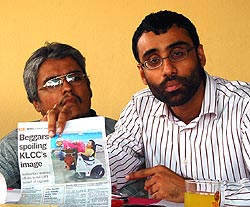
MPS officers had seized his possessions for trading without a license on Jan 5. He and several disabled activists were later allegedly confined for an hour at the MPS Rawang branch when they attempted to reclaim the possessions.

Last Monday, several disabled groups tried to submit a memorandum of protest on the matter to MPS president Zainal Abidin Azim but the latter had insisted that they come up to see him on the ninth floor.

He later told reporters that his enforcement department and the police are investigating the allegations and would make an official statement on the matter in due time.

“The MPS president was neither apologetic nor remorseful. And even after police reports were lodged, no statements have been recorded (from Murugan and his friends),” Surendran said.

Attitude change

Anthony Thanasayan, a wheelchair-bound activist and newspaper columnist, said the lack of action taken against MPS showed that the government consented to the council’s treatment of the disabled.

“The authorities should be protecting us and be approachable. Instead, we are subject to their (alleged) abuse just because we are disabled,” he said.

Thanasayan said the key to making society more inclusive for the disabled community lied within the attitude of the authorities.

“You (the authorities) can’t just provide disabled friendly facilities when your attitude is hostile towards us [...] We held a big showcase of the Fespic Games (2006) but the authorities do not show support for their local disabled groups,” he added.

Madd also demanded that the government initiate a special commission to look into the laws and other issues deemed discriminatory to the disabled.

The coalition also called for the enactment of the Persons with Disabilities Act similar to those found in India and Australia.

Asked on the next course of action for the coalition, Thanasayan said the demands have been made out and the ball was now in the government’s court.


(MADPET is a member of Malaysian Coalition Against Discrimination of the Disabled (MADD))

Thursday, January 11, 2007

Human rights violated in Simpang Renggam (Malaysiakini)

Human rights violated in Simpang Renggam
Andrew Ong
Jan 11, 07 2:02pm


Human Rights Commission of Malaysia (Suhakam) commissioner N Siva Subramaniam is certain that human rights and prison rules were violated during a fracas at the Simpang Renggam detention centre in Johor last week.

Siva had visited the centre on Monday following complaints of physical abuse by wardens on the inmates. He interviewed some 40 inmates regarding the Jan 3 incident.

“While they (the prison authorities) might have reasons to justify the onslaught on unarmed prisoners, (I believe) they have no reason to justify the violation of basic human rights,” he said when contacted yesterday.

The commissioner said he saw the physical evidence of beatings on several of the detainees.

“In my opinion, we should hold a public inquiry on the matter. But its up to Suhakam to decide on Monday after I table my report on the visit,” he added.

There has been no official account of the incident. According to news reports, 16 inmates were given outpatient treatment at the Kluang hospital.

One inmate, who contacted malaysiakini shortly after the incident, claimed that ratan canes and batons were used to beat inmates after they were made to squat on the floor.

Appalling conditions

Based on his findings, Siva said an argument between an inmate and warden led the latter to raise the alarm.

Following this, the Prison Safety Unit (UKP) stormed in and began assaulting the inmates.

“What surprised even more was when I was told that prison officers were shouting at the UKP to stop (the beatings), but they didn’t,” said Siva, a former unionist turned Suhakam commissioner.

The commissioner said he was saddened to learn that several inmates were afraid to seek medical treatment for their injuries for fear of reprisals such as as solitary confinement.

He also pointed out that Simpang Renggam is highly unsanitary and many inmates were suffering from skin diseases and inactivity.

“They are not asking for a five-star hotel. They just want to be treated like decent human beings and also be given medical attention. If not, what rehabilitation are we talking about?” he added.

Meanwhile, human rights watchdog Suaram yesterday submitted a letter to Suhakam chairperson Abu Talib Othman, urging him to conduct a public inquiry into the matter.

“Suhakam is the right body because they are entrusted to defend and promote human rights. Hence, they are duty bound to conduct this public inquiry to ascertain who are the perpetrators and propose how it can be avoided in the future,” said Suaram executive director Yap Swee Seng.

The detention centre holds some 4,000 inmates detained without trial under the Emergency Ordinance 1969 and the Dangerous Drugs (Special Preventive Measures) Act 1985.

Wednesday, January 10, 2007

Disabled: Come down! MPS president: Come up!

Disabled: Come down! MPS president: Come up!
Andrew Ong (Malaysiakini)
Jan 10, 07 5:14pm

About 30 disabled people, some wheelchair-bound, waited in vain for nearly an hour outside the Selayang Municipal Council (MPS) building to meet council president Zainal Abidin Azim today.

They wanted to submit a memorandum to Zainal in the lobby but he insisted that they come up to his office on the ninth floor.

The group refused and waited from 11am to nearly noon but the president did not show up.

Led by Independent Living and Training Centre (ITLS) secretary Gurdip Kaur, they chanted slogans such as ‘MPS oppresses the disabled’ and ‘MPS does not understand the disabled’.

They wanted to meet Zainal to air their grievances over an incident last Friday where council officers had allegedly ill-treated disabled petty trader Murugan Rajoo, 36.

After several rounds of negotiations with Zainal’s aide, Murugan’s lawyer N Surendran told the group that there was a stalemate and there will be no meeting with the council president.

Speaking to reporters later, Surendran said he was disappointed that Zainal did not come down to meet the group.

“He (Zainal) made the ridiculous suggestion of having these people go up to see him. This shows the core problem that council officers, including the president, are insensitive to the needs of the disabled,” he said.

Among the protestors was former TV3 personality Ras Adiba Radzi (right), who has been confined to a wheelchair after a mishap.

Special committees

Anthony Thanasayan, a wheelchair-bound activist, said Zainal’s action this morning rendered MPS’ drive to make the district more disabled friendly meaningless.

“There is no point in making ramps (for us) on the outside, but inside (the council) their (negative) attitude towards the disabled is still the same. Maybe he (Zainal) would understand when he becomes disabled,” he added.

Thanasayan also urged all local authorities to form special committees that includes disabled groups to look into the needs of the disabled and the elderly.

Last Thursday, Murugan (centre) had his motorcycle-cum-stall seized by MPS officers for trading without a licence and was left stranded by the roadside.

Subsequently he and several ILTS members tried to reclaim his possessions at the MPS Rawang branch.

Following this, Murugan and his friends claimed they were illegally confined by MPS officers for an hour while he was not allowed to use the toilet and forced to urinate in his pants, in front of others.

MPS councillor MB Raja returned Murugan his possessions later that evening. Murugan maintains that he had tried in vain to apply for a trading licence for the past three years but became a petty trader to support his wife and four children.

According to Surendran, illegal confinement is a criminal offence under Section 340 of the Penal Code.

Under investigation

Meanwhile, Zainal told a press conference this afternoon that the incident is being investigated by the police and MPS.

Asked if the officers involved are still on active duty, he said: “I told (the enforcement director), if he had investigated and found a breach in procedure, he has to take action. If not, they (the officers) can continue.”

As to why he did not meet the group at the lobby and settle the matter amicably, Zainal said the building is accessible for the group and the meeting room is more conducive to hold discussions.

“In the first place, they wanted to see me. Like now you (reporters) want to interview me, I don’t have to go to the Bernama (office) right?

“Even if you are disabled, you must be sincere. If you want to give a genuine memorandum, you can come. You don’t have to bring lawyers or posters, that is if you genuinely want to address an issue,” he added.

Asked if he was accusing the group of being insincere, he replied: “I’m not saying that. You (journalists) have to observe yourself.”

(MADPET was part of this action and was represented by Mr N. Surendran)

Thursday, January 04, 2007

Video of Saddam Hussein being executed

Originally posted as a link on the Malaysian Bar website. MADPET is against the Death Penalty and condemns the hanging of Saddam Hussein. MADPET calls for the immediate abolition of the death penalty

Monday, January 01, 2007

Saddam Hussein's execution a public murder, says Dr Mahathir

Saddam Hussein's execution a public murder, says Dr Mahathir
Monday, 01 January 2007, 17:31
• NST Editorial: Death of a despot

KUALA LUMPUR, Jan 1 (Bernama) -- Barbaric, sadistic and a public murder -- this was how former prime minister Tun Dr Mahathir Mohamad described Saturday's execution of deposed Iraqi president Saddam Hussein.

In a strongly-worded statement here Monday, Dr Mahathir said the execution was sanctioned by U.S. president George W. Bush and British prime minister Tony Blair, whom he labelled as war criminals.

He said the sadistic act of broadcasting the execution to the whole world was a travesty of justice and meant to demonstrate the imperial power of the United States and served as a warning to peace loving people that they must either bow to the dictates of the Bush administration or face the consequences of a public lynching.

Dr Mahathir, who is a member of International Committee for the Defence of Saddam, said the former president's lynching was also an insult to all Muslims as it occurred on the Holy Day of Eid when Muslims devote themselves to prayer and forgiveness.

"It is all too clear that the war criminal Bush has no sensitivities whatsoever for Muslims on their pilgrimage to Mecca. This barbaric act is a sacrilege," he said.

He said Saddam's entire trial process was a mockery of justice in no less a Kangaroo Court.

"Defence counsels were brutally murdered, witnesses threatened and judges removed for being impartial and replaced by puppet judges. Yet, we are told that Iraq was invaded to promote democracy, freedom and justice.

Dr Mahathir, a vocal opponent of the U.S-led invasion of Iraq in 2003 when he was prime minister, said what happened now was that a peaceful country had been turned into a war zone.

Over 500,000 children died as a result of economic sanctions, and the latest findings by the medical journal, Lancet revealed that over 650,000 Iraqis had died since the illegal invasion.

He also accused Bush of killing more Iraqis than President Saddam ever did.

"If President Saddam Hussein is guilty of war crimes, then the world must find Bush, Blair and John Howard (Australian prime minister) equally guilty and the International Criminal Court cannot but prosecute these war criminals," he said. He said the inaction thus far by the International Criminal Court against Bush, Blair and Howard exposed its double standard when it did not hesitate to prosecute war crimes committed in Darfur, Rwanda and Kosovo.

"If we support human rights and justice, we must condemn this barbaric lynching of Saddam Hussein.

"There can be no excuse whatsoever for this injustice under any circumstances. Bush and the puppet regime in Iraq have made a mockery of the rule of law," he said.


--------------------------------------------------------------------------------

Press Statement: The Barbaric Lynching of President Saddam Hussein
by Tun Dr. Mahathir Mohamad

On the Holy day of Eid, the world watched in horror at the barbaric lynching of President Saddam Hussein of Iraq, allegedly for crimes against humanity. This public murder was sanctioned by the War Criminals, President Bush and Prime Minister Blair.

This sadistic act broadcasted to the whole world is a travesty of justice, and was meant to demonstrate the imperial power of the United States and serves as a warning to peace loving peoples that we must either bow to the dictates of the Bush regime or face the consequences of a public lynching.

The lynching was also an insult to all Muslims, as it occurred on the Holy Day of Eid, whereby Muslims devote themselves to prayer and forgiveness. It is all too clear that the war criminal Bush has no sensitivities whatsoever for Muslims on their pilgrimage to Mecca. This barbaric act is a sacrilege!

The entire trial process was a mockery of justice, no less a Kangaroo Court. Defence counsels were brutally murdered, witnesses threatened and judges removed for being impartial and replaced by puppet judges. Yet, we are told that Iraq was invaded to promote democracy, freedom and justice.

A peaceful country has now been turned into a war zone. Over 500,000 children died as a result of the criminal economic sanctions, and the latest findings by the medical journal, Lancet reveals that over 650,000 Iraqis have died since the illegal invasion of 2003.

The War Criminal Bush has killed more Iraqis than President Saddam ever did, if in fact he was guilty of any crime. If President Saddam Hussein is guilty of war crimes, then the world must find Bush, Blair and Howard equally guilty and the International Criminal Court cannot but prosecute these war criminals. The inaction thus far by the International Criminal Court against Bush, Blair and Howard exposes the double standard of the said Court, when it does not hesitate to prosecute war crimes committed in Dalfur, Rwanda and Kosovo.

If we support human rights and justice, we must condemn this barbaric lynching of President Saddam Hussein. There can be no excuse whatsoever for this injustice under any circumstances. War Criminal Bush and the puppet regime in Iraq have made a mockery of the Rule of Law.


Tun Dr. Mahathir Mohamad,
Former Prime Minister of Malaysia,
Member of the International Committee, For the Defence of President Saddam Hussein,

30th December 2006

Friday, December 22, 2006

CIPFG Asia Urges Open Investigation on the persecution of Falun Gong in China

Vice Team Leader of CIPFG Asia Urges Open Investigation
Epoch Times Malaysia Staff Dec 21, 2006

KUALA LUMPUR–In a press conference held in Kuala Lumpur on December 19, Edmund Bon, vice team leader of Coalition to Investigate the Persecution of Falun Gong (CIPFG) Asia (Malaysia), requested the Chinese Communist Party (CCP) to allow CIPFG Asia to have investigation without restriction on the persecution of Falun Gong in China.

The Coalition to Investigate the Persecution of Falun Gong Asia Delegation was officially formed on December 10, 2006, the International Human Rights Day. According to CIPFG Asia, there are over 116 members to date in the coalition, including local council leaders, administrative leaders, non-governmental leaders, figures from human rights circles, law, medicine, professionals, and media from six countries/regions in Asia.

CIPFG Asia is headed by Dr. Lai Ching-te, who is a member of the Taiwan Legislative Council and a doctor. Individuals in law and political circles in Japan, Korea, Hong Kong, Macau and Malaysia were appointed as vice team leaders in each country/region. All the six countries/regions held a press conference in their respective regions simultaneously on December 19 to inform the public on the formation of CIPFG Asia.

Malaysia is so far the first South East Asia country to have members joining the coalition. According to lawyer Mr. Edmund Bon, CIPFG Asia in Malaysia consists of several lawyers and an NGO, Malaysians Against Death Penalty and Torture (MADPET). The team will invite other regions in Asia to join and expand the coalition.

Lawyer Edmund Bon (The Epoch Times)"This Coalition was setup as part of the international effort to continue the pressure on the Chinese government, because it is quite clear from the evidence and documents, including the United Nation reports, which we have come to know that thousands of Falun Gong practitioner in China are being persecuted for their freedom of belief, expression, and conscious," said Edmund Bon in the press conference.

"The Chinese government should respect the basic rights of the Chinese people declared under the Universal of Declaration of Human Right and International Covenant on Civil and Political Rights and also to really open up all the detention centers, prisons and rehabilitation camps to allow UN staffs, members within and outside China to be able to access to prisoners of conscience who have made the allegations about inhuman torture and illegal treatments," Edmund said.

Edmund Bon also urged the CCP to answer the Canadian independent investigation report which was released on July 6 this year. The investigation report was authored by Mr. Kilgour, a former MP and cabinet member of Canada, and Mr. Matas, a renowned international human rights lawyer. The investigation report concluded the allegations of living organ harvesting of the Falun Gong practitioners by the CCP are true, with the support of 18 proof and disproof.

"Up to this point in time, we have not seen any reply from the CCP to the investigation report. What I think the allegations on the report are serious and we want further investigation," said Edmun Bon.


After the press conference, Edmund Bon together with another CIPFG Asia team member and lawyer Miss Chen Mei Shang went to the Chinese embassy to submit a letter requesting for open investigation into China. The Chinese embassy accepted the letter. About 15 Falun Gong practitioners also showed up to voice their support to the CIPFG Asia by displaying slogans and banners outside the embassy.

The letter to the embassy and the CCP consists of 2 requests:

Falun Gong practitioners support the formation of CIPFG Asia outside the Chinese embassy. (The Epoch Times)1) Follow the Universal Declaration of Human Rights to protect the human rights and enforce the recommendations stated in the Kilgour-Matas Report, i.e. to stop all mistreatments and repression on Falun Gong practitioners; to stop organ harvesting from executed prisoners, and to stop commercialization of organ transplants.

2) Allow CIPFG Asia to have investigation without restriction into all the prisons, forced labor camps, detention centers, mental hospitals, organ transplant hospitals (including organ transplant centres and military hospitals) in Liaoning, Shandong, Henan provinces and Tianjin City which detain Falun Gong practitioners. CIPFG Asia requests to the Chinese government to announce the records of the source of organs and the agreements of the donors to CIPFG Asia and the public.

Wednesday, November 22, 2006

4 from Saudi, Africa caught in Malaysia drugs haul(AFP)


4 from Saudi, Africa caught in Malaysia drugs haul
(AFP)

22 November 2006


KUALA LUMPUR - Four students from Africa and Saudi Arabia, including two women, could face the death penalty after being nabbed by Malaysian police with marijuana, officials said Wednesday.

“They were arrested in a special operation last weekend by our district police narcotics officers,” said Zahedi Ayob, district police chief of Sepang, south of the capital, Kuala Lumpur.

“We have evidence to charge them with drug trafficking, as they had a huge amount of drugs in their possession,” he told AFP.

The four students — two Kenyan women, one man from Eritrea and another man from Saudi Arabia — were arrested at their apartment in the town of Cyberjaya at the weekend.

Zahedi said the four, aged between 18 and 22, were students from a nearby higher learning institution, adding they were arrested after a tip-off.

They were being detained until Friday, when an investigation into their case would be concluded, and were then expected to be formally charged, he said.

Zahedi said narcotics officers found four slabs of marijuana and various small plastic packets of the drug during the arrests, adding the total weight of the drugs seized was about four kilograms (nine pounds) with an estimated street value of about 7,200 ringgit (1,982 dollars).

“We are investigating where they got their supply from, how they came into possession of such a large amount of drugs, and what it was intended for,” Zahedi said.

Malaysian laws set a mandatory death sentence for anyone caught with 200 grams or more of marijuana.

More than 100 people, a third of them foreigners, have been hanged for drug offences in Malaysia since the law was introduced in 1981, but the lucrative drug trade continues to lure traffickers.

Tuesday, October 10, 2006

WORLD DAY FOR THE ABOLITION OF THE DEATH PENALTY

WORLD DAY FOR THE ABOLITION OF THE DEATH PENALTY
LAUNCH OF ADPAN
SEOUL, 10 OCTOBER 2006
Statement by Purna Sen,
Director, Asia-Pacific Programme, Amnesty International


The death penalty is the ultimate cruel, inhuman and degrading punishment. It violates the right to life. It is irrevocable. It can be and has been inflicted on the innocent. To move towards a world where human rights are protected and respected those counties that still execute must abolish this penalty. A world where human rights are real is a world without executions. What will be Asia’s part in this journey? What will be said of South Korea?

We meet today on the occasion of the World Day Against the Death Penalty, the fourth of its kind, called by the World Coalition against the Death Penalty. This grouping of lawyers, NGOs including Amnesty International, trade unions, local governments from across the world, is an important umbrella for work to abolish the death penalty. Last year saw 263 actions all over the world on 10 October. This year we bring an added dimension to the power of this global call with a focus on Asia and the Pacific, through the launch of the Anti-Death Penalty Asia Network (ADPAN). This network brings together voices of those fighting for human rights and against the death penalty across various countries in this region.

Trend towards abolition
In April 2006 Amnesty International estimated that 20000 people were on death row throughout the world. They wait to be killed by their own governments. Despite the shocking figures, the trend towards abolition is clear: the number of countries carrying out executions halved in the last 20 years and has dropped for the fourth consecutive year.

Progress towards global abolition has been dramatic. In 1977, just 16 countries had abolished capital punishment for all crimes. Today the figure stands at 88:
• 88 countries and territories have abolished the death penalty for all crimes;
• 11 countries have abolished the death penalty for all but exceptional crimes such as wartime crimes;
• 30 countries can be considered abolitionist in practice: they retain the death penalty in law but have not carried out any executions for at least the previous 10 years and are believed to have a policy or established practice of not carrying out executions,
This is a total of 129 countries which have abolished the death penalty in law or practice.

Asia
In Asia this trend towards abolition has not been as strong or clear as in the rest of the world. In fact, it could be said that Asia has bucked this trend

The region contains countries with high rates of executions and rare prospects of abolition. Several Asian countries, including Japan, China, Singapore and Indonesia, appear to be staunch supporters of capital punishment. In 2005, China was one of four countries in which 94 per cent of all known executions took place (the others were Iran, Saudi Arabia and the USA) and has the dubious ‘honour’ of being the country with the highest number of executions in the world. In China a person can be sentenced and executed for as many as 68 crimes, including non-violent crimes such as tax fraud, embezzlement and drug offences.

After fifteen months with no executions, Indonesia reaffirmed its preference for executions, with the killing of three men in September 2006. India has announced an October execution date after two years of no state killings (the date has since been postponed). Singapore continues to execute, despite high levels of concern and appeals for clemency from across the world; the state has killed 420 people since 1991. Hanging, shooting, lethal injection and stoning are methods used in Asia to carry out the death penalty.

It is in this context that today we are launching ADPAN – a network of local, Asian voices against the death penalty working together towards a region without state executions. The Anti-Death Penalty Asia Network (ADPAN) brings together 21 members from twelve countries and will campaign against the injustice inherent in the administration of the death penalty in Asia and the Pacific. Today’s launch is marked by a range of activities across the region. These include
 A public outreach action to raise awareness of the death penalty in various countries
 The launch of a national coalition against the death penalty in Indonesia, that will be marked by a candlelight vigil
 A pubic education activity day in Hong Kong
 A demonstration outside Bankwang prison in Thailand, at which messages from prisoners on death row will be shared
 Website blogs against the death penalty in Malaysia and Australia
 As part of ADPAN, Amnesty International will launch a website today where ADPAN members talk about the death penalty in their countries and where other regional information is available
 In the light of the President’s stated goal of ‘zero executions’ Amnesty International has also written to the Taiwanese government, on the occasion of their national day and the world day against the death penalty, to urge abolition.

Asia is indeed a diverse region but moves against the death penalty are increasingly united, as ADPAN demonstrates. We also note, with great pleasure, the recent abolition of the death penalty in the Philippines and congratulate the government for taking this step. Such leadership in the region is very welcome and increases the number of abolitionist countries, to include Nepal, Bhutan, Samoa, Australia and New Zealand, Cambodia, Micronesia, Solomon Islands, Timor-L’este. The work to win abolition in more Asian and Pacific countries will continue and will learn from the examples set by those countries that have lead the way.

Secrecy and doubt surround the death penalty in Asia. Many governments, like China, refuse to publish full official statistics on executions while Viet Nam has even classified statistics and reporting on the death penalty as a 'state secret'. Statistics on executions and prisoners on death row are very hard to elicit from the Indian government. If the claim that the death penalty is a deterrent to crime surely governments would be making them public: how often they execute and for what crimes. The absence of transparency, however, suggests shame; secrecy indicates that the state has something to hide and robs the people of the chance to see what their governments are doing and to hold them to account.

Crime and the death penalty
The death penalty is not the unique or powerful deterrent against crime it is often claimed to be. Instead of relying on the illusion of control given by the death penalty, governments must focus on developing effective measures against crime.

Studies have consistently failed to find convincing evidence that the death penalty deters crime more effectively than other punishments. Reviewing the evidence on the relation between changes in the use of the death penalty and homicide rates, a study conducted for the United Nations in 1988 and updated in 2002 concluded that fears of sudden increases in crime rates as a consequence of abolition are not supported by statistics.

Crime figures from abolitionist countries fail to show that abolition has harmful effects. In Canada, for example, the homicide rate per 100,000 population fell from a peak of 3.09 in 1975, the year before the abolition of the death penalty for murder, to 2.41 in 1980, and since then it has declined further. In 2003, 27 years after abolition, the homicide rate was 1.73 per 100,000 population, 44 per cent lower than in 1975 and the lowest rate in three decades.

It is not the death penalty that inhibits crime but the knowledge that an effective and prompt criminal justice system will investigate and prosecute crime. This is what states must deliver as an effective element of crime reduction strategies; a reliance on the death penalty is not a substitute.

Use of the death penalty today is a failure of justice and a dangerous conclusion to trial processes that are deeply flawed. The death penalty is an irreversible act – a cruel and inhuman punishment indeed. But where the criminal justice process that preceeds state execution is itself flawed the penalty becomes even more indefensible. Allegations of torture and reliance on confessions make convictions questionable and have featured in death penalty cases in Asian countries. The alleged murder victims in cases where the accused have been executed have even re-emerged, sometimes after the execution of the so-called murderer.

South Korea
ADPAN held its inaugural meeting July 2006 and decided that an appropriate launch would be in South Korea, where the potential for an impressive step lies in the hands of the present government. By launching in Seoul, ADPAN draws attention today to the Special Bill to abolish the death penalty, introduced in 2004 and still awaiting its review by the Legal and Judiciary Committee of the National Assembly. South Korea has strengthened its human rights work in the Ministry of Justice, has introduced the language of human rights into public discussion and most likely will provide the next Secretary-General of the United Nations. The eyes of the world are upon this country: will South Korea now deliver on the promises it has made to human rights by showing leadership on that most basic right – the right to life – by abolition of the death penalty? Or will it remain among those countries whose names are shamefully associated with the unjust and outdated practice of the death penalty?

Since the mass state execution of 23 people in December 1997, South Korea has not carried out further executions; 64 people remain on death row. The 15th and 16th National Assemblies considered Special Bills to abolish the death penalty but parliamentary time for debate lapsed before discussion had progressed. The National Assembly again showed in 2005 the strength in this country of the pro-abolition voice. ADPAN calls upon the government, upon the National Assembly, to demonstrate a leadership role in Asia by ending the death penalty not only in practice but in law. Courageous steps have been already been taken; this opportunity cannot be wasted. South Korea must show itself to be a nation progressing towards the full protection of human rights by legal abolition of the death penalty.


Relevant websites:
www.amnesty.org
http://asiapacific.amnesty.org
http://asiadeathpenalty.blogspot.com/2006/07/malaysias-inexcusable-position-on.html
http://www.amnesty.org.au/Act_now/campaigns/adp

Monday, September 11, 2006

Malaysia would not abolish the death penalty as it served as a ‘good deterrent’?


Dr M attacked in death penalty debate
Beh Lih Yi
Sep 11, 06 4:10pm

Minister in the Prime Minister’s Department Mohd Nazri Abdul Aziz appears to be using every opportunity that arises to criticise former premier Dr Mahathir Mohamad.

This was apparent during the question and answer session in the Dewan Rakyat today, where Karpal Singh (DAP-Bukit Gelugor) became collateral damage in the attack.

The minister used the death penalty issue to draw a comparison between Mahathir and his successor Abdullah Ahmad Badawi.

It started when Karpal
asked if the government would review using the death penalty since Nazri had supported calls for its abolishment recently.

Explaining that it was his personal stand, the minister said: “Regarding my statement, I am free to give my views in this more open administration but I will have to adhere to the government’s final decision, this is democracy.

“Maybe (Karpal) is still trapped in the time when his ‘mentor’ was the prime minister,” he added in an obvious reference to Mahathir.

Nazri once again attacked Mahathir when Karpal, in a supplementary question, asked why the minister breached the cabinet’s spirit of collective responsibility by supporting calls to abolish the death penalty.

“You (Karpal) are not a minister. I comply to whatever final decision which is made by the government, not like your mentor (Mahathir), after the cabinet makes a decision (he) still makes noise,” he said.

Nazri has been Mahathir’s strongest critic since the 81-year-old former premier launched an offensive against the current administration.

On one occasion, the minister even challenged Mahathir to “be a man and resign from Umno”.

Good deterrent

Earlier, Nazri said
Malaysia would not abolish the death penalty as it served as a ‘good deterrent’ to hardcore crimes..

“It (the death penalty) has to be maintained to show the government’s determination and seriousness in fighting heavy crimes,” he added
.

Citing an example, the minister said the police’s surprise announcement last week to slash traffic fines led to the perception that the police was not serious in combating such offences. The cabinet later reversed the decision.

Nazri, who is also the defacto law minister, said there were enough ‘safeguards’ in the legal system to ensure a death penalty would not be simply handed down.

In his supplementary question, Karpal said
there was no proof that the death penalty served as a good deterrent but the minister disagreed.

“Murders still happen even though we have the death penalty in place at the moment, try to imagine when there is no death penalty?” he argued.

The Malaysian Bar, which represents some 12,000 lawyers, had passed a resolution during its annual general meeting in March calling for the death penalty to be abolished and for a moratorium on all executions.

Malaysia remains one of the 74 countries yet to abolish capital punishment while 123 other countries have done so.

Saturday, August 05, 2006

Al-Ma’unah leader Mohd Amin hanged


Saturday August 5, 2006


Al-Ma’unah leader Mohd Amin hanged

KUALA KANGSAR: Mohd Amin Mohd Razali, the Al-Ma’unah movement leader who was sentenced to death for treason, had a last meal with his wife and four children on Thursday night before he was hanged yesterday morning.

Mohd Amin: His last words to his children were to study hard and become religious teachers
The death penalty was carried out at the Sungai Buloh Prison in Selangor. His body was returned to his hometown of Kampung Ngor near here and buried after asar prayers at about 5.30pm.

Mohd Amin’s wife Salamiah Sallehuddin, 35, said the prison authorities allowed her and the children to see him.

“We met as a family last night (Thursday) and even managed to eat together,” she said.

Mohd Amin’s last words to his children were to study hard and become religious teache
rs, she said.

Mohd Amin was supposed to be hanged last week together with three others – Zahid Muslim, Jemari Jusoh and Jamaludin Darus – but the prison authorities deferred his execution, pending the return of his mother Aminah Abdullah, 62, who was in Mecca to perform the umrah (pilgrimage).

LAST RITES: Salamiah pouring scented water over the grave of her husband in his hometown of Kampung Ngor near Kuala Kangsar yesterday. Beside her are their daughter Nor Fatihah, 11, son Muhamad Azhan, nine, and relatives.

According to Mohd Amin’s brother Abdul Rahim, his mother managed to see Mohd Amin before the execution yesterday morning.

http://thestar.com.my/news/story.asp?file=/2006/8/5/nation/15061095&sec=nation

Friday, August 04, 2006

4 Hanged in Malaysia in July & August 2006

August 04, 2006, Western Resistance

Malaysia: Islamist Cult Leader Is Hanged

The man pictured left is 35-year old Mohammed Amin Mohammed Razali, the leader of a jihadist cult which kidnapped and killed. Razali was hanged early this morning in west Selangor state, Malaysia, for treason, states Radio Australia and the Malaysia Star.

Razali had tried to overthrow the government of Mahathir Mohammad in July 2000, and had planned to dethrone Malaysia's king. His group was called Al-Ma'unah, or The Brotherhood of Inner Life. Last week, Razali was due to be hanged, but a dispensation had been made to give his 62-year old mother, who was in Mecca on umrah, time to return to see her son before the execution.

Last week, Zahid Muslim, Jemari Jusoh and Jamaludin Darus were hanged at Sungai Buloh Prison, Selangor.

On Thursday night, Razali was allowed to have a meal with his 35-year old wife, and their four children. He told the children to study hard and become religious teachers.

This morning, his mother was allowed to see him, and then he was hanged. His body was later given to the family, who took it back to his hometown of Kampung Ngor, near Kuala Kangsar, in northwestern Perak state, where he was buried at 5.30 pm local time.

The attempted coup in July 2, 2000 included a surprise attack upon two armouries in Perak, where, disguised as soldiers, the group stole 100 rifles. A day later, a villager discovered their jungle camp, and police gathered. Two policemen, an army ranger and an orchard owner were kidnapped, and one member of Al Ma'unah was shot dead. Wives and children of the group had been ferried in to try to negotiate a surrender, and on July 6, two members had surrendered. At the end of the day, the remaining 25 had turned themselves in.

The bodies of two of the hostages were discovered, tortured to death long before the surrender. The dead men were an undercover police officer and the army ranger.

On its website, the group had claimed that it had been founded in 1998, and that it had 1,000 members in various countries, including Brunei, Singapore, Egypt and Saudi Arabia.

They claimed that they could make enemies be hurled back without touching them, and also claimed they were invulnerable to weapons, fire or sharp objects. They also asserted that they could tie up enemies without rope. They said they could cause their enemies to "drop to their knees or fall down with the blink of an eye."

The website had images of group members being burned, scalded with boiling oil, and logs rolled over their chests. Razali, the site claimed, had received enlightenment after spending five years studying the paranormal in a hut in Indonesia.

The group asserted that it was "involved in the teaching of martial arts, particularly the development of one's inner power and the practice of Islamic traditional medicine."

Their slogan on the site had been: "Jihad is our way! Islam will be victorious!"

After the surrenders and arrests, Malaysia's chief of police, Norian Mai, had described Razali as mentally "unstable".

Wednesday, July 19, 2006

SUN: Govt's faith in death penalty defies facts

Govt's faith in death penalty defies facts
By: (Fri, 14 Jul 2006)

Malaysians Against Death Penalty and Torture (Madpet) is disappointed by the statement made by Deputy Minister in the Prime Minister's Department Datuk M. Kayveas who told Parliament last month that the death penalty deters serious crimes. This statement, reported by Bernama on June 28, cannot be justified by any facts or statistical proof.

On the other hand, studies conducted throughout the world over the past 70 years using various different methodological approaches have failed to find convincing evidence that capital punishment is a more effective deterrent of crime than long-term imprisonment.

Studies conducted in Australia show that abolition of the death penalty had no effect on the homicide rate and in Canada there in fact was a sharp decline in the homicide rate after abolition; In the United States over the past 20 years, states with the death penalty in general have had a higher homicide rate than states without the death penalty.

The deputy minister also went on to say that there will be no abolition of the death penalty as it "safeguards public interest". Surely sending someone to death,

especially when there is the real possibility that an innocent man can be killed is against the public interest.

He is further reported to have said that, "There are enough safeguards in the country's judicial system to ensure that death sentences are not meted out easily."

What safeguards are the honourable deputy minister speaking of? In Malaysia there is no immediate access to a lawyer upon arrest, immediate right to a phone call and no

right to full pre-trial disclosure.

Evidence, reports, statements and witnesses obtained during police investigations that may support the accused's story or bring to light possible defences to the accused could be suppressed if prosecution officers are overly interested in prosecuting. Mostjurisdictions in the Commonwealth and elsewhere have made it mandatory for

immediate full disclosure to the accused person.

It must be reiterated that even in jurisdictions where all these safeguards exist, the number of persons wrongfully

condemned to death have been frighteningly high. Human justice is dangerously fallible, and the only acceptable choice for any civilised nation is to abolish the death penalty.

The fact that a person has the right to appeal to the Court of Appeal and then the Federal Court, and thereafter to the Pardons Board for clemency is grossly insufficient to justify the keeping of the death penalty in our law books. It is laughable that the deputy minister even suggested, at this day and time in Malaysia, that thorough investigations carried out by an experienced and effective police force is yet another safeguard to prevent miscarriage of justice.

Last month, President Gloria Macapagal Arroyo signed a law abolishing the death penalty in the Philippines. The number of countries that have done away with the death penalty now stands at 123. The worldwide trend has been towards abolition of the death penalty.

A recent television poll done by RTM2 during the Hello on Two programme on May 7 showed that 64% of Malaysians are for the abolition of the death penalty in Malaysia. Ê

Further, the Malaysian Bar, which comprises about 12,000 lawyers, is also calling for the abolition of the death penalty.

Madpet calls for an immediate moratorium on all executions pending abolition, and the abolition of the death penalty in Malaysia.

N. Surendran
and Charles Hector
for Malaysians Against Death
Penalty and Torture

Seremban dog-shooting incident: Reports lodged against council


Seremban dog-shooting incident: Reports lodged against council
19 Jul 2006
By Devinder Singh


--------------------------------------------------------------------------------
KUALA LUMPUR: Three police reports were lodged against the Seremban Municipal Council yesterday over the shooting of 13 dogs on June 29.

The reports — from the owner, his sister and animal lovers — urged police to investigate the council’s enforcement officers for their alleged cruelty to the animals.

The owner of the dogs, Ng Her Sun, said the barbaric way in which his dogs were killed had no place in a civilised country like Malaysia.

"We are civilised people and we should act civilised," he said outside the Brickfields police station where the reports were lodged.

"My dogs hid under the bed, they were frightened. The officers were cruel."

Ng, 57, and his sister, Choon Mong, 56, lodged separate reports.

Lawyer N. Surendran also lodged a report on behalf of the Coalition Against Dog Shooting and Other Inhumane Methods (CASIM), urging police to investigate all cases of cruelty to animals by enforcement authorities.

Surendran said shooting of dogs was illegal and the proper way to put the animals down was by injection.

"Not only did they shoot the dogs, they also trespassed on private property and discharged firearms in a residential area," he said.

"To shoot the animals in that manner amounts to cruelty."

Surendran said action could be taken against the enforcement officers and the director of enforcement under Section 44 of the Animals Act 1953 and Section 428 of the Penal Code.

"We expect the enforcement officers to prevent cruelty to animals but here the opposite happened," he said.

CASIM is a coalition made up of the Society for the Prevention of Cruelty to Animals, the Malaysian Association for Responsible Pet Ownership, Bivai Special Dogs Selangor, Malaysian Animal-Assisted Therapy for the Disabled and Elderly Association, Malaysia Against Death Penalty and Torture, and Paws.

On June 29, a team of MPS enforcement officers entered Ng’s house and shot 13 of his dogs.

Ng, an odd-job worker, lived with his sister and 26 dogs in the house.

The council had said that they had issued Ng numerous warnings to remove the dogs but they were ignored.

The council had also claimed that the dogs attacked several enforcement officers who went to the house to have them removed.

Shooting of 13 dogs: Reports lodged against council


Thursday, July 20 2006

Shooting of 13 dogs: Reports lodged against council
-by NUR AZWA IBRAHIM -
THREE police reports were lodged against the Seremban Municipal Council (MPS) yesterday, for shooting 13 dogs in Taman Desa Rasah, Seremban, on June 29.

The reports were lodged at Brickfields police station, led by the dog owner, Ng Her Sun, and his sister, Ng Choon Mong.

The other report was lodged by the Coalition Against Shooting and other Inhumane Methods (Casim).

Casim, made up of of six non-governmental organisations, was led by lawyer N. Surendran, 39.

They claimed the council had committed unlawful acts by breaking into Ng’s house and shooting the dogs inside the compound.

Her Sun, 57, said: “I wanted to give shelter and food to the dogs. What the officers did was cruel. I had to leave with some of the dogs because I feared the officers would kill them all.”

Her sister, Choon Mong, 56, claimed she was dragged out by female enforcement officers against her will.

“I begged them not to shoot my dogs but they ignored me. I heard the dogs howling and they looked frightened. They were not aggressive and were hiding under the beds when the officers shot them,” she said.

Surendran called for reforms to regulations on stray animals and asked for a more humane approach to combat the problem of animal over-population.

“There are other methods, including shooting and using wire loops to catch dogs, which are cruel, inhumane and cause a lot of pain and distress to the animals.

“We want police to investigate and act against the offenders,” he said.

Negri Sembilan PAS commissioner, Dr Rosli Yaakop, who was outside the station, said he supported the decision to lodge reports against the council.

MM says: All dogs go to heaven

Friday, July 14, 2006

SUN: TO KILL OR NOT TO KILL


To kill or not to kill?
Umran Kadir

It came as quite a surprise to me that jury trials in Malaysia were abandoned in 1995 due to cost and difficulties in finding qualified jurors.

It was thus a pleasant turn of events to read about the Attorney-General's recent suggestion of reintroducing juries. As we all know, the Attorney-General's bright idea was promptly extinguished by Minister in the Prime Minister's Department Datuk Seri Nazri Abdul Aziz. In his justification Nazri bluntly accused Malaysians of being racist and amenable to bribery.

Given the furore raised when Reader's Digest recently labelled KL the third rudest city in the world, I immediately wondered what studies or data Nazri had in his possession to back an even more slanderous allegation. And how could the government place a price tag on democracy? Would the powers-that-be next claim that elections are costly and unnecessary as the outcome is already certain?

Arising from the above events I intended to write today about why jury trials are in many ways the epitome of the democratic process. Having a jury as opposed to a single judge decide on the facts of a case also provides more surety, as with a jury of seven a minimum five-two majority is required for a firm verdict. The accusation that Malaysian jurors are not legally trained is irrelevant as judges normally guide juries on points of law.

In researching the history of jury trials in Malaysia I came across a point which forced me to step back and examine the larger picture. Jury trials were introduced to Malaysia subsequent to independence and they have only ever been an option for capital cases - cases in which the accused face the death penalty.

In my view, the argument over whether we reintroduce jury trials for capital offences misses the point. Whether it is a judge or jury which sentences a person to death, blood remains on the collective hands of our society. Hence the title of this piece: "To kill or not to kill?", for that is the real question we should be asking ourselves.

On June 28, Deputy Minister in the Prime Minister's Department Datuk M. Kayveas clarified that the government stance that the death penalty is here to stay as it reflected the government's seriousness in dealing with crime. This is an inexcusable position to take when international studies overwhelmingly support the notion that the death penalty is not an effective deterrent to crime. Shortly after Kavyeas made his statement, reports surfaced of death row inmates who have been languishing in Malaysian jails for more than 20 years; apparently some of the Pardons Boards meet very infrequently.

Is this the sign of a criminal justice system which is fair, just and humane?

Moreover, the ugly truth is that in dispensing justice mistakes can and do happen. Between 1976 and 2003, 112 death row inmates in the United States were released after the unearthing of new evidence led to the overturning of their convictions.

Civilisation has moved far beyond the time of Hammurabi when "an eye for an eye" was the basis of all laws. The death penalty creates a senseless and vicious cycle of violence. I firmly believe that we are in no position to take away that which God has bequeathed upon each of us.

Fortunately, Malaysians can rely on several voices of sanity in this debate. Organisations such as the Bar Council and Madpet (Malaysians Against Death Penalty and Torture) have consistently called for an end to capital punishment.

Indeed, the global trend is for countries to drop the death penalty from the repertoire of punishments. The latest country to do so was the Philippines which repealed capital punishment last month. To date 125 countries have so far abolished the death penalty. Malaysia is among a shrinking group of 71 countries that continue to cling on to an unmerciful and irreversible punishment.

It is high time we let compassion guide us on this issue.


The writer notes with sadness that from 1970 to the present, 359 people have been condemned to death by Malaysian courts while 159 are still on death row. Send comments to feedback@ thesundaily.com


Updated: 10:33AM Fri, 14 Jul 2006

Thursday, July 13, 2006

DAILY EXPRESS : Jail term upped for rape; down for incest

DAILY EXPRESS NEWS
--------------------------------------------------------------------------------

Jail term upped for rape; down for incest

Kuala Lumpur: Rape will be punishable by up to 30 years jail and whipping compared to the present maximum 20 years plus whipping under an amendment to the Penal Code tabled in the Dewan Rakyat Wednesday.

Home Affairs Minister Datuk Seri Mohd Radzi Sheikh Ahmad, who moved the amendment Bill, said the most severe penalty would be applied in cases of a man committing gang rape or rape in the presence of others, rape resulting in injury to the victim or others and rape of a pregnant woman.

He said the maximum penalty would also be applied in the case of man who raped a woman below 16 years without her consent, raped a girl below 12 years with or without her consent or raped a woman by using his position of authority even with her consent.

"The penalty for all these categories of rape is a minimum jail term of five years to a maximum of 30 years and could include whipping," he said.

In other categories of rape, there is no minimum jail term and the maximum remains at 20 years plus whipping, he added.

The proposed changes to the Penal Code were recommended by a parliamentary select committee which conducted public hearings.

In the case of incest, Radzi said the present minimum 15 years jail would be reduced to eight years because it was felt the longer imprisonment discouraged the victim from reporting the crime.

He said the committee recommended that the death sentence for rape that caused the death of the victim be replaced with either the death sentence or a minimum 15 years jail to a maximum 30 years plus not less than 10 strokes of the cane.

"The change in the punishment is based on the consideration that the accused in some rape cases did not have the intention to cause the death of his victim," he said.

He said the Bill introduced a new section that provides for a maximum sentence of 20 years jail and whipping for a person having sex with another by inserting an object in the vagina or anus without the other person's consent.

On the issue of marital rape, Radzi said the committee did not agree that it be made an offence in Malaysia on the ground that it would be inconsistent with the syariah and the practices of other religions.

However, he said, the committee recommended the inclusion of a provision to punish a husband who injured his wife or placed her or others in fear of death or injury with the intention of having sex with her.

"The offence is punishable by a jail term not exceeding five years. This punishment does not conflict with the principles of any religion. In this context, the stress is on injury caused by a husband against his wife," he said.

Radzi said the Bill also proposed to reclassfify snatch theft as robbery that would be punishable by the higher imprisonment of up to 14 years plus whipping instead of seven years for theft.

Another change to the Penal Code is abolishing the distinction between an offence of criminal intrusion committed in daytime or night.

Radzi said the distinction was no longer practical and effective.

Friday, July 07, 2006

Mkini: 'Doggycide': Bar Council's bureau ready to bite


'Doggycide': Bar Council's bureau ready to bite


Fauwaz Abdul Aziz
Jul 7, 06 2:03pm

The Bar Council's legal aid bureau is prepared to take on the Seremban municipal council (MPS) for the killing of 13 dogs in a house recently.

Lawyer N Surendran said the violence with which MPS officers carried out their tasks - including having allegedly broken into Eng Her Sun’s house to shoot the terrified canines - was ‘totally illegal’.

This contravened provisions of the Animal Ordinance Act 1953 against prohibiting unnecessary pain or suffering to animals, he added.

"All the individuals (who committed or abetted in the incident) should be charged for the offence," he told a press conference held in Kuala Lumpur yesterday with the six-member Coalition Against Dog Shooting and Other Inhumane Methods (Casim).

Casim and other animal welfare groups have been up in arms over the incident last Friday in which MPS enforcement officers had allegedly sawed their way into Eng's house in Taman Desa Rasah before shooting 13 of the 26 stray dogs that he had adopted and given shelter.

Court order

MPS president Abdul Halim Abdul Latif was reported to have said his officers were acting on a court order following complaints from neighbors of the foul stench and disturbance caused by the dogs.

Abdul Halim also claimed Eng, 57 and his dogs had turned aggressive, an allegation that Surendran dismissed.

"That is a total lie.. Some of the dogs were found having squeezed between two cupboards, others were shot while hiding under a mattress," he said.

"The only ones acting aggressive that day were the council officers," he added.

Surendren also said he could only assume that they had gone into Eng’s house on the pretext of a local government by-law pertaining to the control of dogs.

“They said they were acting on a court order following a notice issued six months earlier, but they never showed Eng that court order,” he said.

Surendran's statements were met by murmurs of agreement from the crowd of animal lovers and animal welfare groups that had gathered in the compound of the Society for the Prevention of Cruelty to Animals (SPCA), a member of Casim.

'Animal terrorism'

"I have only one word to describe MPS' actions that day: Terrorism! It was an act of pure animal terrorism!" cried one dog-owner to a resounding applause.

Eng, who was also present at the press conference, accused MPS of high-handedness and excessive violence.

"I'm not the one who is mental. MPS officers are the mental ones!" he said

A veterinarian from Seremban was also present to confirm that Eng (right) had properly cared for his dogs by ensuring their cleanliness, vaccination, spaying, and sterilisation.

Surendran also questioned the legality of MPS officers, who were accompanied by four Veterinary Services Department officials and two police officers, having discharged their firearms in a house within a residential area.

On this point, Casim member Malaysian Association for Responsible Pet Ownership's (Marpo) pro-tem president Dr Jon S Satyamoorthy said the Animal Ordinance Act providing for local officials to ‘put down’ on sight dogs was in the context of a by-gone problem.

The law pertains to the problem many decades ago of rabid dogs which had to be shot immediately when identified because of the dangers that they posed to the public, he noted.

"But this problem is no more relevant in 2006 as rabies has since been wiped out," he said.

Humane methods

Casim, meanwhile, called for an immediate ban to shooting and other inhumane methods used in dog-catching, including the use of wires and nylon ropes whereby dogs are almost strangled to death while suffering from the deep cuts inflicted on their necks and bodies.

"The whole shooting massacre, which looked like a bloody crime scene, was a horrendous, cruel and violent act and the Seremban municipal council should have never taken this merciless route," said SPCA chairperson Christine Chin.

Dog catchers should be trained to use humane methods, like nets and tranquillisers while the only acceptable and humane method of putting dogs to sleep is the administration of lethal injection by a veterinarian or other qualified person authorised by the former, she added.

"In times of resistance, a mediator should be sought to diffuse the situation in a humane, effective and considerate manner. SPCA and the other participants of this coalition can assist in this area," she pointed out.

For the long-term, Chin said local municipalities should adopt more a effective and humane mindset and attitude to solve the problem of dog and cat over-population.

Among the concrete steps that can be taken is the establishment of 'humane shelters and pounds' where animals can be kept and re-homed, she suggested.

"This gives the residents a chance to bring in strays and abandoned animals instead of taking them into their own homes and thus creating neighborhood problems," she said.

Chin also urged the establishment of high volume, low-cost neutering clinics where dogs and cats are spayed at reduced rates.

She also called for local governments to emulate the pro-active measures taken by Kuala Lumpur City Hall (DBKL)in cooperating with the SPCA to establish the Kembiri Clinic, which has over the past three years successfully prevented 2.7 million dog and cat births in the city.

"The coalition is willing to embark on a working committee together with a number of municipalities to provide a wealth of knowledge, experience and expertise in solving this man-made problem," she said.

Star- Humane way to catch strays sought


Humane way to catch strays sought

KUALA LUMPUR: A new coalition vowing to fight for a humane way to catch dogs and cats has been formed following the recent shooting of 13 dogs by the Seremban Municipal Council.

The Coalition Against Dog Shooting and Other Inhumane Methods (Casim) is endorsed by the Society for the Prevention of Cruelty to Animals (SPCA), Malaysian Association for Responsible Pet Ownership (Marpo) and Bivai Special Dogs Selangor.

Other organisations include Malaysian Animal-Assisted Therapy for the Disabled and Elderly Association, Malaysian Interfaith Network, Pure Life Society, Malaysia Against Death Penalty and Torture (Madpat) and PAWS.

Marpo pro tem president Dr Jon Satyamoorthy told a press conference that the coalition wanted all municipalities to adopt a more effective and humane mindset to solve the overpopulation of dogs and cats.


Thursday, July 06, 2006

Mkini: Death penalty debate needs to go beyond emotions


Death penalty debate needs to go beyond emotions
Sad Malaysian
Jul 6, 06 4:21pm

I refer to your report It’s the gallows for abolish death penalty call.

The death penalty has always been a controversial subject. There are many arguments used by both the proponents and opponents of the death penalty. The usual arguments that you would receive from the proponents would be is one, the death penalty is a preventive measure and two, our judicial system is well equipped to deal with this issue.

In Malaysia, the death penalty is reserved for what is deemed ‘the most heinous of crimes’ which include murder, treason, trafficking of drugs and being in possession of firearms. And the most famous of all arguments, ‘If someone you loved was brutally raped and murdered, wouldn’t you want the murderer to die?’ Make the victim a child, and you have a winning argument to sway almost anyone into in saying we need the death penalty.

So then, why are there people who keep saying the death penalty is a form of cruel, inhumane and degrading treatment? That the death penalty goes against one of the holiest tenets of all religions, which is the sanctity of life? Why do these people persist in saying that there is no concrete evidence to say that the death penalty works as a preventive measure?

Let us take a look at the Malaysian scenario and all the necessary actors in the death penalty drama.

We will start with the police. How many of us are of the firm belief that the Royal Malaysian Police Force is one of the best in the world? Are corruption and abuse of power not rampant within the police force? No, you say, our police are decent and incorruptible. How about the cases where people died in police custody and the reports made about police abuse by countless Malaysians? Hearsay, hearsay!

Now let us look at our judiciary. Have there been any allegations of corruption and judicial misconduct? No, never. Our ‘house of Denmark’ smells of roses! Our judges have always exemplified the highest standards of professionalism, even when they go on holidays with lawyers that they have cases with. All right then, so we have the best judiciary in the world. All appeal cases are heard in record time since there is no backlog in our courts.

Let us not forget, that the poor and marginalised (who seem to constitute a large number of those on death row) always get the best defence lawyers pro-bono. We have a state-run institution that provides for the best lawyers to defend someone’s life right? I am sure we do. Just check with the Legal Aid Centres on the numbers of lawyers lining up to do their part in ensuring everyone gets the best defence possible even if they cannot afford it.

And we have an excellent track record of the Pardons Board, who meets up on a frequent basis to discuss any clemency appeals by those who have exhausted all avenues with the courts. I mean the reports in the papers about them meeting up only in 10-15 years was just a lie, wasn’t it?

Well, since everything is in place that guarantees that only those who are guilty beyond a doubt get the death penalty, I guess the death penalty serves its purpose in getting rid of the scum of society. Therefore, Malaysians have nothing to fear. We live in a perfect society. Only the bad get punished.

But wait a minute... if the death penalty works and we have punished all those people who have committed heinous crimes by taking their lives, why is there an increase in the crime rate? Why are the crimes becoming more heinous by the day? Why isn’t the death penalty preventing all those who continue to commit heinous crimes? Why do people who have been on death row for decades still maintain their innocence, when we know for a fact that our perfect system of justice found them guilty?

In conclusion, the death penalty will always be a contentious issue simply because people delude themselves in thinking that the ‘eye for an eye’ argument make sense and it will provide them with security from the barbarians out there. No amount of data and facts will make them think otherwise.

It is my sincere hope that people educate themselves about the death penalty and evaluate the circumstances in which a person is killed, even if it is state-sanctioned. The death penalty deserves more than just an emotional response to the heinousness of a crime. It needs to go beyond emotions to justify going against the fundamental right of all people – the right to life.

COALITION AGAINST DOG SHOOTING AND OTHER INHUMANE METHODS (CASIM)

MEDIA STATEMENT

COALITION AGAINST DOG SHOOTING AND OTHER INHUMANE METHODS (CASIM)

Endorsed by
SOCIETY FOR THE PREVENTION OF CRUELTY TO ANIMALS (SPCA)
MALAYSIAN ASSOCIATION FOR RESPONSIBLE PET OWNERSHIP (MARPO)
BIVAI SPECIAL DOGS
MALAYSIAN ANIMAL-ASSISTED THERAPHY FOR THE DISABLED & ELDERLY ASSOCIATION (PETSPOSITIVE)
MALAYSIANS AGAINST DEATH PENALTY & TORTURE (MADPET)
PAWS

The Coalition believes that compliance with the city council’s by laws is paramount and that neighbours complaints should be taken into consideration. However we deplore the manner in which the operation was conducted . The tragic end to the 13 dogs lives, that were BRUTALLY shot in their homes, have angered many Malaysians and animal carers all over the world.

The whole shooting massacre, which looks like a bloody crime scene, is a HORRENDOUS, CRUEL and VIOLENT act and the Seremban Municipal should have never taken this merciless route. What if children, the disabled or the elderly were shot as they stepped in to protect the dogs and their property? Is this the way Malaysia wants to be portrayed? Are there no other more humane and non-violent solutions that the Seremban Municipal could have resorted to?

Kind and caring Malaysians have stepped forward to feed and give temporary shelter to many abandoned/stray dogs and cats in the hope of rehoming them. Cases like Mr Eng’s show that sometimes love can be misplaced and misguided.Most municipals lack the infrastructure and capacity to assist these animal carers and the problem is compounded. Municipalities should engage and assist the animal carers who regularly take these animals off their streets.

It is indeed an irony that this tragedy occurred in the Year of the Dog. We hope they did not die in vain as this sad and unfortunate incident has propelled the plight of the SILENT CRIES THAT GO LITTLE HEARD by the majority of Malaysians. Excess dogs are considered garbage and any way to clear them off the streets by any contractor that vouches to do that is employed usually with a price tag of RM 35-50 per dog head.

This coalition demands an END to this indifference and discrimination against dogs and the suffering the dogs endure and vigorously proposes the following reforms and humane options:-


A) AN IMMEDIATE BAN TO SHOOTING AND OTHER INHUMANE METHODS USED IN DOG-CATCHING

1. Other inhumane methods used are wires - where animals have been severely cut in their necks and bodies, ropes- where the dogs are almost strangled to death.

2. Dog Catchers be trained to use humane methods like nets and tranquilizers.

3. The only acceptable and humane method is lethal injection administered by a veterinarian or an authorized person supervised by him.

4. In times of resistance, a mediator be sought to diffuse the situation in a humane, effective and considerate manner. SPCA can assist in this area.


B) THE MUNICIPALITIES ADOPT A MORE EFFECTIVE AND HUMANE ORIENTED MINDSET AND ATTITUDE TO SOLVE THE PROBLEM OF DOG AND CAT OVERPOPULATION

1. Establish a Humane Shelter and Pound where animals can be kept and rehomed. This gives the residents a chance to bring in strays and abandoned animals instead of taking them into their own homes and thus creating neighbourhood problems. SPCA is able to assist in developing humane procedures and guidelines.

2. Establish a high-volume, low-cost spay neuter clinic like DBKL-SPCA Klinik Kembiri (KK) where dogs and cats are spayed at largely reduced rates of RM90 and RM50 respectively. This has been a huge success as the number of prevented dog and cat births in KL reached an unbelievable 2.7m in the 3 years since KK was established!!! (attached is the statistical evidence).This is the cheapest, smartest and most effective pro-active way to prevent over population of unwanted dogs and cats.

The Coalition is willing to embark on a working committee together with a sizable number of Municipalities to provide a wealth of knowledge, experience and expertise in solving this MAN MADE problem.

The Coalition urges all animal carers to be Responsible Pet Owners and spay and neuter their pets to prevent pet overpopulation and to be considerate neighbours as well.

6 July 2006