Monday, May 29, 2006

MADPET(29/5/06) POLICE ATTACKS ON PEACEFUL PROTESTERS MUST END

MEDIA STATEMENT – 29/5/2006

POLICE ATTACKS ON PEACEFUL PROTESTERS MUST END
-Take action against policeman who used tear-gas gun butt on protester’s head-

MADPET(Malaysians Against Death Penalty & Torture) is shocked by the conduct of the Malaysian police who forcibly dispersed a peaceful assembly of about 500 persons on Sunday(28/5/2006) at Kuala Lumpur City Centre(KLCC) using brutal and excessive force. These persons were there at about 10.30am in front of the Kuala Lumpur Twin Towers exercising their constitutionally guaranteed right of peaceful protest and legitimate dissent. This group included women and children. They were there expressing their opposition to the recent fuel hikes and the increase in electric tariffs, which were adversely affecting the majority of Malaysians.

In total disregard of their fundamental rights, these brave Malaysians were fired upon by an FRU(Federal Reserve Unit) water cannon and subjected to unreasonable force by FRU and plainclothes police personnel under the direction of the OCPD of Dang Wangi police district ACP Kamal Pasha.

The manner in which the police used violence on the crowd which resulted in about 3 persons suffering head injuries is deplorable and completely unacceptable. One victim was kicked and beaten by police in front of his two young daughters.

Possibly the most shocking image to emerge from the violent action of the police on Sunday 28th May 2006 is that of an FRU officer apparently using the using the butt end of his tear-gas
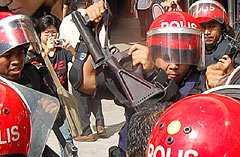
canister launcher on the naked head of a protester. This is reminiscent of South Africa during the days of the Apartheid regime. This horrifying image, which will long endure in the minds of all peace-loving Malaysians, is itself an eloquent argument for the immediate formation of an Independent Police Complaints and Misconduct Commission(IPCMC).

We demand that immediate action be taken against the policeman who used the butt end of the tear gas launcher to assault a protester , ACP Kamal Pasha and all other policemen responsible for the 28th May attack on peaceful protesters. We also demand that the IPCMC be immediately set up in order to protect citizens of Malaysia from the unlawful acts of the police.

Charles Hector
N. Surendran

for Malaysians Against Death Penalty and Torture (MADPET)
29th May 2006

Wednesday, May 10, 2006

MADPET(10/5/06):-OPPOSE DEATH PENALTY FOR WATER OFFENCES


OPPOSE DEATH PENALTY FOR WATER OFFENCES

MADPET (MALAYSIANS AGAINST DEATH PENALTY AND TORTURE) calls for the immediate removal of the clauses imposing the death penalty in the Water Services Industry Bill 2006, which came up for second reading in Parliament today(10/5/2006).

Section 121, under Part X : General Offences and Penalties of this Bill, which deals with the offence of water contamination provides that “…a person who contaminates or causes to be contaminated any watercourse or the water supply system or any part of the watercourse or water supply system with any substance (a) with the intention to cause death; (b) with the knowledge that he is likely to cause death; or (c) which would likely endanger the life of any person ….[and]… where death results shall be punished with death or imprisonment…”

The Malaysian Bar, a body representing over 12,000 Malaysian lawyers, at its 60th Annual General Meeting held on 18/3/2006 passed a Resolution calling for the abolition of the death penalty in Malaysia, an immediate moratorium on all executions pending abolition and the commutation of the sentences of all persons currently on death row.

It must be pointed out that a recent television poll done by RTM 2 during the Hello on Two programme on 7/5/2006 showed that 64% of Malaysians are for the abolition of the death penalty in Malaysia. This program has an estimated audience of 80,000. It is thus important that members of Parliament, the representatives of the people respond to the aspirations of Malaysians and remove the death penalty from the Water Bill and all other laws of Malaysia.

It is ironic that at a time when the nations of the world are rapidly moving towards abolition of the death penalty, Malaysia is once again unnecessarily and imprudently extending the range of capital offences. An average of three countries have abolished the death penalty each year over the last decade 122 countries have abolished capital punishment in law or practice as opposed to 74 countries which retain the death penalty;

We therefore call on all Parliamentarians, from both the Barisan National ruling coalition and the Opposition, who value human rights, justice and mercy to immediately cause the removal of the provisions that provide for the sentence of death.

N. Surendran
Salbiah Ahmad
Charles Hector

for Malaysians Against Death Penalty and Torture (MADPET)

10th May 2006

Monday, May 08, 2006

Death to Malaysian Water Contaminators?

DEATH PENALTY:
Death to Malaysian Water Contaminators?

Anil Netto

PENANG, May 8 (IPS) - While there is a global trend toward abolishing the death penalty, the Malaysian government is set to add more entries to its list of capital offences -- like contamination of water and rape.

A new Water Services Industry Bill is one of two water-related bills due for a second reading in parliament this week. The bill seeks to revamp the way water is managed in the country, transferring control of state water authorities and privatised firms to a single federal regulatory body.

But it also provides for capital punishment for serious cases of water contamination that result in loss of life.

Anyone who contaminates the water supply with the intention of endangering lives or causing death could face the death penalty. The death penalty could also apply to those who contaminate the water supply with any substance that would likely endanger lives.

Opponents of the law believe the proposed rules are draconian and unworkable. Moreover, they do not address the real causes of water pollution.

"Most of the time, the real offenders are likely to be companies and you can't hang the companies," said Charles Hector, a human rights lawyer who was one of the coordinators of the campaign network Malaysians Against Death Penalty and Torture (MADPET). "So who would face the death penalty then -- the chairman of the board? All the directors? The general manager? The administrative officer? It's absurd."

Hector told IPS there was no need to add to the death penalty laws as there are already provisions in the penal code that cover the intention to kill someone. "Besides," he added, "we are against the death penalty as it doesn't address the real issues."

More than half the rivers in Malaysia are polluted by raw or partially treated sewage as well as industrial effluents, agricultural run-offs, waste from animal husbandry and land development, and municipal rubbish.

These can pollute sources of drinking water. After a flood in February, residents around Kuala Lumpur complained of smelly water coming from their taps. A common complaint at other times is of murky water in parts of the country.

The soaring costs of maintaining the rivers prompted the government of the developed state of Selangor to announce in February that it would privatise three key rivers to firms, which would be tasked with ensuring their cleanliness. Critics argue that this is not the solution as the sources of river pollution have to be tackled.

The new water bills are being tabled at a time when the private sector has been eyeing a larger stake in water treatment, supply and distribution.

Top officials at the Energy, Water and Telecommunications Ministry could not be reached for comment about the provision for the death penalty despite several attempts. That leaves Malayasians only speculating why that provision was added.

"I think the death penalty was included because they had terrorists in mind" who might deliberately contaminate water sources, opposition Parliamentarian Teresa Kok told IPS, adding, however, that she was opposed to the death penalty.

Others have a different view. "It seems that the intention of the bill is merely to randomly prosecute harshly some nobodies to give an impression something is being done," was one comment in response to a blog entry on the issue at the popular website, Malaysia Today.

By including the death penalty in the bill before parliament, Malaysia is bucking a global trend against capital punishment. It is one of 74 countries where the death penalty is still allowed, while 123 countries have abolished capital punishment.

In contrast, Malaysia's neighbour, the Philippines, commuted the death sentences of all prisoners last month. President Gloria Macapagal-Arroyo has appealed to the Philippine Congress to abolish the death penalty, while Chief Justice Artemio Panganiban has described the country's death penalty laws as unconstitutional.

In Malaysia, however, the death penalty remains mandatory for drug trafficking (including possession), murder, certain firearms offences and offences against the king.

The majority of the death sentences meted out are for drug trafficking. Out of 52 people sentenced to death from 2004 until July 2005, 36 were convicted for drug offences. Last December, Deputy Internal Security Minister Chia Kwang Chye said that from 1960 through last October, 434 convicts were hanged while 172 cases were pending appeal.

But despite the country's tough stance, the drug menace remains serious. For MADPET, that proves that capital punishment is not the solution. It has never been proven that the death penalty effectively deters crime, the group says.

Parliamentarian Kok, however, is under no illusions that it will be easy to abolish capital punishment. She was a member of a Parliamentary select committee, made up predominantly of ruling coalition members, which traveled the country in 2004 seeking public views on proposed amendments to the penal code and criminal procedure code, which will be brought to Parliament on Thursday.

During the hearings, she said she got the impression that public sentiment was in favour of the death penalty. "The problem is that many among the public still want the death penalty in cases where the victim loses his or her life."

Kok told IPS that among proposed amendments to the codes is the provision for the death penalty for any act of terrorism involving the "release of poisonous substances into the environment". The death penalty would also be handed out to those found guilty of rape resulting in the death of the victim.

Kok pointed out that when the cabinet minister responsible for the law, Nazri Aziz, spoke out against the death penalty in March, he did not receive much support from his ruling coalition colleagues. "For me, a life is a life. No one has the right to take someone else's life, even if that person has taken another life," he had said.

Public opinion may be changing though. Nazri's comments were in response to an unprecedented resolution opposing the death penalty by the Malaysian Bar Council, the governing body for the country's 12,000 lawyers, at its annual general meeting on Mar. 18. The resolution, calling for the death penalty to be abolished and for a moratorium on all executions, was passed by a thumping 105-2 majority, with 21 abstentions.

And, during a recent morning talk show programme aired on state-run television station RTM2, a cell phone text message poll showed that just over 60 percent of those who responded supported the abolition of capital punishment. (FIN/2006)

Tuesday, March 21, 2006

MALAYSIA:Justice Minister backs abolition of death penalty


21 March, 2006

MALAYSIA
Justice Minister backs abolition of death penalty

For Nazri Aziz “a life is a life. No one has the right to take someone else's life, even if that person is a murderer”. From 1970 to the present, 359 people have been condemned to death; 159 are on death row.


Kuala Lumpur (AsiaNews/Agencies) – The Malaysian Justice Minister has said he supports abolishing Malaysia's death penalty. "For me, a life is a life. No one has the right to take someone else's life, even if that person has taken another life," Nazri Aziz, minister in charge of law, was quoted as saying to a local newspaper.

The minister’s statement comes as the Malaysian Bar Council launched a campaign for abolishment of the death penalty: “I welcome this proposal. This is definitely something which should be looked into.”

The Council said the death penalty is “barbaric, inhumane and an insufficient deterrent for crime”, and called for an immediate moratorium on all death sentences.

But the minister said this would not be possible: “The death sentence has been part of our laws for a long time. It goes with the fabric of the whole system. After discussions are held, hopefully the attorney general will advise the government.”

Malaysia is one of 76 countries which still impose the death penalty. It is mandatory for murder, for trafficking in heroin, cocaine, opium and marijuana, and for offences against the king. In the national penal code, possession of drugs is presumed to be trafficking.

At his discretion, a judge can also hand down the death penalty – administered by hanging – for crimes like kidnapping, associating with people carrying arms or explosives and waging war against the ruler.

Since 1970, Malaysia has hanged 359 people, 40 of them in the last 10 years. Most were convicted of drug trafficking. There are 159 prisoners on death row.

Sunday, March 19, 2006

18/3/2006 - MALAYSIAN BAR RESOLUTION CALLING FOR ABOLITION OF DEATH PENALTY

RESOLUTION OF THE MALAYSIAN BAR FOR THE ABOLITION OF THE DEATH PENALTY
(which was adopted at the 60th AGM of the Malaysian Bar on 18/3/2006)

WHEREAS every human being has the inherent right to life;

WHEREAS Malaysia has hanged at least 358 persons between 1981 and 2005;

WHEREAS about 173 persons are on death row as at December 2005;

WHEREAS :

a) studies conducted throughout the world over the past seventy years have failed t
o find convincing evidence that capital punishment is a more effective deterrent of crime than long-term imprisonment;

b) studies conducted in Australia show that abolition of the death penalty had no effect on the homicide rate and in Canada there in fact was a sharp decline in the homicide rate after abolition;

c) in the United States over the past twenty years, states with the death penalty in general have had a higher homicide rate than states without the death penalty;

WHEREAS on the other hand the execution of human beings by the State gives an ‘example of barbarity’ to society and legitimizes the taking of human life;

WHEREAS Malaysia lacks safeguards that would ensure a fair trial such as the right to immediate access to a lawyer upon arrest, right to full disclosure of evidence in the possession of the police and prosecution, and has to the extreme prejudice of accused persons loaded a capital crime statute such as the Dangerous Drugs Act 1952 ( which generates the largest number of death sentences annually ) with presumptions of trafficking that compromise the presumption of innocence which is integral to any fair and just criminal justice system;

WHEREAS:

a) it is not possible in any system of human justice to prevent the horrifying possibility of the execution of innocent persons; and

b) the infliction of the death penalty makes wrongful convictions irreversible;

WHEREAS :

a) 122 countries have abolished the death penalty in law or practice as opposed to 74 countries which retain the death penalty;

b) An average of three countries have abolished the death penalty each year over the last decade;

c) the trend worldwide has been for the abolition of the death penalty;

WHEREAS the UN Commission on Human Rights Resolution 2005/59 passed in 2005 calls upon all states to abolish the death penalty and states that the abolition of the death penalty is essential for the protection of the right to life of every human being;

WHEREAS Article 1 of the Second Optional Protocol to the International Covenant on Civil and Political Rights (ICCPR) provides that ‘ No one within the jurisdiction of a State party to the present Optional Protocol shall be executed ’.

WHEREAS the death penalty has no place in any society which values human rights, justice and mercy;

NOW IT IS HEREBY RESOLVED that the Malaysian Bar calls for the:

1) Abolition of the death penalty in Malaysia;

2) An immediate moratorium on all executions pending abolition;

3) Commutation of the sentences of all persons currently on death row;

4) Ratification by Malaysia of the Second Optional Protocol to the International Covenant on Civil and Political Rights (ICCPR).

Proposers: N.Surendran , Charles Hector, Amer Hamzah Arshad, Sreekant Pillai

* the facts and statistics relied on here are from Professor Roger Hood’s The Death Penalty( A Worldwide Perspective) OUP 2002, Amnesty International and statistics released by the Government of Malaysia.

Sunday, February 26, 2006

MADPET(26/2/06):NO JUSTIFICATION FOR DEATH PENALTY FOR DRUG TRAFFICKERS

NO JUSTIFICATION FOR DEATH PENALTY FOR DRUG TRAFFICKERS
- Prime Minister Abdullah was wrong to endorse the death penalty -

MADPET (Malaysians Against Death Penalty and Torture) is disturbed by the statement issued by Prime Minister Abdullah Ahmad Badawi justifying the death penalty for drug traffickers as reported by Bernama on 22/2/2006.

The Prime Minister is blindly echoing the flawed and fundamentally mistaken argument that the death penalty deters potential offenders from trafficking in drugs. The fact is that it has never been proven that the death penalty effectively deters the commission of capital crimes. This is proven by studies conducted throughout the world over the past 70 years using various different methodological approaches.

The official report to the United Nations on the death penalty states as follows, “…the low rates of effectiveness of law enforcement, the relative immunity from the law of those who profit most from the trade in drugs and the higher risk of violence and death they most probably run from others engaged in the drug racket, all make it seem implausible that the death penalty in itself will have a marginally stronger deterrent effect than long terms of imprisonment...”

The Prime Minister also failed to take into consideration the great and real risk that innocent persons may be executed under Malaysia’s harsh drug laws. This is a very real danger in view of the fact that the Dangerous Drugs Act 1952 is tainted with presumptions of trafficking which effectively places the burden of proving innocence upon the accused person. This militates against the fundamental and well established presumption of innocence enshrined in the criminal justice system of all civilized nations.

By reason of being caught in possession of a small amount of drugs, the presumption is activated that the person is a drug trafficker. Many innocent victims may not even have been aware that they are carrying drugs. In a recent case, Msimanga Lesaly, a Nigerian widow and mother of five, was condemned to death by the Malaysian courts despite her protests that she was unaware that she had drugs in her possession. As a result of the presumption of trafficking, she was unjustly forced to try and prove that she was innocent of the offence of trafficking whereas it should have been the task of the prosecution to prove beyond a reasonable doubt that she was in fact trafficking in drugs. It should also be remembered that the resources of an individual forced to prove her innocence of trafficking is minimal compared to the vast powers and resources of the State in carrying out prosecutions.

It should be noted that the majority of death sentences handed out in Malaysia are for the offence of drug trafficking. In 6 December 2005, it was disclosed in Parliament that of 52 people who were sentenced to death from 2004 until July 2005, 36 were convicted for drug offences.

The tendency throughout the world has been towards the abolition of the death penalty, with an average of 3 countries abolishing the death penalty over the last decade. At present 122 countries have abolished the death penalty in law or practice as opposed to 74 countries which retain the death penalty.

Crucially, in 2005 the UN Commission on Human Rights passed Resolution 2005/59 that called upon all states to abolish the death penalty and states that the abolition of the death penalty is essential for the protection of the right to life of every human being;

It is unfortunate that the Prime Minister of Malaysia did not take into account the above facts when he endorsed the barbarous practice of executing human beings.

We call upon the government of Malaysia to abolish the death penalty for all offences in Malaysia and for an immediate moratorium on all executions pending abolition.

Charles Hector
N. Surendran
Salbiah Ahmad

for Malaysians Against Death Penalty and Torture (MADPET)
26th February 2006

Tuesday, February 21, 2006

MADPET(21/2/06) :CHINA MUST CEASE VIOLATION OF HUMAN RIGHTS

CHINA MUST CEASE VIOLATION OF HUMAN RIGHTS
Stop persecution of Human Rights Defenders

MADPET condemns the continuing and escalating suppression of religious freedom, human rights and basic civil liberties in China.

On February 12 2006, the Asia Pacific Relay Hunger Strike for Anti-Persecution Support Network began a hunger strike in Kuala Lumpur, Malaysia in order to support the human rights movement in China and in protest against the cruel persecution of human rights activists and oppressed people in China. This hunger strike campaign also seeks to publicise and gather support for prominent human rights lawyer Gao Zhisheng. In a blatant atempt to silence Mr.Gao, the Chinese authorities have closed down his law office and are said to have repeatedly threatened him and even placed him under 24 hour police surveillance.

Mr.Gao has been at the forefront of the legal battle on behalf of political and religious dissidents. His legal firm has been involved in a land dispute case against locally elected officials in Taishi Village in Guangdong which is a test case for local democracy, has supported Chen Guangcheng a lawyer under house arrest in Linyi City because of his involvement in class action suit aginst local authorities, has defended Zheng Yichun a journalist and former professor who has sentenced to seven years imprisonment for his on-line writings and has aided Falun Gong members who have been brutally tortured and imprisoned by the Chinese authorities. In one of his letters dated 22 November 2005 to President Hu Jin Tao and Premier Wen Jiabao, Mr Gau disclosed “…the true accounts of unbelievable brutality, among the records of the government’s inhumane torture of its own people, …the lewd yet routine practice of attacking women’s genitals by 6-10 Office staff and the police…Almost all who have been persecuted, be they male or female, were first stripped naked before any torture...”

The Chinese government also continues to persecute many other human rights activists and lawyers in an attempt to cow them into abandoning their principled and brave stand against persecution and repression. A case in point is that of Zheng Enchong, a human rights lawyer who has been imprisoned for three years on absurd charges and who has allegedly been beaten in prison in Shanghai. These actions of the Chinese authorities are in flagrant defiance of international norms and basic standards of human decency.

We demand that the Government of China guarantees the safety of Gao Zhisheng and other human rights defenders and lawyers and allows them to continue their efforts on behalf of the people of China without further harassment and persecution.

We call for the immediate release of activists such as Zheng Engchong who have been imprisoned upon baseless charges.

We also ask that the Government of Malaysia request the Chinese Government for an immediate assurance of the safety of Gao Zhisheng.

N. Surendran, Charles Hector & Salbiah Ahmad
for Malaysians Against Death Penalty and Torture (MADPET)
21st February 2006

Thursday, February 09, 2006

MADPET(9/2/06):-THE DEATH PENALTY MUST BE ABOLISHED - Malaysia Must Respect the Right To Life

THE DEATH PENALTY MUST BE ABOLISHED
Malaysia Must Respect the Right To Life

MADPET (Malaysians against Death Penalty and Torture) is deeply perturbed by the continued imposition and carrying out of the death penalty in Malaysia, and reiterates its call for the abolition of the death penalty, and a moratorium on the carrying out of all death sentences pending abolition.

On 6 December 2005, the Deputy Internal Security Minister disclosed in Parliament that 52 people were sentenced to death from 2004 until July. Of these, 36 were convicted for drug offences and 16 for murders. This disclosure brings the number of persons on death row to approximately 173. In November 2003, it was said that there were 121 persons, including 4 women, on the death row.

It was disclosed in February 2005 that over the past 24 years 358 persons have been hanged in Malaysia.

Malaysia lacks many safeguards that would ensure a fair trial which make it most unsafe to sentence a person to death. There is at present no right to a phone call upon arrest, no right to immediate access to a lawyer upon arrest and no right to full disclosure (i.e. the right of access to documents and information that were obtained during the police investigation and after). In Malaysia, in practice an accused only gets access to his own cautioned statement and the first information report. The police and the prosecution do not even have a duty to make known witnesses and evidence that they may have discovered that would have assisted the accused person in his defence. Without pre-trial full disclosure, an accused is deprived of the opportunity and the means to fullly exercise his right to defend himself. Without these necessary safeguards to ensure a fair trial, it becomes a real and horrifying possibility that innocent persons will be sent to the gallows.

The death penalty has never been proven to be effective in deterring crime. Studies conducted throughout the world have repeatedly established this fact. Matters are made worse in the Malaysian context as the government has in general unjustifiably and systematically witheld necessary information on the passing of and execution of death sentences. The government is thus preventing public debate on the death penalty. In 2005, the UN Special Rapporteur Philip Alston stated in his report, “ For a government to insist on a principled defence of the death penalty but to refuse to divulge to its own population the extent to which, and the reasons for which it is applied is unacceptable.”

As of December 2005, 122 countries have abolished the death penalty in law or practice. The worldwide trend has been towards increasing awareness of the inhumanity, brutality and irrevocability of the death penalty. The death penalty is repugnant to human dignity and the right to life. In 2005 , the UN Commission on Human Rights by Resolution 2005/29 declared that the abolition of the death penalty is essential to protect the right to life.

In the name of humanity, justice and human dignity, and in defence of the principle that all life is sacred, we call upon the Government of Malaysia to abolish the death penalty, and declare an immediate moratorium on the carrying out of all death sentences pending abolition.

Charles Hector
N. Surendran
Salbiah Ahmad

for Malaysians Against Death Penalty and Torture (MADPET)

9th February 2006

Thursday, January 05, 2006

Jailers beat us, claims EO detainee (Malaysiakini)

Jailers beat us, claims EO detainee
Andrew Ong
Jan 5, 07 2:05pm


Warders attacked some 40 inmates in the Simpang Renggam detention camp on Wednesday afternoon leaving scores injured, claimed an inmate.

The source, who contacted malaysiakini that evening, said detainees from seven cells in a particular block were attacked after being made to squat.

“They used ratan canes and batons. Some of us were beaten until we vomited. Others could not walk as their bones were broken,” said the inmate, a businessman prior to incarceration and accused of being notorious criminal gang member in Johor.

According to newsreports today, 16 detainees were given out-patient treatment at the Kluang Hospital on Wednesday evening following the incident. One of them, S Selvam, allegedly suffered a broken hip, according to the New Straits Times.

The source however claimed 21 individuals sought medical attention.

Rehabilitation or reaffirmation?

He said the beatings probably stemmed from a fracas between two youths that day, but the matter was then ‘handled’ and resolved by senior inmates.

Two hour laters, an unspecified number of warders carried out the attacks.

“Normally, they would call detainees in for questioning to find out about any fights that have taken place, but not this time,” he said, warning that resentment towards warders and the government by inmates were growing after the alleged attack.

“This is a Pusat Pemulihan Akhlak (Moral Rehabilitation Centre) but they treat us worst than animals. Kita langsung tidak boleh baik. Depa buat kita lebih teruk. (We can’t be better persons like this. They make us even worse),” he added.

Detention centre authorities could not be contacted for comments.

Suhakam to probe

Malaysian Human Rights Commission (Suhakam) commissioner Siva Subramaniam said the human rights watchdog would be investigating the matter.

“Suhakam is concerned if the accusations are true. Prisoners need to be treated well as they are human beings too,” said Siva, who contacted by malaysiakini yesterday after he heard similar allegations on the beatings at the detention centre.

He added that a Suhakam delegation might visit the centre on Monday.

Almost all detainees in the detention camp are held under the Emergency (Public Order and Preventive of Crime) Ordinance 1969, a law which allows detention without trial.

Detention can be renewed every two years under the discretion of the internal security minister on advice from the police.

Generally, detainees at the centre range from alleged criminal gang members to petty thieves. They are normally never charged in court for their alleged crimes.

The Simpang Renggam detention camp which holds about 1,000 inmates is often a subject of controversy due to its deplorable, unsanitary and overcrowded conditions

Thursday, November 10, 2005

madpet(10/11/05) -TAKE STERN ACTION AGAINST POLICE FOR TORTURE OF SUSPECT

TAKE STERN ACTION AGAINST POLICE FOR TORTURE OF SUSPECT
- torture incident witnessed by lawyer & 2 others -

Malaysians Against Death Penalty and Torture (MADPET) is shocked by the recent revelation of torture at the Banting District Police headquarters on 28 October 2005 (as reported in the New Straits Times 29/10/2005). The suspect’s mouth was gagged with a white tape/plaster and his arm was being pulled upwards behind him and he was crying in pain.

This harrowing incident was witnessed by a lawyer and 2 others. All three eye-witnesses immediately lodged police reports about the incident.

We also view with great concern that the reaction of the Officer in Charge of the Police District(OCPD) of Banting, Superintendent Shah Gzali Khan, was to deny the allegations, even before proper investigations have been commenced. His denial and his threats of action against the complainants was reported in the NST of 29/10/2005.

It bodes ill for the nation that the uniformed protectors of the public are terrorizing and torturing persons in violation of the law and human decency.

All those involved in this atrocity, including those police officers who stood by and did nothing to prevent it , must be brought to justice.

We demand the following:-

a) That the Inspector General of Police (IGP) appoint an independent police team to investigate this matter;

b) That the Home Affairs Minister and the IGP take urgent steps to put an end to custodial torture by police personnel in police stations throughout the country

c) That the government immediately sets up a permanent independent body to investigate complaints of abuse or torture perpetrated by the police.

d) That the victim of torture be identified and be justly compensated.

Charles Hector
Salbiah Ahmad
for Malaysians Against Death Penalty and Torture (MADPET)

10th November 2005

Tuesday, April 19, 2005

MADPET(19/4/05) STOP HANGING OF SINGAPORE TWINS' FATHER

STOP HANGING OF SINGAPORE TWINS’ FATHER

We note with concern and sadness the case of 14 year old Singaporean twins Gopalan and Krishnan Murugesu, who have been tramping the streets of the city-state seeking public support for a petition against the execution of their father. Their father Shanmugam Murugesu was sentenced to death for drug possession and will be executed unless Singapore President S.R.Nathan grants his petition for clemency. This heart-rending case well illustrates the evil caused by the infliction of the death penalty.

The death penalty is an extremely cruel and degrading form of punishment.The condemned person not only suffers from the barbarity of the execution itself, but also the cruelty of waiting upon death row for the day he is to be methodically killed by the state.

It has never been proven that the imposition of the death penalty reduces the incidence of crime. On the other hand, there is overwhelming proof of the horrendous impact of the death penalty upon the loved ones of thecondemned person.

These two young boys will almost certainly be seriously traumatized by the killing of their father by the State, particularly since he is the only parent they have. They are mere children who should be in school or at theplayground, and living the carefree existence of childhood. Instead, they are walking the streets of Singapore, begging for their's father's life. How can the State of Singapore justify this?

Justice that is not tempered with mercy is nothing more than the brute unfeeling exercise of force by the State. In the name of pity and human dignity, and for the sake of these suffering children, we call upon His Excellency President S.R. Nathan to grant the clemency petition of Shanmugam Murugesu.

We also call upon the government of Singapore to immediately impose a moratorium upon all executions, as a first step towards final abolition of the death penalty.

N. Surendran
Charles Hector
Salbiah Ahmad

for Malaysians Against Death Penalty and Torture (MADPET)

19th April 2005

Saturday, April 09, 2005

MADPET(9/4/05) POLICE MUST STOP HUMILIATING ARRESTED PERSONS

Police Must STOP Humiliating Arrested Persons

We are shocked that the Federal CID Director Comm. Datuk Fauzi Shaari has defended the action of police in giving crew-cuts to arrested persons detained at police station lock-ups. It must be remembered that persons detained at police lock-ups are mere suspects pending investigation. Many a time arrested persons are released in a couple of hours or days after police investigations show that they are not involved in the crime they are suspected to have committed.In his statement reported in the Star (9/4/2005), Datuk Fauzi Shaari absurdly claims that the crew-cuts are necessary for hygiene and discipline reasons.

In claiming that the crew-cuts are necessary for discipline reasons, Datok Fauzi Shaari clearly exhibits the police department’s inveterate inability to understand that arrested persons are not convicts and are innocent until proven guilty. The police have no right to humiliate arrested persons in this manner in order to impose discipline. It is not the task of the police department to teach discipline to the Malaysian public.

It is time the police realize that in this country arrested persons cannot be treated as if they were inmates of notorious penal institutions such as Chekhov’s Island of Sakhalin or the Gulag Archipelago or Devil’s Island. This seems obvious to everyone except the police department who appear to think that it is permissible to treat arrested suspects as if they were hardened convicts.

As regard Datok Fauzi’s claim that crew-cuts are necessary for hygiene purposes, we take this as an admission that police lock-ups are unhygienic places. It is undeniable that lock-ups in Malaysia are generally smelly, dirty, over-crowded and lacking adequate toilet and bathroom facilities. The police department ought to take the initiative to improve conditions instead of giving crew-cuts to detainees

In addition, the time of the police department is better spent investigating and solving crimes instead of posing as ‘barbers’ to arrested persons.

It is unacceptable that the Federal CID Chief should think that he has the right to treat Malaysians in this manner and for these reasons.

We demand that the practice of giving hair-cuts to arrested persons immediately cease as it is humiliating and is an affront to human dignity.

N. Surendran
Charles Hector
for Malaysians Against Death Penalty and Torture (MADPET)

9th April 2005
Kuala Lumpur

Friday, February 25, 2005

Mkini: Do away with ‘cold-blooded’ death penalty, govt urged


Do away with ‘cold-blooded’ death penalty, govt urged

Feb 25, 05 3:22pm

The death penalty imposed on the murderer of Canny Ong Lay Kian is just as bad and unacceptable as the crime itself, said an anti-corporal punishment group in a statement today.

“(Her) murder was indisputably shocking and barbaric. However, the death penalty to the perpetrator is just as barbaric and amoral.

“The death penalty is a glaring instance of state amorality and cold-bloodedness at its worst,” said the newly-formed Malaysians Against Death Penalty and Torture (Madpet).

On Tuesday, the Shah Alam High Court sentenced 29-year-old aircraft cabin cleaner Ahmad Najib Aris to death by hanging for the rape and murder of the US-based IT analyst in 2003.

However, Madpet accused the state of being savage by imposing the death penalty as it “reiterates the very crime it seeks to mark as reprehensible and the solution it arrives at is thus inconsequent to the problem it addresses”.

“The state-sponsored extinguishing of human lives is not a solution to the problem of the crime,” said its coordinators N Surendran, Charles Hector and Salbiah Ahmad in the statement.

They argued that studies have consistently shown that there is no evidence that the death penalty effectively deters crime and furthermore, as the punishment is irreversible, the state runs the risk of executing innocent people.

“For example, since 1973, more than 100 condemned persons have been released in the US (United States) due to credible fresh evidence,” they added.

Malaysia has hanged 358 people over the past 24 years.

Suspend executions

Madpet claims that since 1976, at least three countries a year have abolished the death penalty and that as of today over half of the world’s nations have abolished the punishment.

“This worldwide trend towards abolition is reflected by the United Nations Human Rights Commission (UNHRC) resolutions calling for the suspension of all executions towards final abolition,” it added.

The UNHRC has, since 1997, passed a resolution calling on countries that have not abolished the death penalty to establish a moratorium on executions.

The latest UNHRC resolution which was adopted in April 2004, was co-sponsored by 76 UN member states and recorded its highest support figure.

Urging the Malaysian government to support the growing global stand against the death penalty, Madpet has called on it to immediately cease the “brutal punishment”.
“We call for a suspension of all executions pending abolition of the death penalty. We call for this in the name of humanity,” it added.

Madpet’s calls are in-tandem with those made by international rights organisations such as Amnesty International and the American Civil Liberties Union.

Thursday, February 24, 2005

MADPET(24/2/05) ABOLISH THE DEATH PENALTY

ABOLISH THE DEATH PENALTY

The murder of Canny Ong was indisputably shocking and barbaric. However, the death penalty meted to the perpetrator is just as barbaric and amoral. The death penalty is a glaring instance of State amorality and cold-bloodedness at its worst.

Since 1976, every year at least 3 countries have abolished the death penalty and today over half of the countries of the world have abolished the death penalty. This worldwide trend towards abolition is reflected by the UN Human Rights Commission’s Resolution calling for the suspension of all executions towards final abolition.

The State-sponsored extinguishing of human lives is not a solution to the problem of crime. Studies have consistently shown that there is no evidence that the death penalty effectively deters crime. As this punishment is irreversible, we run the horrendous risk of executing innocent persons. For example since 1973, more than 100 condemned persons have been released in the US due to credible fresh evidence.

The infliction of the death penalty upon its citizens by the State, reduces it to the level of a savage. It reiterates the very crime which it seeks to mark as reprehensible and the solution it arrives at is thus inconsequent to the problem it addresses.

The statistics in Malaysia are shocking as 358 people have been hanged over the past 24 years.

We call for an immediate cessation of this brutal punishment.

We call for a suspension of all executions pending abolition of the death penalty.

We call for this in the name of Humanity.

N. Surendran
Charles Hector
Salbiah Ahmad

for Malaysians Against Death Penalty and Torture (MADPET)

24th February 2005

Saturday, February 19, 2005

MADPET(19/2/05) STOP ABUSES OF POWER BY ENFORCEMENT OFFICERS

STOP ABUSE OF POWER BY ENFORCEMENT OFFICERS

We are sickened by news report that Simpang Rengam District Council enforcement officers entered a private premise and brutally killed a dog, the family pet, in front of the family. The helpless animal which was a beloved family pet of 6 children was killed with shocking cruelty. Siau Mau, as it was lovingly called by the children was shot and then bludgeoned to death.

We view with grave concern the increasing instances of enforcement officials who abuse their power and easily resort to the use of guns.

In a notorious incident in Penang in mid- January, Yeoh Yew Jin, a 19 year old alleged VCD seller was shot in the chest by enforcement personnel. The shot also injured a 52 year old innocent by-stander having his dinner at a nearby coffee shop.

Despite a public outcry following this incident, Prime Minister Abdullah Ahmad Badawi made a poorly reasoned decision to continue to allow enforcement officers to bear firearms.

His decision showed a disturbing lack of sensitivity to the interest and safety of the general public and is inconsistent with his professed people friendly and transparent administration.

We are further shocked that the Simpang Rengam District Council enforcement officers had abused their power by trespassing into a private citizens home and destroying private property.
We call upon the authorities to take swift and stern action against those involved in this shameful incident. There must be no hesitation to charge in court those guilty of wrongdoing for cruelty to an animal, criminal trespass and destruction of private property.

We also call upon the Prime Minister to re-consider his decision to allow enforcement officers to carry arms as it is not certain that they are able to bear this responsibility without endangering the Malaysian public.

N. Surendran
Charles Hector
for Malaysians Against Death Penalty and Torture (MADPET)

19th February 2005

Thursday, February 03, 2005

Mkini - Gov't reveals execution statistics: 358 hanged in 24 years


Gov't reveals execution statistics: 358 hanged in 24 years

Feb 3, 05 8:56am

The government has revealed that it executed 358 people by hanging in the past 24 years, parliamentary opposition leader Lim Kit Siang said today.

Lim said he had received the statistics from Prime Minister Abdullah Ahmad Badawi, who is also Minister for Internal Security, in response to a written question submitted in parliament.

Figures for the number of executions in Malaysia have rarely been published, and media attempts to establish the number in recent years were rebuffed.

The death penalty is imposed in Malaysia for a number of offences from murder and treason to drug trafficking, for which it is mandatory.

Lim, who leads the biggest opposition party in parliament, the Democratic Action Party, said the prisons department had provided him with a statistical breakdown of just 234 of the hangings.

This showed that 50 foreign nationals were hanged, including seven from Thailand, eight from Hong Kong, 23 from the Philippines, four from Singapore, two from Indonesia and one each from Australia, Britain and Pakistan.

Forty-six of them were hanged for drug offences.

Of 184 Malaysian citizens executed, 48 were from the indigenous Malay majority, 102 were members of the ethnic Chinese minority and 15 were ethnic Indians. Most of the executions - 129 - were also for drug offences.

Five of the 234 people hanged were women.

12 hanged under ISA

Twelve of the executions were for offences under the Internal Security Act (ISA), all between 1984 and 1993. Lim told AFP he could not immediately account for the number of hangings for security offences in such a concentrated period.

The act, most widely known for the powers it gives the authorities to detain people without trial, also prescribes the mandatory death penalty for certain offences to be tried in court, including carrying firearms, ammunition or explosives "in any security area".

The ISA was introduced by former British colonisers to fight a communist insurgency in the 1950s, and has been used more recently to detain without trial more than 80 suspected Islamic militants.

The number of executions overall, according to the limited figures released by the prisons department, reached a peak of 31 in 1990 while just 15 had been hanged since 2000. None were executed last year, according to these statistics.

Lim said the period between the end of all appeals and the carrying out of the sentence varied from less than a year to more than four years.

- AFP

Thursday, January 29, 2004

Mkini: Death penalty for killer rapists


Death penalty for killer rapists

Jan 29, 04 05:00am

Malaysia's cabinet, reacting to public outrage over the rape and murder of two 10-year-old girls, has given the go-ahead for the mandatory death sentence to be imposed on rapists who kill their victims.

The cabinet also agreed in principle to provide for life imprisonment and possibly public whipping for rape, particularly of children, local media reported today.

Amendments to the law will be put before the next sitting of parliament, de facto Law Minister Rais Yatim said.

At present rapists who cause the death of their victims need to be prosecuted separately for rape, which carries a maximum penalty of 20 years in jail, and for murder, which carries the death penalty.

"The cabinet views this as insufficient and feels that rape resulting in death must automatically carry the mandatory death sentence," Rais said. The death penalty in Malaysia is carried out by hanging.

The proposal to flog rapists in public would be studied further before any decision was taken, he said.


Gang rape

The government's soul-searching has been prompted by a public outcry over the rape and murder of two 10-year-old schoolgirls this month.

Nurul Huda Ghani was gang-raped by three men, sodomised and strangled near her home in Johor while on an errand for her mother to the grocery store.

A 47-year-old security guard has been sentenced to 20 years in jail and 24 lashes after admitting raping the girl. He will later face a murder charge. Another suspect is in custody and a third is being sought by police.

On Jan 8, Haserati Saridi was stabbed to death after being raped while walking to school in eastern Sabah state.

A 26-year-old man released from prison last month after serving a sentence for theft has pleaded guilty to raping her and will also face a murder charge. - AFP

Wednesday, September 10, 2003

Lawyers, accountants face death penalty in new terror law


Lawyers, accountants face death penalty in new terror law

Sep 10, 03 05:58am

Lawyers and accountants who provide financial services for terrorists could face the death penalty under proposed new legislation, local media reported today.

Amendments to the Penal Code submitted to parliament on Tuesday aim to punish not only terrorists but those who provide them with services or facilities, The Star newspaper said.

If terrorist acts result in death, then lawyers and accountants who helped the terrorists can be executed, the paper said. The death penalty in Malaysia is carried out by hanging.

Those who escape execution face jail terms of between seven and 30 years.

The proposed legislation also provides tough sentences of up to life imprisonment for anyone who harbours or interferes with the arrest of terrorists, recruits members into a terrorist group or provides them with explosives or facilities such as meeting places.

International convention

The amendments to the Penal Code "will enable Malaysia to accede to the International Convention for the Suppression of the Financing of Terrorism adopted by the general assembly of the United Nations on Dec 9,1999," the bill says.

Malaysia already has legislation allowing for indefinite detention without trial which it has used to round up more than 90 alleged Islamic militants over the past two years.

Many of the suspects are accused of being members of the Jemaah Islamiah (JI) terrorist network, a Southeast Asian group linked to Osama bin Laden's al-Qaeda.

JI has been blamed for a string of attacks in the region, including last October's Bali blasts which killed 202 people and the car bombing of the Marriott hotel in Jakarta last month in which 12 people died.

The United States last weekend listed 10 Malaysians as alleged members of JI and ordered a freeze of their financial assets.

Six of the 10 are already in detention while four others, including alleged master bomb-maker Azahari Husin, are on the run. - AFP

Saturday, November 16, 2002

More object to death penalty for child rapists


More object to death penalty for child rapists

Susan Loone
Nov 16, 02 08:41am

More objections are pouring in over the proposed death penalty for child rapists which is likely to be accepted by the Cabinet soon.
Universiti Sains Malaysia associate professor Dr Rohana Ariffin, who is currently undertaking a project to profile rape perpetrators in prisons, said the proposed penalty was too “drastic” and may lead to adverse consequences for the victims.

For example, she said, due to the heavy penalty, rape perpetrators may decide to kill their victims to prevent themselves from being indentified.

Likewise, those who are related to the perpetrator, such as their father, brother or uncle, may refused to come forward to lodge a report for fear for sending the relative to the gallows.


“This will certainly place the victim in a much higher danger. There is no guarantee that the death penalty can reduce the crime rate, perpetrators may just decide to take the risk,” she told malaysiakini today when contacted in Penang.

“We should do this by stages. Impose heavier penalty, then see the results. If this doesn’t work, then we go to the next step,” said Rohana, who was a founder member of Penang Women’s Crisis Centre (now Women’s Centre for Change).

Counselling important

Rohana, whose profiling of the rape perpetrator project under Universiti Institute Teknologi Mara, will be conducted in Seremban, Melaka and Johor next year, stressed that counselling was an important aspect of understanding why such heinous crimes occur so that solutions could be found to counter them.

“We do not only need religious counselling, we need psychologists and psychiatrists to go into prisons to counsel the perpetrators or else we’ll never know why they commit such crimes nor will we know how to deal with this problem,” she added.

Her response came in the wake of a statement made by Minister in the Prime Minister’s Department Dr Rais Yatim’s on Friday that the Cabinet was expected to accept a proposal calling for the death penalty for child rapist.

Rais, who is de facto law minister, said the ministry had received feedback from many quarters including the National Unity and Social Development ministry pressing for the death sentence for such offences.

Women and Family Development Minister Shahrizat Abdul Jalil also supported the stiffer penalty, which she said “was what the public wanted”.

But some public sectors, including women’s groups and the Bar Council have rejected the idea, saying that they maintained their stand against the death penalty.

Effective prosecution

In a joint press statement prepared by Women’s Aid Organisation and endorsed by 29 non-governmental organisations, the groups urged the government to reconsider the proposal and focus on ensuring effective prosecution that will result in conviction of perpetrators.

Sisters In Islam, Protect and Save the Children Association of Selangor and Kuala Lumpur, Association of Registered Child Care Providers Malaysia, Malaysia Association of Kindergartens, Selangor and Federal Territory Association for Retarded Children are among the NGOs who opposed the move.

Bar Council president Mah Weng Kwai said the council will not support the move to impose the death penalty for statutory rape but will support other means of heavier penalty.

Mah said the penalty for statutory rape, where victims are below 16 years, should be stiffer and different from the penalty imposed on normal rapists as the offences were of different level.

Meanwhile, joining the fray of those who oppose the move, Gerakan Wanita chairperson Rhina Bhar urged the authorities not to be hasty in considering the death penalty.

Rhina said it would be more appropriate if the authorities consider increasing the limits of prison sentences and whipping.

Castration suggested

The current sentence in Section 376 of the Penal Code provides a jail term of not less than five years and not more than 20 years for rape perpetrators.

“It is appalling to note that in spite of courts meting out punishments time and again, young girls even toddlers, are raped,” she said in a press statement today.

“The current sentence could be amended to direct imprisonment with whipping and, or castration,” she added.

However, Rhina stressed that the punishment should apply to rapists in general as “rape is rape” whether it is committed against a toddler or a woman.

Friday, November 15, 2002

M'sia debates death sentence for child rapists


M'sia debates death sentence for child rapists

Nov 15, 02 03:01am

The cabinet is expected to accept a proposal calling for the death penalty for child rapists later this month, local media reported today.

"It is very likely that the proposal will be accepted," Minister in the Prime Minister's Department, Rasi Yatim, was quoted as saying by the New Straits Times.

The cabinet is scheduled to discuss the planned legislation in two weeks time.

The death-sentence proposal comes amid public outrage over the rape and murder of a two-year-old girl in Kedah two weeks ago.

The body of two-year-old Siti Nurliyana Shamimi was found in a river 500 metres from her parents' house.

Widespread support

Rais said there was widespread support for the the death sentence for child rapists, which was also backed by the Women and Family Development Ministry.

"Even if the young girl doesn't die as a result of her physical injuries, it amounts to the same thing. As such the strong calls to impose the death sentence ... will almost certainly be acknowledged by the government," The Star quoted Rais as saying.

However, some women's groups here have criticised the proposal, saying a death sentence would not address the issue and would only deter victims from making a police report.

Under existing laws, convicted rapists face a jail term of not less than five years and not more than 20 years, and the offenders are also liable to be whipped.— AFP