
Media Statement – 10/12/2025(World Human Rights Day)
Abolish VETO power to enable the United Nations to be able to be an effective defender of human rights, with the power to end human rights violations
On this World Human Rights Day (10 December) we, the 15 undersigned groups, organizations and trade unions express our greatest disappointment that the United Nations that was expected to defend and promote human rights have failed in its objects, and the expectations of the peoples of the world.
It is still possible to rectify this dilemma, if and only if the member states of the United Nations are committed to abolish the VETO power that is now with the 5 Permanent member States – Russia, China, France, United States of America and the United Kingdom, so that it can no longer impede the UN from defending and promoting human rights, and ensuring justice be done.
VETO violates principle of sovereign equality
The UN Charter, in Article 2(1) states, ‘The Organization is based on the principle of the sovereign equality of all its members.’ This fundamental principle of EQUALITY is violated if the United Nations continue to allow a class of ‘super members’, who can use their VETO power to prevent actions advocated by even the majority of UN member States.
VETO prevents UN from ending human rights violations
The preamble of the UN Charter clearly states the obligation of the UN is ‘to reaffirm faith in fundamental human rights, in the dignity and worth of the human person, in the equal rights of men and women and of nations large and small,’. Thus, the UN acts for human rights, not just when States commit extra-territorial human rights violations but also human rights violations within the jurisdiction of respective States, regardless they are UN members or not. Thus, the UN protects human rights of ALL human persons, and not just rights of member States.
Through the various UN processes, including the UPR process, the UN and UN member States has called on member States to move away from injustices and human rights violations, and calls on States and others to enact rights protecting laws, and abolish laws, practices and even policies that are in violation of human rights. As such, the UN has worked to promote, amongst others, women rights, indigenous rights, environmental rights and the rights of human rights defenders. It has opposed ethnic cleansing, genocide, forced labour
However, the United Nations have been prevented from doing the needful, by reason of abuse of power of some of the permanent 5 by the use of the VETO – that has effectively prevented UN from fulfilling its intended duties to human rights, especially when the perpetrator and collaborators of rights violation, are ‘friends’ of VETO power holding States, or the said VETO power holding States themselves.
The will of the majority of UN member States in issues of human rights can thus be IGNORED or prevented by the use of the VETO. Of late, this has happened in several countries including Palestine, Myanmar and Ukraine.
The VETO has been used to block UN actions. “Instead of being a vehicle for action, the Security Council has too often become an instrument of deadlock. “We see the consequences in places like Gaza, in the persecution of the Rohingya, and in the war in Ukraine,” he [Malaysian Prime Minister Anwar Ibrahim] said in his keynote address at the Common Action Forum (CAF) 2024.
The abolition of the VETO power will restore true sovereign equality in the United Nations, and will allow the UN to be a more effective tool to act against violation of human rights and injustices.
If perpetrators do not heed the call of the UN to stop human rights violations and restore justice, the UN can then take further actions in the form imposition of sanctions, and even cause the United Nation’s forces to enter into the area of rights violations, to not just protect victims, but to also cause perpetrators to do the needful to restore justice including the return of people back to their land and property, and to ensure justice be done.
VETO power CAN be ABOLISHED …
The VETO power can be abolished, whereby the UN Charter, amongst others, in Article 108 states that ‘Amendments to the present Charter shall come into force for all Members of the United Nations when they have been adopted by a vote of two thirds of the members of the General Assembly and ratified in accordance with their respective constitutional processes by two thirds of the Members of the United Nations, including all the permanent members of the Security Council.’
The VETO power can thus be abolished, if two-thirds of the UN Member States support the move, and the 5 existing Permanent Members with VETO power agrees to it. If any one of the VETO power-holding member State objects, it cannot be done. We hope that no member State will oppose this move to abolish the VETO power.
Therefore, we call of all members of the UN Member States to vote in favor of abolishing the VETO power, and all call on all the VETO power holding States to also support this initiative.
We call on all UN Member States to vote without fear or favour to remove this often abused VETO power, that has made the UN a ‘toothless tiger’ unable to act definitely to defend human rights and restore justice even when an overwhelming majority of UN member States wants the UN to act;
We also call on all the 5 Permanent Members, being Russia, China, France, United States of America and the UK, to agree to the removal of the VETO powers to restore democracy and sovereign equality within the UN, so that the UN can regain its power to act in the interest of human rights, and
We call all the 5 Permanent Members, being Russia, China, France, United States of America and the UK to adopt a MORATORIUM in using their VETO powers pending the abolition of VETO.
Charles Hector
Koong Hui Yein
For and on behalf the 15 organizations/groups/trade unions listed below
MADPET (Malaysians Against Death Penalty and Torture)
Teoh Beng Hock Association for Democratic Advancement, Malaysia
Banglar Manabadhikar Suraksha Mancha (MASUM), India
COAC (Center for Orang Asli Concerns), Malaysia
Global Women’s Strike, UK
Global Women’s Strike, US
Legal Action for Women, UK
North South Initiative (NSI), Malaysia
Payday Men’s Network, UK-US
Programme Against Custodial Torture & Impunity (PACTI), India
Sabah Timber Industry Employees Union (STIEU), Malaysia
Second Chance Redemption, Pakistan
WH4C (Workers Hub for Change)
Women of Colour Global Women’s Strike, UK
Women of Color Global Women’s Strike, US
PM Anwar calls for ban on UNSC veto power in mass atrocities cases, wants global justice reform

KUALA LUMPUR, Dec 2 — United Nations Security Council (UNSC) veto power should be banned in cases of mass atrocities until it can be abolished, said Prime Minister Datuk Seri Anwar Ibrahim.
He said the UNSC decision-making processes require broader support from both permanent and non-permanent members and be subject to ratification by the General Assembly through a simple majority.
Anwar said the veto power has paralysed the council, while the lack of representation from regions such as Africa and Latin America reflects a bygone era.
“Instead of being a vehicle for action, the Security Council has too often become an instrument of deadlock.
“We see the consequences in places like Gaza, in the persecution of the Rohingya, and in the war in Ukraine,” he said in his keynote address at the Common Action Forum (CAF) 2024, here today.
The Prime Minister said the world stands at a critical juncture for global justice, emphasising that Israel’s actions against Palestinians undermine the very foundations of the global order.
“... war crimes, collective punishment, and genocide are a blatant affront to the norms of international law and fundamental human rights,” he said.
As Malaysia has advocated at the UN, Anwar said the world must take bold, immediate steps, starting with an arms embargo on Israel.
However, he said the severity of Israel’s actions warrants more including a global consensus towards suspending or even expelling Israel from the UN.
The UNSC reform is one of the key areas proposed by Anwar that urgently needs to be reformed for a more equitable world.
Other areas are the international financial architecture, international trading system, climate finance and climate justice.
At the UNSC Debate in New York in September, Malaysia made a strong appeal to limit the use of veto power in the UNSC, stressing that the unchecked use of veto has obstructed peace efforts, particularly in the case of Palestine. — Bernama
Malaysia urges UN to curb or abolish veto power
Foreign minister Mohamad Hasan says the UN Security Council must be freed from this humiliating paralysis.

In addressing the 80th session of the UN general assembly (UNGA) 2025 in New York yesterday, Malaysian foreign minister Mohamad Hasan said there was a need to limit, if not abolish, the veto power, Bernama reported.
“We must challenge it each and every time that it is wielded, particularly in cases of crimes against humanity.
“Authority must flow back to the general assembly. As the most inclusive body of this house, it should be allowed to serve as the conscience and voice of the world, unimpeded,” he was quoted as saying.
Mohamad urged the organisation to continue to demand accountability from the permanent members of the UN Security Council, referring to the United States, Russia, China, France and the United Kingdom.
“We must pursue results through Resolution 377A: Uniting for Peace. No more shall we quietly accept the dismissal of our collective voice.
“We must question and challenge the veto. We must free the UN Security Council from this humiliating paralysis,” he said.
He added that the UN must remain a relevant and effective international organisation and a global guardian of peace.
On the issue of Israel and its recent actions, Mohamad called for the UN to impose sanctions on Israel, stressing that the metastasis of Zionist regime brutality in the Middle East must not be allowed to continue.
He said Israel’s latest assault on Doha, Qatar, was not merely an attack on a few Hamas representatives but a violation of another state’s sovereignty and an insult to all mediation efforts.
Mohamad added that the strike signalled that Israel’s violence would continue to destabilise the region.
“The atrocities may have begun with Palestine, but they certainly will not end with Palestine. As the Middle East grows ever more dangerous for its residents, we will feel the reverberations all over the world.
“This is why simply advocating for a two-state solution is not enough,” he said, according to Bernama.
He also reiterated Malaysia’s commitment to support the Palestinian people through any measure, including the New York Declaration.
Mohamad said concrete action must also be taken against the occupying force, while long-term support should be prepared to ensure the development of a self-governing Palestinian state.
“The test that we now face is an existential one. After 80 years of the UN, and 77 years of the ethnic cleansing of Palestine, if we cannot resolve this, the citizens of the world will lose faith in us and in the international order,” he said. - FMT, 28/9/2025
Slovenian president reiterates end to UN Security Council veto power
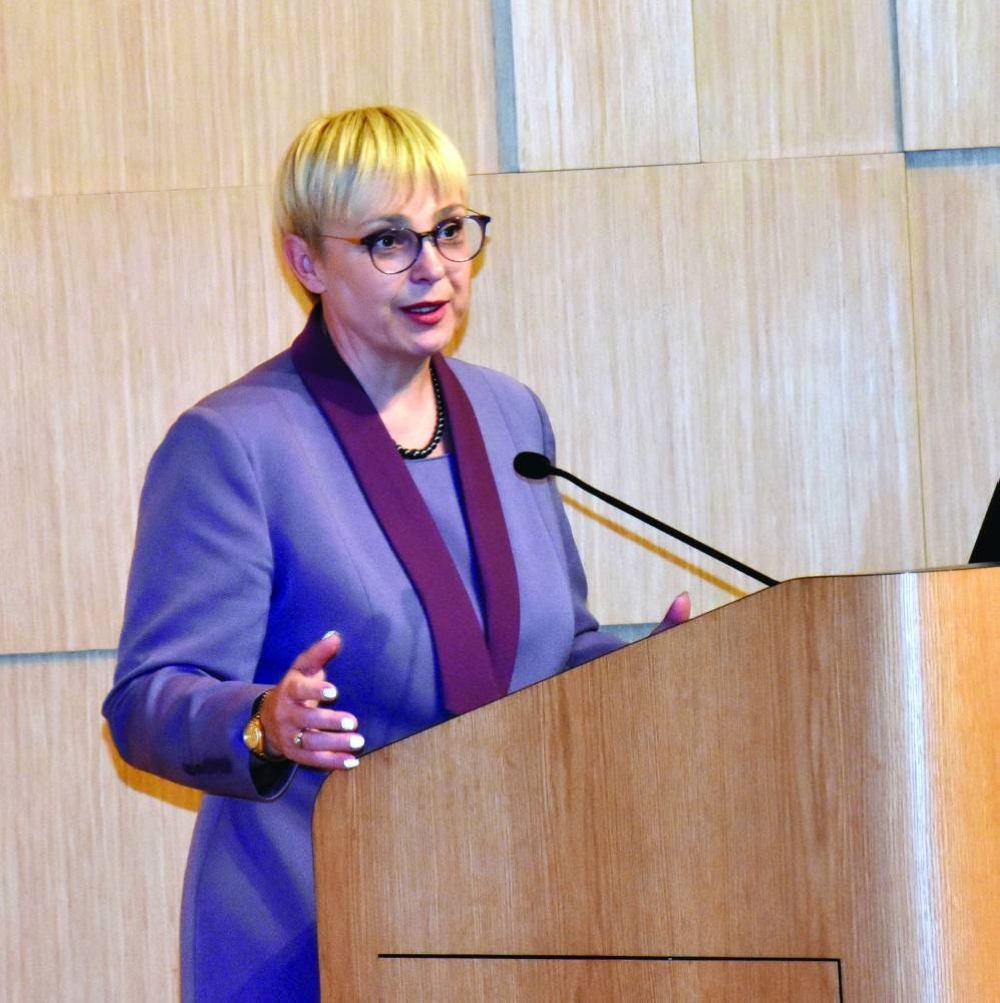
“When you do have something absolute, it is always a problem,” she said. “You know what the saying is?, ‘Power tends to corrupt, and absolute power corrupts absolutely’. It is so true, also in politics,” Pirc Musar said in her lecture, titled “The Realities of Multipolarism vs the Need for Multilateralism”.
She was speaking at Hamad Bin Khalifa University’s Minaretein Auditorium Monday, addressing global governance, artificial intelligence, and gender equity. The event forms part of her official visit to Qatar and reflected HBKU’s ongoing efforts to foster international dialogue on diplomacy and leadership.
Elected in 2022 as Slovenia’s first woman head of state, Pirc Musar used the platform to make an appeal for UN reform, particularly targeting what she described as the “hybrid war” within the Security Council, where five permanent members – the United States, United Kingdom, France, Russia, and China – hold veto powers.
Pirc Musar outlined three proposals to curb the Security Council’s unchecked authority: Restricting voting rights of countries under discussion in the Council; banning the use of vetoes in cases involving mass atrocities, crimes against humanity, or genocide; and subjecting veto decisions to review by the UN General Assembly, where a two-thirds majority could overrule or confirm them.
The Slovenian president cited her September address at the UN General Assembly, where Slovenia urged the body to seek an advisory opinion from the International Court of Justice on the legality and limits of the veto power in cases of humanitarian crises. “Now is the time to discuss this really very important topic,” she said, adding that “we don’t have another 25 years to waste.”
Pirc Musar also touched on the interconnectedness of global issues, from wars in Ukraine, Palestine, and Sudan to the ethical implications of artificial intelligence: “Everything is interconnected,” she stressed, adding that knowledge-sharing and cultural dialogue are vital to overcoming political egoism and sustaining multilateral co-operation.
“Knowledge is to be shared and not a single country on this planet has all the knowledge it needs,” she said. “If you only stick to your own country and are not willing to share, that is egoistic.”
Pirc Musar also tackled the theme of gender equity, linking it to the broader struggle for fairness and inclusion in global governance.
Echoing her faith in multilateralism, she described the UN as “the only multilateral body covering the whole planet,” insisting that it “should be the diamond of international politics.” - Arab Times, 10/11/2025
Finland's president wants end of single state veto at UN Security Council
India to UN: Abolish Security Council veto powers or give them to new permanent members
Pressing its case for a reform of the United Nations Security Council, India has called for an equal voice for all nations—or at least, for permanent members.


No comments:
Post a Comment